


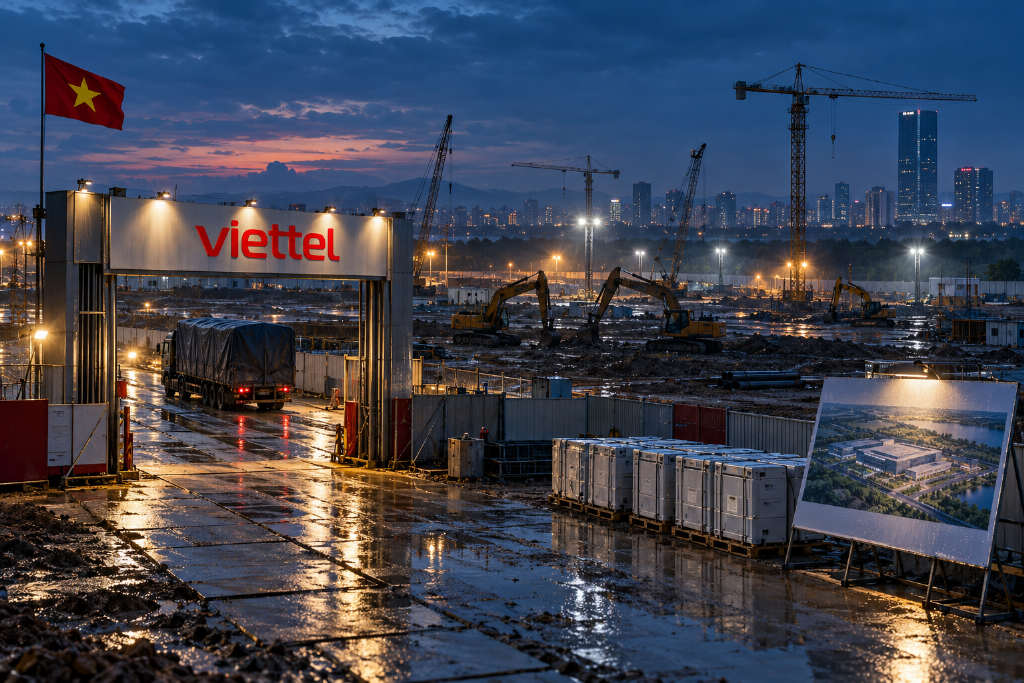
Vietnam’s first semiconductor wafer fab is running into early doubts over whether it can stay on schedule, even after a high-profile groundbreaking ceremony earlier this year.
On Jan. 16, 2026, military-run telecom and industrial group Viettel held a groundbreaking event for the country’s first semiconductor chip manufacturing plant at Hoa Lac Hi-Tech Park in Hanoi. Communist Party General Secretary To Lam and Prime Minister Pham Minh Chinh both attended. At the ceremony, Viettel Chairman and General Director Tao Duc Thang said the project would complete investment and construction, receive technology transfer, and start trial production by the end of 2027. From 2028 to 2030, the company planned to refine the manufacturing process, with full-scale production targeted for 2030.
Site progress does not match the original plan
The fab is planned to cover 27 hectares and have monthly capacity of 3,000 to 4,000 wafers. Its products are intended for telecommunications, automotive, aerospace, and medical equipment applications. In a project report released in January, Viettel also said it planned to use a 32 nm process. Reuters described that goal at the time as highly ambitious for a country and a company with no prior wafer manufacturing experience.
Nine months later, Reuters reported that conditions on the ground looked very different from the vision presented at the launch. Satellite images taken by Planet Labs PBC and Airbus in January and October both showed that no buildings had been erected at the site.
Several people familiar with the matter told Reuters that the target of starting trial production in 2027 is unlikely to be achieved. One person with direct knowledge of the project said Viettel lacks experience in building a wafer fab, while administrative procedures have slowed the release of government funding. Together, those delays have put the original timetable under pressure.
Viettel told Reuters that the project is moving forward according to its established plan and schedule, with work being carried out in phases. Vietnam’s Ministry of Finance did not respond to a request for comment.
ASML equipment talks remain unresolved
Beyond the lack of visible construction, equipment procurement remains another major issue.
According to three sources cited by Reuters, Viettel has been in talks for months with Dutch chip equipment maker ASML over the purchase of a deep ultraviolet lithography system, or DUV machine. Two of those sources said the discussions involve this core piece of wafer manufacturing equipment, but no agreement has been reached so far.
Reuters said it could not determine why the talks had stalled, and it was also unable to confirm which DUV model was under discussion. That detail matters because different DUV systems face different export-control thresholds, which directly affect whether a transaction can proceed and at what cost. An ASML spokesperson declined to comment on the company’s discussions with Viettel.
Vietnamese authorities had previously estimated the fab’s construction cost at $1.3 billion, but the equipment side of the project remains unsettled.
32 nm reference removed, technology partner still unclear
Reuters also reported that the 32 nm process reference has quietly disappeared from Viettel’s website. The company has not disclosed whether it has secured a partnership with an established chipmaker to obtain manufacturing know-how and process expertise.
For a greenfield fab, the choice of technology partner is as important as equipment procurement. On both fronts, public information remains limited.
Vietnam’s stronger footing is still in assembly, testing, and packaging
Industry sources told Reuters that Vietnam’s recent efforts to attract foreign direct investment for wafer fabs have also produced limited results. That has left the burden of building the country’s first fab on Viettel, a domestic military and telecom group without an established semiconductor manufacturing base.
In practice, Vietnam’s semiconductor industry has made faster progress in assembly, testing, and packaging, or ATP. That segment is less capital-intensive and has given the country a more concrete role in the global semiconductor supply chain.
- Intel’s packaging and testing base in Ho Chi Minh City is one of its largest such facilities globally, with cumulative investment of $4.1 billion.
- Amkor operates one of its largest packaging and testing plants in Bac Ninh province.
- Hana Micron and Samsung Electronics are also expanding back-end capacity, and Samsung plans to invest $1.5 billion in a chip testing plant.
Vietnam’s semiconductor and electronic components market was valued at about $4.35 billion in 2025, with a compound annual growth rate of 14.61% from 2020 to 2025, according to the figures cited in the report.
On the talent side, Vietnam currently has about 6,000 to 7,000 integrated circuit engineers. The government has set a target of training at least 50,000 semiconductor graduates at bachelor’s level or above by 2030.
The gap between back-end growth and front-end manufacturing
Those figures point to a more gradual path for Vietnam: extending from packaging and testing into chip design and building capabilities step by step, rather than jumping directly into front-end wafer production.
The current difficulties facing the fab do not negate Vietnam’s broader semiconductor strategy, but they do show the gap between different layers of the industry. Growth in packaging and testing has been built on manufacturing systems developed over decades by multinational companies, with Vietnam contributing location, labor, and policy support. Wafer fabrication demands something else: access to equipment, process integration experience, stable capital deployment, and engineering teams capable of handling hundreds of production steps. Those capabilities cannot be created from scratch in two years through a groundbreaking ceremony alone.
Reuters said the unresolved ASML talks, the removal of the 32 nm reference, and the empty construction site all point to the same issue. Moving from back-end operations into front-end manufacturing requires technology partners, export approvals, and administrative execution to line up within the same window.
Over a longer cycle, Vietnam’s push for domestic wafer manufacturing is aimed at completing more of the semiconductor value chain and reducing external dependence. Its established back-end ecosystem could, in theory, provide downstream support for front-end production. But the jump from packaging and testing to wafer fabrication still runs through gaps in equipment, materials, process talent, and supporting supply chains. For now, Vietnam’s semiconductor industry is still more likely to advance first along the extension of packaging, testing, and design. Whether the country’s first fab can move from an empty site to trial production will depend on whether the government can align equipment access, talent development, and administrative timing.
This article was originally published by the WeChat public account TechSugar and written by Tan Xin.