
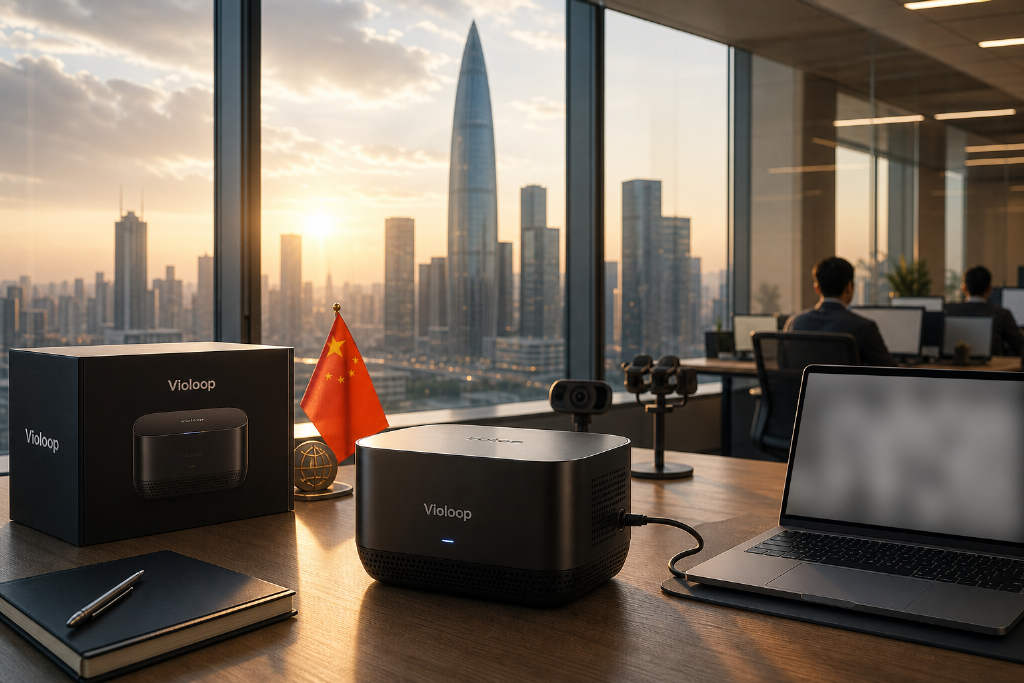
Office AI is moving from concept to day-to-day use in 2026. Public data cited in the report show that Tencent's WorkBuddy reached 20.97 million visits in June 2026, just three months after launch, ranking first among China's desktop AI-native office agent platforms. ByteDance has also been folding its office AI efforts together: on July 30, the Feishu product team and the Doubao product team were merged, and on Aug. 25 the productivity-focused agent product "Doubao Work" was released and deeply integrated with Feishu, allowing users to state goals in natural language while the system breaks down tasks, calls tools and pushes the workflow forward.
That has left large technology companies chasing the same position: the AI work entry point on the computer desktop.
Against that backdrop, IT Juzi reported that Shenzhen AI hardware company Violoop recently completed an angel round and a pre-A round worth more than RMB 100 million. The investors were Lenovo Capital, CICC Porsche, BlueRun Ventures, Genesis Capital, Qifu Capital and Zero2IPO Holdings, with Xiangyang Capital serving as long-term exclusive financial adviser.
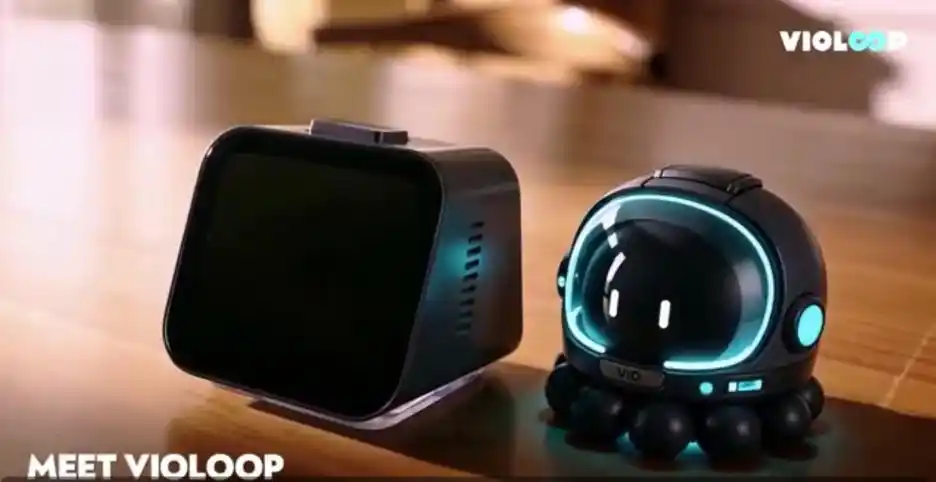
Violoop did not choose to go directly after the large companies on software distribution. It moved into AI hardware instead and built a handheld-sized external device that can connect to a computer. The device has its own chip and on-device compute, can plug into a computer through HDMI and USB, can obtain visual information from the screen, and can carry out actions through keyboard and mouse signals. In the company's framing, it is trying to build a physical personal AI agent.
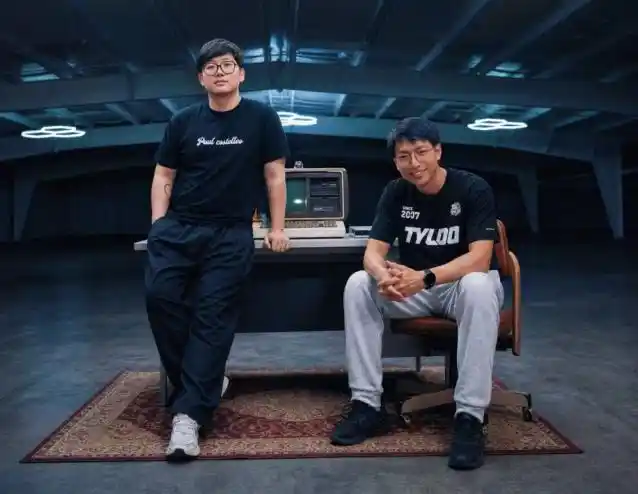
In an interview with IT Juzi, founder He Jialin, who was born in the 1990s, discussed the product path, the hardware form factor and the logic behind the software stack. Those choices, he said, come back to three questions: where the ceiling of AI capability sits, how to protect the lower bound of trust in AI, and why a hardware device is still needed when software agents are already getting stronger.
Removing prompts as the starting point of work
Most mainstream AI agent assistants still operate on a request-and-response basis. A user asks for something, the AI interprets the request, carries it out, and then stops to wait for the next instruction. Some products have added calendar reminders, scheduled tasks and automatic triggers, but they still depend on rules set in advance by the user.
Violoop wants a different model: active AI. In its design, the system keeps track of what the user is doing and, based on the current situation, long-term memory and past work habits, prepares what is needed before the user speaks up.
During early product testing and conversations with multiple users, the team said it found a common obstacle. What keeps AI from entering real production work is not only model capability but also the prompt itself. To get AI to complete a complicated task, a user often has to stop, reconstruct the background, locate relevant materials, describe the goal, break the job into steps, and compress context scattered across the screen, files, history and personal experience into a clear, structured prompt that a machine can parse.
For a small group of experienced users, that is a skill. For most ordinary users, it is extra work. When the cost of asking for the task approaches the cost of doing it by hand, an agent struggles to become part of a high-frequency, continuous production environment.
Violoop wants to remove that front-loaded step and stop treating prompt writing as a required condition for AI to understand a task. The interaction model it describes starts from always-on context, long-term memory and the real workflow. The system works out what is happening, organizes information, breaks down the task and completes reversible preparation before the user explicitly asks. Prompts still exist in that setup, but not as the mandatory starting point for every task. They are used when extra correction or calibration is needed.
Violoop calls that capability "Artificial Intuition."
In a live demonstration of an internal testing build, He showed several linked scenarios. When a user is discussing something with a colleague in WeChat, the system can prepare the next reply from the current conversation and related background, and the user can accept it through a shortcut key. When a colleague asks for a candidate's resume in chat, the system can infer what is needed, locate the file and stop before sending it, waiting for confirmation. When the user opens the resume and keeps reading, the system can connect that to the current project, ask whether a role-matching analysis is needed, and organize the required information in advance.
In that workflow, the user does not need to open a separate AI app, re-enter the background, copy chat logs or write a prompt. The system has already advanced the task to the point where it is waiting for a decision.
That depends on more than a stronger model. It requires a system that can sense activity across applications, maintain long-term context, build personal memory and judge user intent and permission boundaries. He split Violoop's learning path into three stages.
Stage one: build long-term memory around the individual
The system gradually learns the people, projects, files and historical work associated with the user from authorized work context. It has to judge which information should be kept over the long term and which is short-term noise, while merging duplicates and correcting stale information over time.
Stage two: learn how a person works
The system needs to remember more than what happened. It also has to understand where the user looks for information, how similar tasks are handled, how judgments are made, and which steps can continue on their own and which have to wait for confirmation. Through repeated use and correction, those work habits become skills, workflows and execution paths that are added to the Agent Harness, the execution framework for the agent.
Stage three: turn repeated experience into more stable personal model capability
He said Violoop has already established the technical chain of capturing work traces, forming long-term memory and using that for personalized training, and is now putting that into engineering practice. The team is training and testing two kinds of in-house models at the same time: one focused on task understanding and decomposition, and another focused on execution.
He compared the shift to "muscle memory." When an experienced person faces a familiar task, that person does not need to reason from scratch every time. Past experience has already been compressed into fast judgment. Violoop wants an agent to do the same, keeping the results, feedback and corrections from real work so each task does not start from zero.
"Large models are no longer short only on intelligence," He said. "What is more scarce is how to preserve the experience from each real task and eventually form a way of working that belongs to the user."
For active responses to be useful, one more condition matters: timing. If the user has already left the page by the time the suggestion appears, even a correct suggestion loses much of its value. Violoop has therefore set a target of under one second for some key active interactions, and has raised on-device AI compute from 6 TOPS in the previous generation to 26 TOPS. For comparison, He said a mainstream AI PC from a major manufacturer tops out at 40 TOPS, a level roughly comparable to a mini PC. The higher on-device compute is meant to support low-latency sensing, memory processing, local model inference and some personalized tasks.
As active AI grows stronger, trust boundaries need to be explicit
The report cited foreign media coverage of an incident in April this year in which an AI coding agent obtained an API credential with excessive permissions while handling a testing-environment task and deleted a startup's production database and same-volume backup within seconds. The data was later restored, but the incident exposed a deeper concern: once an agent has execution power, how do you make sure it does not overstep or delete critical data by mistake? If it misunderstands the task or drifts during execution, how can it be stopped?
Violoop's answer has two layers.
The first is to keep the tasks that are closest to the user and most sensitive to latency and privacy on the device. Violoop handles screen sensing, memory building, some text completion and low-latency model tasks locally. More complex tasks that need stronger reasoning are routed to cloud models when needed.
The company argues that hardware by itself does not automatically create privacy. What an independent device can do is separate sensing, memory, model inference and cloud calls for complex tasks into clearer and more controllable data boundaries. It also does not force users into a single model package. Users who already have API keys for Zhipu, DeepSeek or other models can connect them on their own. The main value of the official model package, the report said, is unified provisioning and scheduling across models, balancing output quality, speed and cost.
The second layer is to take critical authorization out of the model and ordinary software. Violoop has placed an independent security chip inside the device to manage execution-side authorization. When the model encounters actions defined as irreversible, such as sending, deleting, submitting or paying, it must stop and wait for the user to confirm through a physical button before the action can proceed.
The architecture does not promise that AI will never misunderstand. What it does promise, according to the company, is that irreversible actions inside the authorization chain cannot bypass final human confirmation.
He used signing a contract as an analogy. Contract terms can be revised many times, and materials can be prepared in advance by others, but the stamp is the point at which the decision takes effect.
"An agent can help the user finish the first 80%, even 99%, of the preparation," He said. "But the last step should still be confirmed by the person. We want to keep the signing authority and the stamp in the user's hands."
If a system can only offer suggestions and cannot enter real software to complete actions, its value is limited. If it can send messages, delete files or make payments without restraint, long-term trust is also hard to build. In Violoop's product logic, capability boundaries and trust boundaries have to expand together. AI can become more active, but decision-making power should not shift with it.
Why build a hardware device at all?
Near the end of the interview, IT Juzi asked whether long-term memory, computer use, local models and secure confirmation could be achieved through software alone.
He's answer was that none of those capabilities is exclusive to hardware when viewed on its own. But along the technical route Violoop chose, hardware turns several scattered capabilities into a complete product.
The first reason is persistent presence. Active AI needs to know what is happening now, and it also needs to connect the current state to past memory. Violoop uses HDMI to obtain the same screen information the user sees and uses an independent device to keep processing authorized context. It does not depend on whether a particular app is open, and it is not fully constrained by the lifecycle of a single software session. Hardware creates persistent presence, and persistent presence creates complete context. In Violoop's view, that is the data foundation for long-term memory and active judgment.
The second reason is that software-only agents have limited coverage and compatibility constraints. They usually depend on operating-system permissions, software interfaces or API adaptation. In the real software world, many applications do not expose standard AI interfaces, and many older systems are unlikely to be rebuilt for each agent.
Violoop uses an interaction method people have used for decades: obtain information from the screen and carry out actions through standard keyboard and mouse interfaces. That means its practical range does not have to depend entirely on whether software has opened a dedicated API for AI. In theory, any software that a human can use through a screen plus keyboard and mouse could fall within its reach.
The third reason is the creation of a physical trust boundary independent of the model. If sensing, reasoning, execution and authorization all sit inside the same software system, a problem in the model, plugin or permission setup could let risk spread across the same chain. Violoop's design separates those functions: the AI model handles understanding and preparation, the execution system handles operation, and an independent security chip plus physical button handle final authorization for irreversible actions. Software expands what AI can do; hardware determines data flow, execution boundaries and where the system must stop.
Those three points make up what Violoop calls AI-native hardware. The company says the device was designed from the start around one goal: enabling AI to continuously understand and use a computer. Its choice of compute chip, input and output interfaces, local models and security architecture all serve that requirement.
After the funding round, the product is moving toward sale
Violoop's core team mainly comes from software and model-engineering backgrounds. From 2023 to 2024, the team provided model deployment, post-training and optimization services on computing clusters for European Fortune Global 500 companies. The company is now trying to compress AI systems that previously required large enterprise compute resources and custom delivery into a desktop device that ordinary consumers can use.
On the product side, Violoop said its first batch of internal-test hardware has already received ongoing feedback from dozens of real users. Broader product testing has covered more than 200 users across multiple countries and regions. Under the current plan, Violoop will formally launch through overseas channels in mid-September, begin a first small-scale domestic sale, and gradually expand market coverage after October. About 12,000 overseas users have already paid deposits, according to the report.
While major technology companies compete for the AI work gateway inside software, Violoop has chosen a heavier and more difficult route. The company now has to prove whether hardware can deliver three things at the same time once AI agents begin to do real work: fuller context, lower interaction latency and more credible execution boundaries.
The original article was published by MarsBit and sourced from the WeChat public account IT Juzi (ID: itjuzi521), written by Wu Meimei.