
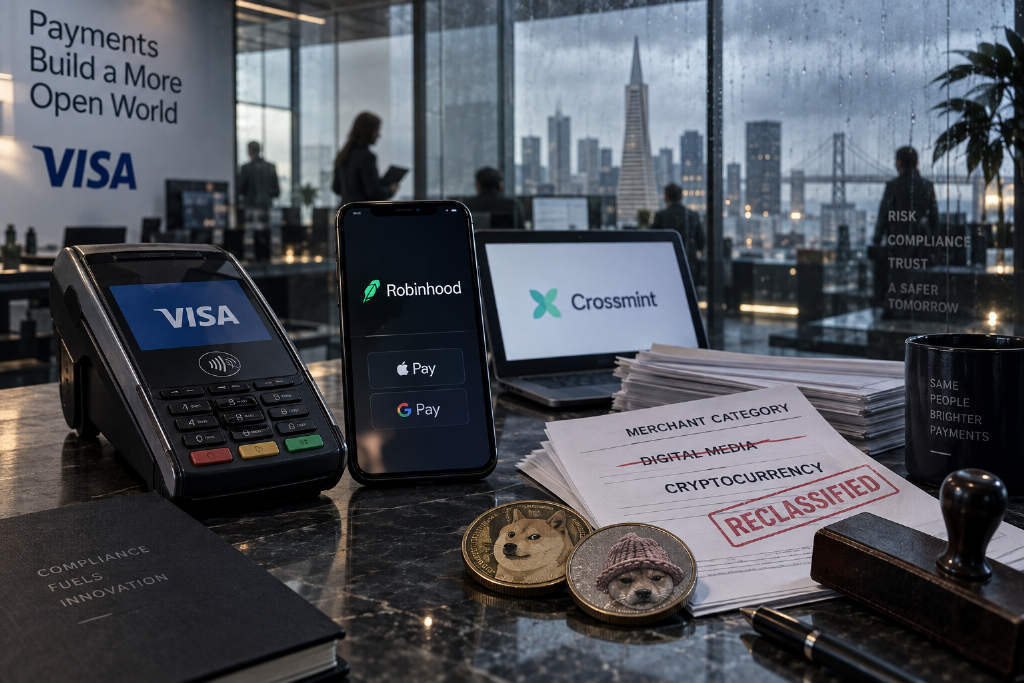
Visa has reportedly asked payment providers to stop coding some memecoin purchases as "digital media" and to switch them back to the merchant categories used for cryptocurrency transactions, according to a Sept. 19 report from Crypto In America.
Blockcast had earlier reported that The Block tested a checkout flow in Robinhood Wallet and the social trading app Fomo and found that users could buy selected memecoins through Crossmint’s payment service with a credit card paired with Apple Pay or Google Pay. During the test, no additional full KYC identity verification form appeared. The transactions included tokens such as WIF, and users also received standard credit card reward points.
Transactions were coded as digital media
The report said Checkout.com, Crossmint’s payment partner, had received the notice. Earlier testing by The Block found that purchases of the Solana memecoin dogwifhat (WIF) through Robinhood Wallet and Fomo, using Visa and Mastercard credit cards via Crossmint, were marked under MCC 5815, "Digital Goods Media," rather than a category typically used for crypto transactions.
Because banks received the charge as a standard digital goods code, those test purchases qualified for normal card points or cash back. In practice, buying WIF on a card briefly looked more like a purchase of digital content than a crypto transaction from the bank’s side.
Visa’s rules point to different MCC categories
That classification does not match Visa’s own merchant coding rules. Visa’s Merchant Data Standards Manual says cryptocurrency purchases should usually be processed under MCC 6012 or MCC 6051, with the relevant crypto or quasi-cash markers, rather than MCC 5815 for digital media.
JPMorgan Chase, after reviewing one of The Block’s test transactions, also concluded that the coding was incorrect and said the purchase should not have earned rewards under its credit card program. Chase then submitted a case to Visa.
Why Robinhood Wallet is part of the story
Robinhood Wallet’s involvement does not appear to stem from Robinhood setting the MCC itself. The report said part of the card-based crypto purchase function is provided by Crossmint.
If Visa requires Crossmint and its processors to reclassify those transactions, users of Robinhood Wallet and Fomo who use that payment rail may no longer be able to treat memecoin purchases as ordinary digital spending for points or cash-back rewards.
The report did not say Visa was banning card purchases of memecoins. It said Visa is reportedly asking payment providers to stop using MCC 5815 for these transactions and return them to the normal classification framework for crypto purchases.