

Ethereum co-founder Vitalik Buterin said it is plausible that artificial intelligence could break encryption within the next two years, arguing that the crypto industry should protect itself not only from quantum-vulnerable cryptography but also from cryptography that may be vulnerable to AI-driven advances in mathematics.
The comments came one day after Ethereum Foundation researcher Justin Drake urged the industry to prepare for a “bunker mode” approach by moving funds to addresses whose public keys have not been exposed. Drake said it is now reasonable to think that AI progress in mathematics could lead to broken encryption before quantum computers become strong enough to do the same, a point often described as Q-Day.
Buterin warns AI could hit lattice security
In a post on X, Buterin wrote: “There is a good chance that the concrete security of lattices will take serious hits from the next two years of AI math. If AI will bring us 50 years of math in two years, then that 50 years of math may very plausibly include a [...] level of improvement to our ability to break lattices.”
Lattice-based cryptography is one option some crypto projects have considered as part of efforts to become more resistant to quantum threats. Decrypt noted that Cardano is among the projects that have considered that route. The concern raised in the report is that users trying to avoid a long-term quantum threat could end up moving funds into addresses that are more exposed to AI attacks in the short term.
Buterin did not call for an immediate scramble into new wallets. In the same thread, he said: “I don't recommend anyone scramble to move their funds to new wallets today. But we should take the risks to cryptography from AI-accelerated math seriously, and minimize our exposure to not just quantum-vulnerable cryptography, but also potentially AI-vulnerable cryptography.”
Industry voices call for caution, not panic
According to Isabel Foxen Duke, head of Mara Foundation, a Bitcoin quantum proofing project, the industry had generally viewed quantum-computer-related cryptographic breaks as a problem mainly for elliptic curve cryptography and RSA.
She told Decrypt: “Breaks in cryptography by classical methods (e.g. those potentially created by AI) could affect types of cryptography that are broadly considered quantum secure (e.g. lattice-based cryptography). If we include concerns about classical breaks in the mix, we have to be even more conservative.”
Based on that risk, Buterin said any lattice constructions should increase significantly in size to improve safety. He now sees hash-based cryptography as a better route for quantum proofing, while adding that, in theory, AI-driven mathematics could break hashes as well.
Two years is not a hard deadline
Ananda Banerjee, founder of analytics firm Charlie Quant Lab, pushed back on treating Buterin’s timeline as a fixed cutoff. “I wouldn’t treat Vitalik's two-year scenario as a deadline. The post doesn’t demonstrate that these systems have been broken,” Banerjee told Decrypt. “I would prepare carefully rather than rush to move funds.”
Buterin is not proposing drastic action for what he described as a plausible doomsday scenario. His practical suggestion is to keep funds in addresses that have not made transactions, because the public key would not have been exposed, which he said significantly lowers the chance of attack.
A shift from his comments a month earlier
The renewed focus on AI risk comes just one month after Buterin said AI would not doom crypto security because defensive systems would keep pace. Decrypt wrote that his latest remarks may indicate the industry has been moving in a slightly wrong direction.
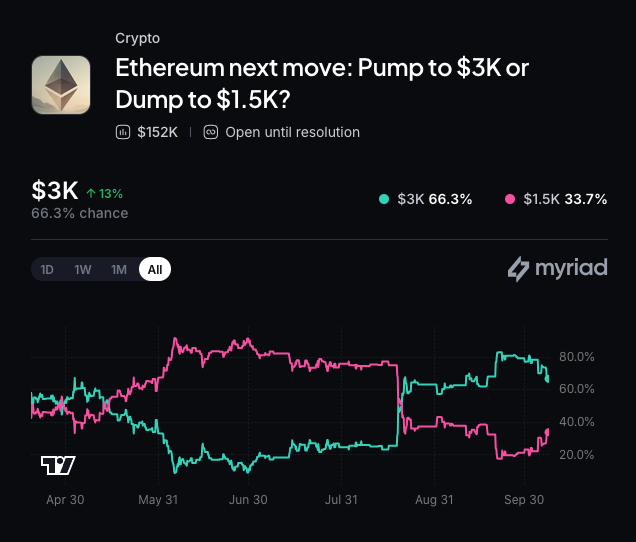
The report also included a Myriad prompt asking where Ethereum goes next and inviting readers to make a prediction.