
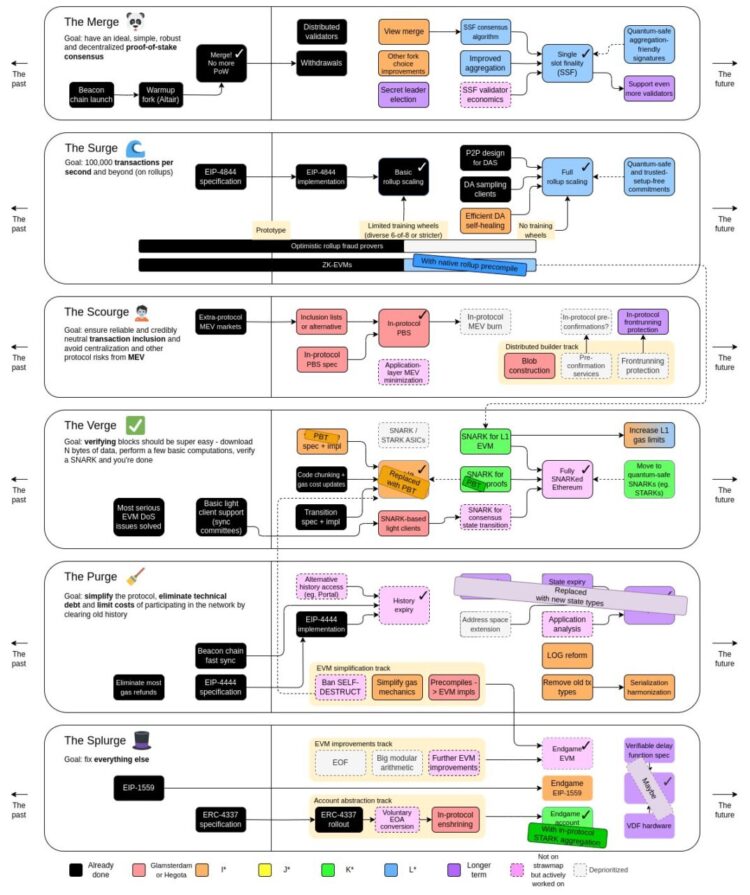
Ethereum co-founder Vitalik Buterin said in a post on X that he recently compared the Ethereum roadmap he published in 2023 with the Ethereum Foundation’s latest version of the Strawmap, a working reference document for protocol upgrades. He said the two documents still overlap in many places, but the ordering of several items has changed.
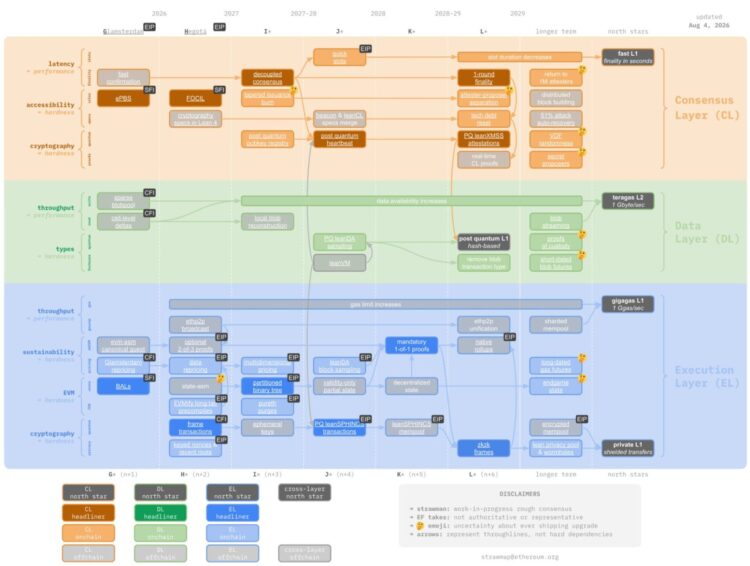
According to Buterin, post-quantum security has moved higher in priority, while verifiable delay functions and several EVM-related improvements have moved lower. Some earlier items have also been replaced by different technical approaches. He pointed to a path in which Verkle Tree work first shifts to a unified binary tree and later to a segmented binary tree, while state expiry has been replaced by new state types.
Privacy and post-quantum work appear as major additions
Buterin said the Strawmap now includes several items that were not present in his 2023 roadmap at all, reflecting a broader change in Ethereum’s upgrade priorities. The most prominent additions are stronger privacy protections and a more active scaling plan designed for a post-quantum era.
On the privacy side, he listed items including key random numbers and latest roots, parts of the FOCIL mechanism, simplified privacy pools, and a design referred to as wormholes. The report says FOCIL-related work is expected to be one of the main upgrade items in Ethereum’s Hegota hard fork.
On post-quantum security, the Strawmap now includes leanSPHINCS signatures and aggregation techniques, as well as a framework design called zkzk frames, which is intended to support post-quantum signatures together with STARK integration.
STARK recursion and AI-assisted formal verification move closer to the protocol core
Buterin also said recursive STARK verification and AI-assisted formal verification are now being treated as core components in Ethereum’s future technical stack.
He described one mechanism in the protocol as an approach that aggregates verification dependencies into a union. That mechanism, he said, is expected to be used across the execution layer, consensus layer, and data layer. In his telling, that design can only be made safe through formal verification, and formal verification itself depends on modern AI tools.
Native rollups and new instruction-set directions enter the picture
The article said Buterin has repeatedly highlighted post-quantum preparation this year. In January, he called on developers to adopt post-quantum cryptography early. In February, he proposed a phased plan to replace four Ethereum cryptographic components that could face quantum-related threats. In July, he put quantum safety and privacy at the center of a broader effort to streamline Ethereum.
The Strawmap also includes concepts that did not exist in the 2023 roadmap, including blockspace and gas futures and native rollups. Buterin said native rollups were not considered at the time because SNARK technology was still far from mature enough to support that kind of complex scaling design.
As zkzk frames advance, the protocol could eventually expose leaner instruction-set architectures to developers, including leanISA or RISC-V. If that happens, the EVM’s role could change as well. Rather than remaining a built-in feature of the base protocol, it could become an intermediary layer built on top of a new instruction set.
Buterin says Ethereum still aims for security, privacy, censorship resistance, and scale
At the end of his post, Buterin wrote that Ethereum will become post-quantum secure, place user privacy high on the list of priorities, preserve security and censorship resistance, and still pursue high performance, scalability, and simplification under those constraints.
The report describes the Strawmap as a reference document used by the Ethereum Foundation to plan the direction of protocol upgrades. It is a continuously revised draft rather than a fixed timetable. The current timeline runs through 2029, and the latest update was made on Aug. 4.
The article also noted that the Ethereum Foundation has faced criticism in the past over delayed upgrades and resource allocation. In June this year, the foundation cut 20% of its workforce and reorganized into five core teams around CROPs goals. During the same period, new entities including EthLabs and EthSystems were established to support research and development as well as institution-grade privacy technology.
Technical terms referenced in the report
FOCIL
FOCIL stands for Fork-Choice Enforced Inclusion Lists. It is described as a consensus-layer mechanism designed to improve transaction inclusion reliability and censorship resistance on Ethereum.
Under the Strawmap, FOCIL is expected to be one of the main upgrade items in the Hegota hard fork. The goal is to prevent validators from arbitrarily excluding specific transactions and to reduce the risk of censorship or concentration in block building.
leanSPHINCS
leanSPHINCS is a hash-based post-quantum signature scheme and a lighter version within the SPHINCS signature family. Because it does not rely on elliptic-curve cryptography, the design is intended to remain secure even if quantum computers eventually break traditional signature systems.
The report added that Buterin said on the Ethereum Magicians forum that he favors a hash-based approach over lattice-based cryptography in this context because he wants to keep the protocol’s base layer as simple as possible and reduce operational complexity.
zkzk frame
zkzk frame is a transaction framework concept that Buterin presented on the Ethereum Magicians forum. The report links it to proposal number EIP-8288 and says the goal is to combine post-quantum signatures with STARK aggregation.
Under that design, a transaction can declare its cryptographic verification dependencies, after which block builders can aggregate the verification requirements of multiple transactions into a single recursive STARK proof. The report says this is meant to preserve efficiency in on-chain data use and gas costs even when larger post-quantum signatures are introduced. It also says the proposal is still in forum discussion and does not yet have a formal EIP number.
STARK
STARK stands for Scalable Transparent Argument of Knowledge. It is a zero-knowledge proof system that lets verifiers confirm the correctness of a computation without rerunning the full computation.
Compared with some other zero-knowledge systems, STARKs do not require a trusted setup and generally offer post-quantum security properties. For that reason, they are being treated in multiple Ethereum upgrade plans as a core verification tool that could be used across the execution, consensus, and data layers.
SNARK
SNARK stands for Succinct Non-Interactive Argument of Knowledge. It is also a zero-knowledge proof technology, known for small proof sizes and fast verification, and it is already widely used in existing scaling systems such as zk-rollups.