

Vitalik Buterin has made a rare public purchase tied to a new crypto project, taking part in the first CCA public auction for The Interfold on Uniswap with 16 ETH last month, worth about $28,000 by the source article’s estimate.
The article says his previous sizable public allocation to a new project token or related asset dates back to November 2024, when he put 32 ETH, roughly $107,000, into the public NFT sale for prediction market Truemarkets.
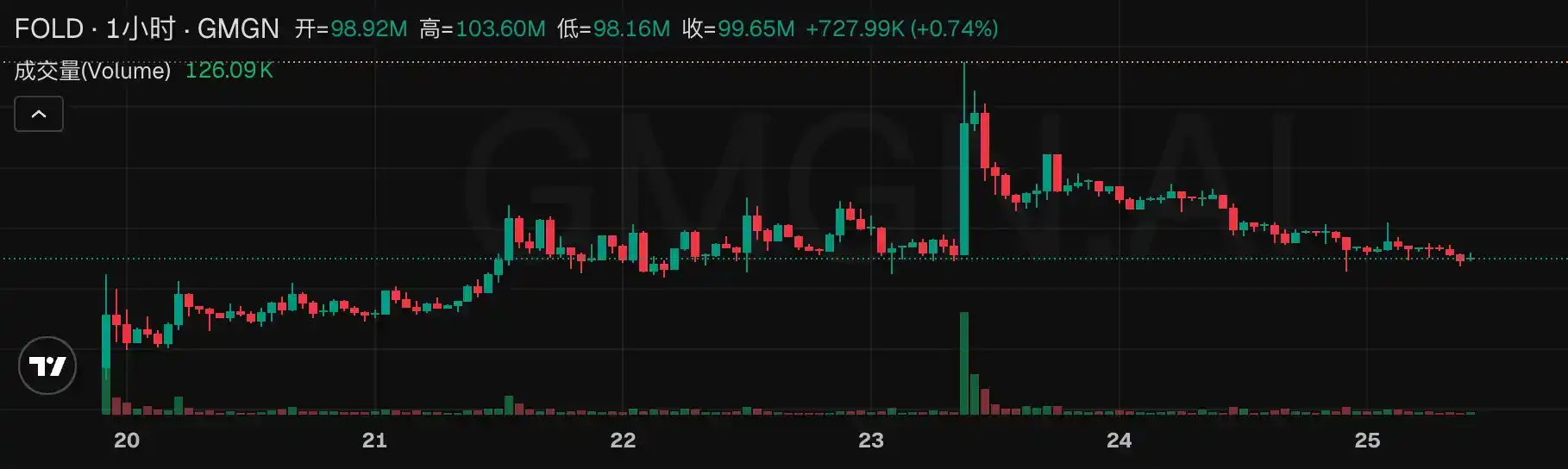
FOLD surged after its TGE, then got a second boost from Upbit
FOLD held its token generation event on Aug. 19 and later rose by more than 7x at the peak. The source breaks that move into two separate phases rather than treating it as a single rally.
Before the Upbit listing, the article says the token’s move was driven largely by the market narrative that Vitalik had bought in. In that period, on-chain traders formed a consensus around the story and pushed FOLD from a market capitalization of about $28 million to a high near $140 million.
Then came Aug. 23. Upbit listed FOLD that day, and the token price briefly doubled, sending market capitalization to about $230 million.
The move did not hold. After the listing-related jump, FOLD failed to extend higher with the broader market and later fell back to the area it traded at before the Upbit catalyst. The article’s framing is that the token has now returned to a valuation range tied mainly to the 「Vitalik bought」 narrative.
What The Interfold is designed to do
The source describes The Interfold as an open-source privacy protocol developed by Gnosis Guild. Its aim is to let multiple independent parties that do not trust one another complete verifiable shared computation without exposing their private inputs, without relying on a single operator, and without using trusted hardware.
One example given in the article is DAO voting. Participants could vote privately, no one would be able to see any individual voting record, and everyone would still be able to verify that the final outcome is authentic.
Under the structure outlined by the source, encrypted data inputs are submitted to an encrypted execution environment called E3. A separate E3 is created for each computation involving encrypted data. Once the computation is finished, that E3 is shut down and leaves no data trace behind.

The article also says nodes that handle encrypted computation and decryption must stake FOLD to qualify for the role.
A privacy story that is harder to grasp than ZEC
The source compares The Interfold with ZEC. In its telling, ZEC is itself a privacy-focused asset, while The Interfold is a multiparty privacy-computing protocol built around a different use case: several participants can work together without sharing their underlying data.
The article argues that ZEC is easier for the market to understand. It gives a simple framing for ZEC — a privacy version of Bitcoin where others cannot see where the money went. The Interfold, by contrast, comes with a higher learning curve, with more technical and more specialized privacy assumptions behind it.
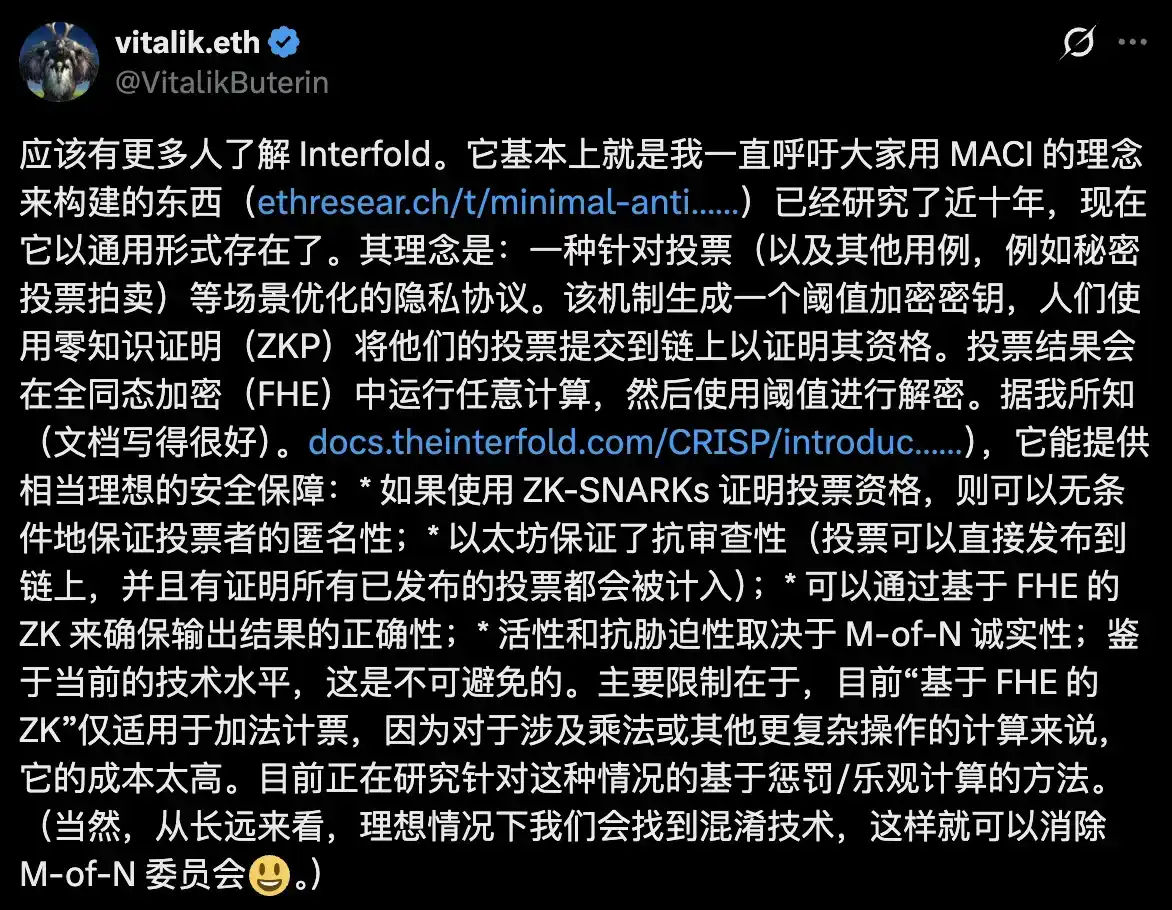
It also notes that Buterin promoted the project directly on X in late May this year and mentioned it again in person at dappcon in July.
Buterin has not claimed the auction tokens, the article says
Beyond the 16 ETH auction participation, the source adds that Buterin has not yet claimed the tokens from the sale and, as a result, has not sold them either.
From there, the article argues that many traders may care less about the project’s concrete use cases than about the simpler market message: this is a project Buterin has repeatedly discussed and personally backed with capital.
The article’s view on valuation and trading setup
The source says Truemarkets is not a clean comparison for FOLD. It points to a different market backdrop during TRUE’s TGE last year and says TRUE never listed on any exchange, large or small.
Using the figures cited in the article, TRUE’s peak fully diluted market capitalization never broke above $20 million. FOLD, by comparison, is said to be about 27% circulating, with a circulating market capitalization near $27 million and a fully diluted valuation around $100 million. The article says that, viewed through that lens, FOLD may still have room after reaching Upbit just days after its TGE.
The source also makes a trading argument around Buterin’s public backing. For shorter-term speculation, it says traders may treat his position as relatively sticky rather than assume an imminent sale. It cites Truemarkets as an example, saying Buterin did not move his position either during the later price low or during the peak in October last year. On that basis, the 「Vitalik bought」 narrative around FOLD may continue, especially while he is still mentioning the project publicly.
At the same time, the article says that even though The Interfold is a serious privacy protocol, traders can still approach it through the same attention-driven logic often seen in meme-coin speculation. The bullish factors it lists are ETH strength, healthy on-chain conditions, the Upbit listing, and Buterin’s repeated mentions. In that framework, the bet is less about users understanding the technology and more about liquidity and attention rotating into an ETH-native name.
The source ends on a more measured note. It says the protocol’s technology and use cases are difficult for most on-chain traders to understand, which may keep attention focused on headline catalysts rather than fundamentals. With profitable opportunities already visible across Robinhood, BSC, and Solana, the article says it is still hard to judge whether buying an ETH mainnet token with circulating market capitalization close to $30 million is getting ahead of the crowd or simply leaning into a niche trade. Its conclusion is that FOLD still carries a Buterin-backed narrative, but the risk-reward at current levels may not be especially compelling.