
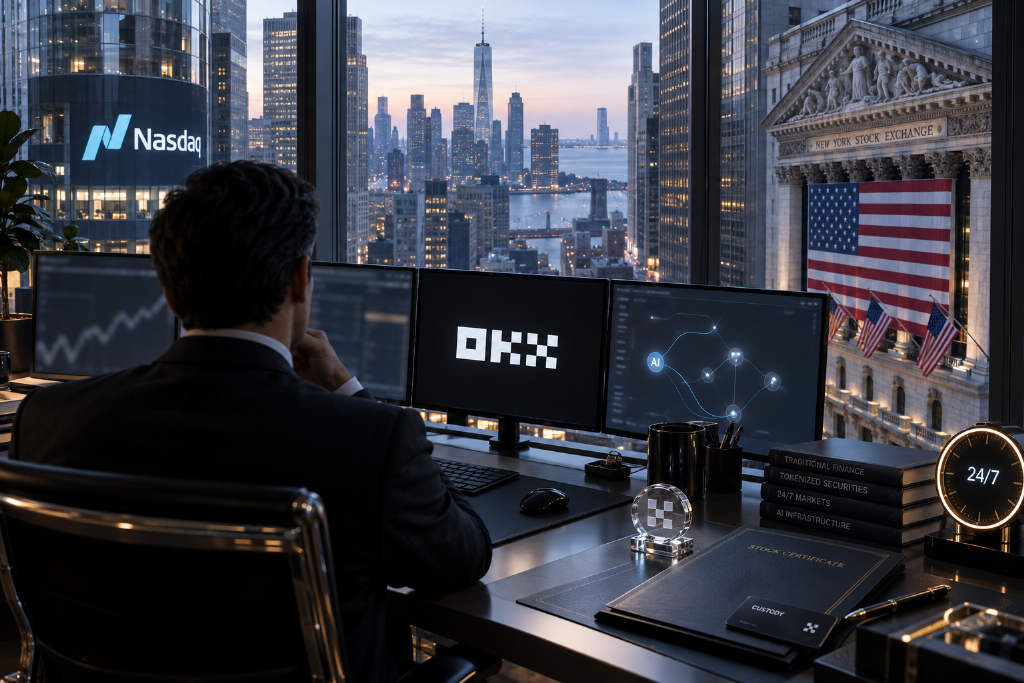
Nasdaq plans to extend U.S. stock trading to 5x23 hours on Dec. 6. The New York Stock Exchange is also exploring a further step with Web3 partners: a 7x24 tokenized securities trading platform. The U.S. Securities and Exchange Commission has opened room for experimentation around tokenized securities trading, pushing financial markets toward a state that looks much closer to always-on access.
This is not just a matter of moving the closing bell later. The deeper change is in how assets, capital and risk move through the financial system, and in how investors manage trading when markets no longer fit neatly into fixed operating hours.
After receiving a strategic investment from Intercontinental Exchange, the parent company of the NYSE, OKX held its "OKX NOW | The Future Is Here" forum in Singapore on Oct. 6. The event placed several developments into the same frame: longer trading hours, on-chain settlement, AI agents, and a growing exchange of capabilities between traditional finance and digital asset platforms.
A broader shift runs through all of this. Financial services are moving away from business-hour schedules and toward real-time online availability.
Longer trading hours are one step; settlement remains the harder problem
Demand for near round-the-clock trading is easy to understand. Companies such as NVIDIA, Microsoft, Apple and Tesla are listed in the U.S., but investors following them are spread across Asia, the Middle East and Europe. For many of those investors, the U.S. market opens late at night. Earnings releases, macro policy decisions, geopolitical events and breaking news do not stop when exchanges close.
Once information moves 24 hours a day, the boundaries around trading hours come under pressure. Nasdaq's move toward 5x23 trading is, on the surface, an extension of market hours. Underneath that, it is a response to the time gap between U.S. markets and global capital. For exchanges, the business case is also clear: longer hours can attract more cross-time-zone orders and capital.
But the real bottleneck in all-day trading is not matching orders for a few more hours. It is post-trade settlement. Traditional finance usually does not settle every trade in real time; it records transactions during the day and reconciles them later in batches. Nasdaq's decision to leave a one-hour gap each day also reflects the need for a settlement window.
If financial markets are to stay online close to 24 hours a day, one basic question has to be answered first: after a trade happens, can cash and assets move with the same real-time speed, safety and verifiability?
That is where the article places Web3. Tokenization allows securities to be recorded on-chain in real time, while digital currencies offer a payment medium that can move without interruption. Combined, they create a path toward settlement that is closer to automatic delivery-versus-payment, rather than relying entirely on reconciliation during fixed windows. The article says this has been one of the directions OKX has been testing over the past 13 years.
Tokenized securities are getting a testing window, not a blanket approval
For years, Web3 has often been reduced to price swings in digital assets. In the context of financial infrastructure, the article argues, its larger value may lie elsewhere: helping capital move faster and at lower cost across borders.
Wall Street's move on-chain is not being framed as a teardown of the existing financial system. Traditional financial institutions still hold the licenses, asset supply, pricing benchmarks, custody experience and risk management systems. Digital asset platforms bring 24-hour matching, on-chain settlement, global user networks and experience with capital moving closer to real time. The relationship is not simple replacement. It is a search for new combinations.
The strategic relationship between ICE and OKX is presented as one example. ICE, as the parent of the NYSE, controls traditional market infrastructure, pricing benchmarks and regulatory experience. OKX brings digital asset trading, blockchain technology and a global user base. The significance of the tie-up goes beyond plugging in a single product. It suggests that the boundary between traditional market infrastructure and digital asset platforms is becoming more open.
The SEC's "Innovation Exemption," released in September 2026, gives tokenized securities trading a clearer testing space. The article stresses what that does not mean. It does not mean U.S. equities have fully moved on-chain, and it does not mean regulators have approved every tokenized stock model. It is described instead as a temporary, conditional sandbox where tokenized stock trading mechanisms can be tested in a limited and permitted environment while regulators gather real-world data.
According to the article, the latest information shows that OKXICE, a joint venture between OKX and ICE, plans to launch a tokenized securities venue, or TSV, under the SEC's innovation exemption framework. The venue is expected to cover more than 60 U.S. stocks, including NVIDIA, Apple and Microsoft. Each stock token would be backed 1:1 by real shares and support 7x24 trading.
Traditional finance and digital asset platforms are, in the article's words, borrowing capabilities from each other.
Trading is only the start; custody and collateral models are also shifting
Tokenized U.S. equities make a once abstract question much more concrete: if stocks, fund units and other traditional assets can be tokenized in a compliant way and traded on regulated on-chain venues, how will responsibilities be divided among exchanges, clearing institutions, custodian banks and digital asset platforms?
As OKX put it at the forum while discussing changes in its business, "Trading is the starting point, not the end."
Institutional capital has another practical question: where are the assets held, and who carries the counterparty risk? Under the traditional platform custody model, asset safekeeping and trade execution are often concentrated on the same platform, leaving institutions directly exposed to that platform.
The collateral mirroring partnership between Standard Chartered and OKX offers a different structure. Eligible institutional clients can place collateral assets with an independent custodian and then obtain corresponding trading capacity on the platform through a mirroring mechanism. The key point is not a new marketing label. It is the partial separation of asset custody from trade execution. Institutions can participate in digital asset trading without depositing all collateral directly onto the trading platform.
On the day of the forum, OKX also announced a new round of financing. Disclosed investors included SC Ventures, the fintech investment arm of Standard Chartered, USDC issuer Circle, payments infrastructure and stablecoin developer Ripple, and London-based quantitative hedge fund QRT.
The article argues that the investor list matters more than the financing amount. Ties between traditional financial institutions and digital asset platforms are moving beyond front-end trading access and into custody, collateral management, liquidity and market infrastructure. Participants are choosing strategic partners with deeper business alignment.
As markets stay open longer, AI agents move into the trading workflow
Near 24-hour trading answers one question: when is the market open? It creates another one immediately. Markets can keep running, but people cannot watch them all the time. For investors operating across time zones, longer trading hours mean more opportunity, but also more moments when prices, news and risk can shift.
In the past, investors had to gather information, judge market conditions, design strategies and place trades themselves. As markets move closer to real-time operation, that workflow needs new tools. The article places AI agents in that role.
At the OKX forum, users could describe trading ideas in natural language. In a test environment, an AI bot would generate a corresponding strategy and provide backtest results. AI could also combine live market data and news information to offer strategy suggestions.
That moves AI beyond information organization and into a trading chain that includes analysis, strategy and execution support.
The article then extends the idea further. As more investors use AI agents, the relationship may expand from human-to-AI into AI-to-AI. One user's agent could subscribe to professional trading signals, while another could provide on-chain risk controls, asset allocation or strategy services. How those agents call services, receive authorization and settle with one another becomes a new infrastructure question.
From the article's description of OKX's product direction, the company is trying to build a full stack around that shift: trading tools that help AI understand market conditions and account status, agent wallets that let AI access on-chain assets within approved limits, an on-chain operating system connecting trading and DeFi services, and OKX.AI as an entry point for collaboration between different agents.
In that setup, AI could become a new entry point for financial services. The article also says that once AI is combined with on-chain infrastructure, services that were once reserved for high-net-worth clients, such as continuous monitoring, personalized strategies and around-the-clock support, may be broken down, automated and offered to a broader group of users at a lower threshold.
Faster finance still depends on trust, compliance and risk controls
Longer trading hours, real-time payments, asset tokenization and AI agents all point in the same direction: financial services are becoming more global, more immediate and more automated.
For investors across time zones, longer trading hours can mean fewer late nights. For cross-border workers, faster payments can mean family members receive remittances sooner and pay less in fees. For retail users, AI tools can make it possible to keep managing assets within self-defined rules without watching the market constantly.
But faster finance does not remove the need for trust. Whether the subject is tokenized securities, stablecoin payments, on-chain settlement or AI agents executing trades, the same issues remain unavoidable: compliance, custody, transparency and risk control. Are the assets real? Is trading fair and transparent? Is user authorization clear? Are the data and models reliable? If something goes wrong, who is responsible? Those questions will shape how far always-on finance can go.
The article's conclusion is straightforward. Competition in the future financial system will not be only about speed; it will also be about credibility. Traditional financial institutions still provide core strengths in compliance, custody and pricing systems. Digital asset platforms offer a technical path through real-time trading, on-chain settlement and global liquidity. AI can make services smarter, but it also raises the bar for risk controls and authorization design.
Financial services once looked more like bank branches, with fixed hours and fixed locations. They may increasingly look like cloud services instead: online by default, responsive in real time and reachable globally. Wall Street is stretching the trading clock, Web3 is trying to move capital and assets in a more real-time way, and AI is starting to take on part of the burden of analysis, monitoring and execution. As those capabilities connect, financial services may become less tied to fixed times, fixed places and fixed institutions, and more like infrastructure that is available whenever it is needed.