

The bearish Wall Street call that artificial intelligence would hollow out the software sector is starting to crack.

For much of the past year, many U.S. software stocks traded under pressure as investors worried that AI would reduce demand for traditional software subscriptions. The argument was straightforward: if employees can produce more with AI tools, companies may need fewer workers, and fewer workers could mean fewer software seats. At the same time, the rise of “vibe coding” fed the view that custom software could be built more cheaply and with lower barriers, weakening the case for packaged software.
That combination helped drive the broader narrative that AI was “eating” traditional software, and talk that “SaaS is dead” grew louder. Recently, though, that view has started to lose some force, prompting investors to ask whether the harshest phase of the selloff is already over.
Salesforce earnings shift the tone
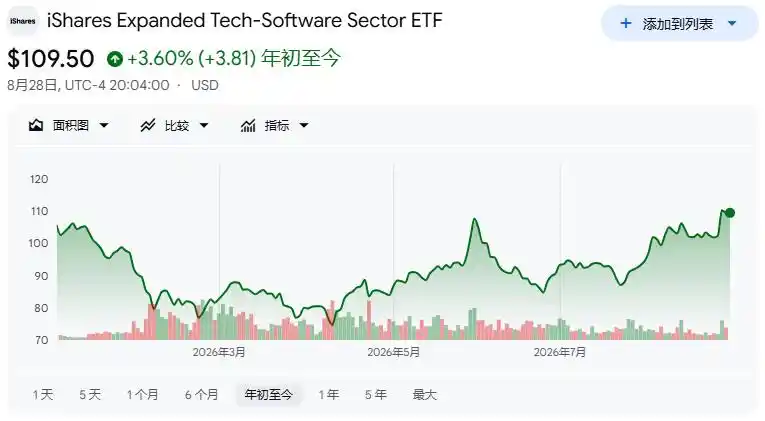
Last week, software bellwether Salesforce delivered what the report described as an exceptionally strong earnings release. After that report, the iShares Expanded Tech-Software Sector ETF (IGV) moved back into positive territory for the year.
Salesforce reported second-quarter revenue and profit above Wall Street expectations and also raised its full-year guidance. One of the standout figures in the release was a 14% year-over-year jump in current remaining performance obligations, or cRPO. Net new annual contract value also hit a four-year high. Salesforce shares surged 22.6% in Thursday trading last week on the back of those results.
“Everyone thought our subscriptions would decline. The opposite happened: Agentforce sales, service and Slack all posted year-over-year growth,” Salesforce Chief Executive Officer Marc Benioff said on the earnings call.
Michael Monaghan, partner and portfolio manager at Founder ETFs, said Salesforce’s latest report directly addressed what had become an existential question hanging over the company. In his view, the results suggest Salesforce is not losing users. Instead, customers eager to connect to the latest technology are helping drive upgrades into higher-tier packages.
“We are not surprised at all,” Monaghan said in an interview. He added that even during the trough in March, when software stocks were hit hard, he remained convinced that the sector would stage a strong AI-driven recovery in the following months.
“You could already see in March that these companies were going to post very strong second-half results. Salesforce’s earnings may be the first powerful proof of that,” Monaghan said. “The idea that AI and vibe coding can wipe out packaged software simply does not hold up.”
Strength broadens beyond Salesforce
Salesforce was not alone. Workday shares climbed 5.8% last Friday after the company reported quarterly subscription revenue above market expectations. Management also said annual recurring revenue from Workday’s autonomous AI products was approaching $600 million, up from $500 million in the prior quarter.
Other software names, including CrowdStrike Holdings and ServiceNow, also posted strong gains over the past week. According to the report, demand for CrowdStrike’s Falcon platform has been lifted by AI-related cybersecurity threats, helping the company deliver its “best quarter ever.” ServiceNow, much like Salesforce, is increasingly being viewed as an authoritative repository of customer data, and that kind of data is seen as difficult for AI to replicate.
Nicholas Frasse, thematic ETF product manager at VanEck, said that while some companies may be displaced by frontier labs, “I don’t think all SaaS companies should be lumped together. Deeply entrenched companies like Salesforce have very unique proprietary datasets, which makes them more competitive in this new era and could also make them some of the biggest beneficiaries of this technology.”
How long can the rally last?
Software stocks have already gone through a sharp rebound over the past few months. Some market participants said a large part of that move came after heavy selling in chip stocks pushed investors toward software. Others think the rebound may have more staying power.
“Investors and the market have started to pick out the signal from the noise,” Frasse said. “They are making more precise choices based on each company’s business model instead of blindly buying or selling the whole sector as one block.”
Mizuho tactical strategist Jordan Klein took a more measured view. In a note published last Friday, he said the central debate now is how long the rush into software stocks can continue before institutional positioning normalizes or buying momentum fades.
Klein argued that the latest surge in software shares has been driven more by institutional positioning than by any radical new change in fundamentals. Many hedge funds and long-only growth managers had been holding software at weights well below the sector’s share of the broader market. That reflected both concern about AI threats and the fact that software stocks had become a source of cash for investors looking to add exposure to semiconductors and AI hardware.
Even so, Klein said the market’s broad underweight position in software could allow the rebound to continue into September or even October. He said Salesforce shares could keep rising ahead of next month’s Dreamforce conference, though he also made clear that he would not chase the stock at current levels and would rather position in other quality names such as ServiceNow and Microsoft.
The original article was published by the WeChat account Kechuang Daily and written by Xiaoxiang.