
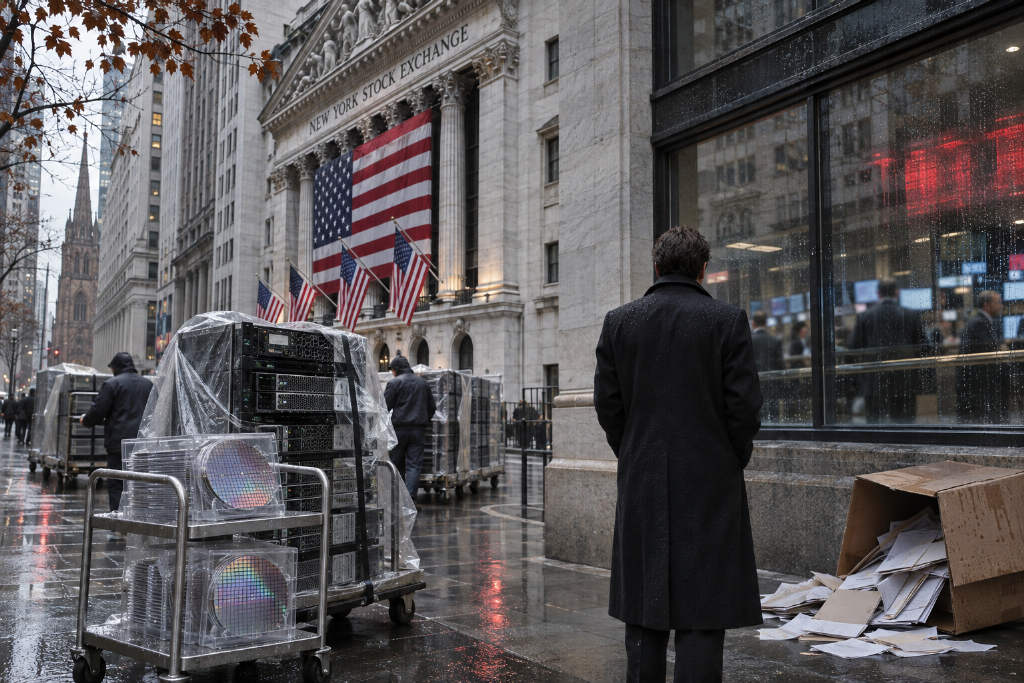
Wall Street is facing a costly wake-up call. As large-cap technology stocks suffer their sharpest monthly sell-off since March 2025, doubts over the payoff from artificial intelligence infrastructure spending are moving to the center of the market’s debate, and signs of an unwind in the AI trade are becoming harder to ignore.
On the final trading day of October, more than $1.5 trillion in U.S. stock market value was erased for the month. The Nasdaq Composite dropped 5.3% in October, its worst monthly showing since March 2025, while the S&P 500 logged a second consecutive monthly decline.
In a recent article, senior analysts Bert Dohmen and Dion Dohmen of market research and investment analysis firm Dohmen Capital Research said the sell-off spread outward from AI and semiconductor stocks, triggering a chain reaction of leveraged liquidations and margin calls. Even liquid assets such as gold and silver were not spared. In their view, the question of whether AI capital spending can produce meaningful returns has shifted from a side issue to the main cloud hanging over the sector.
AI and semiconductor names took the first hit
Bert Dohmen and Dion Dohmen wrote that the $1.5 trillion in market value lost in a single month was three times the roughly $500 billion wiped out in one day during 1987’s Black Monday.
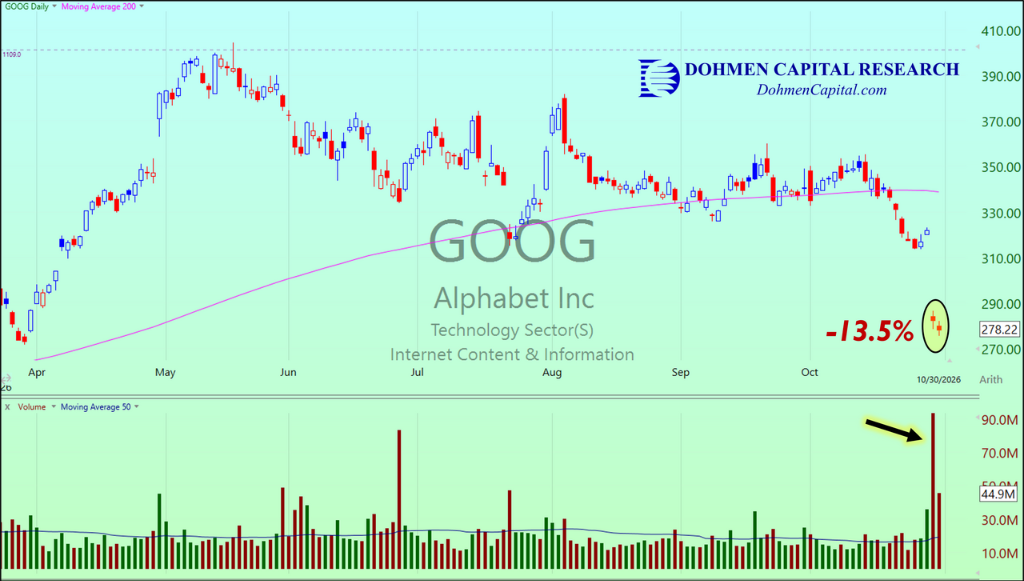
The catalysts arrived in quick succession. After Meta released its third-quarter earnings after the close on Oct. 21, market sentiment turned sharply. Then on Oct. 28, Microsoft and Google reported results. Alphabet, Google’s parent company, plunged 13.5% in a single day, dragging down the broader group of mega-cap technology stocks.
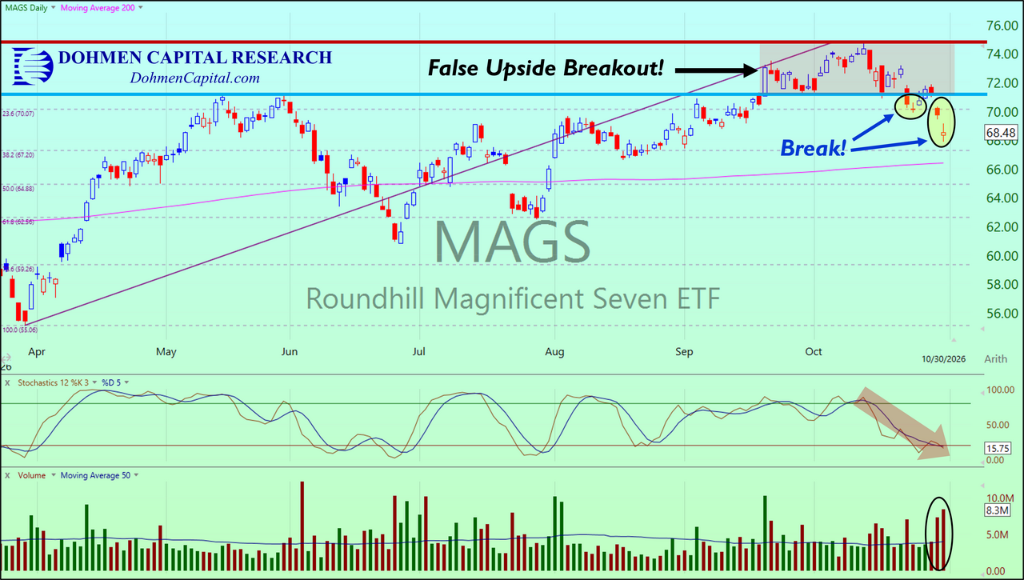
The MAGS ETF, which represents the “Mag 7,” has also lost momentum quickly since its Oct. 13 peak. By the end of October, it had closed below the key 70 level for two straight sessions, which the Dohmens said confirmed that the earlier upside breakout had been false.
They also argued that the real top in technology and semiconductor stocks had already formed in June this year, even though the market paid little attention at the time. In their telling, major tops often form months before the dramatic break that captures public attention, and by the time most investors recognize the risk, many are already trapped.
The core issue: who is paying for AI?
The deeper driver behind the retreat in the AI trade is a question the market had long avoided: can enormous AI infrastructure spending be turned into sustainable commercial returns?
Dohmen wrote that concerns around AI financing continue to build and are now “a huge cloud hanging over the market.”
Elliott Investment Management has already issued its own warning. A Wallstreetcn article, citing The Wall Street Journal, said Paul Singer’s Elliott told investors in its October letter that “at present, nearly every alarm bell warning of a major bear market is ringing,” and compared the current environment to the “Roaring Twenties” before the Great Depression.
In that letter, Elliott listed three specific concerns tied to AI:
- circular investment between AI model companies and AI infrastructure manufacturers;
- capital expenditure expansion supported by borrowing;
- and a rising anti-AI social movement.
Elliott warned that if AI product pricing comes under pressure, or if expectations for AI buildout begin to contract, the market impact “could be historic, at least as severe as any bear market in the past several decades.”
That logic is beginning to show up in price action. Mega-cap technology stocks enjoyed large valuation premiums on the back of the AI narrative. Once the market starts questioning whether that narrative can be monetized, the valuation framework comes under pressure. If leveraged money concentrated in those names starts to retreat, margin calls can follow, forcing investors to sell other assets to raise cash and widening the chain reaction.
From FOMO to FOGO
Elliott said the current bull market is supported by several factors at once, and that is exactly what creates systemic risk. If any one or two pillars among widening U.S. budget deficits, sticky inflation, private credit risks and the AI bubble begin to weaken, market psychology could swing from FOMO, or fear of missing out, to FOGO, fear of getting obliterated, and set off a self-reinforcing breakdown.
The firm also described the growing popularity of zero-day options trading and Meme stock speculation as behavior “closer to gambling,” saying those activities are distorting normal market price discovery.
Elliott managing partner Jesse Cohn wrote recently on X: “The stock market feels different now because it is different. Winners keep winning, losers get crushed, earnings season reactions are becoming harder to predict, and the size of those moves is getting bigger.”
Some institutions are moving into defense
Given those risks, some major firms have already started cutting exposure and shifting into a more defensive posture.
Elliott has moved its focus toward capital preservation. Singer and co-chief executive Jonathan Pollock wrote in the letter: “In Elliott’s fifty-year history, quiet periods have existed, but historically those periods have often come with market turbulence and have later been followed by rare windows of opportunity. Our goal is to be fully prepared — protected on the downside while holding capital that can buy cheap assets at market lows — and wait for the tide to turn again.”
Bert Dohmen and Dion Dohmen made a similar point in more direct terms: avoid buying the dip in AI and related stocks as they fall. They used a poker-table saying to make the case: “If you can’t tell who the sucker is, it’s you.”
A historical pattern they say investors miss
Both the Dohmens and Elliott are pointing to the same market pattern: real tops usually form before the public notices.
Dohmen said the top in AI and semiconductor stocks had already taken shape in June this year, but the warning did not draw enough attention at the time. Investors who added positions only after prices had already climbed are now dealing with large unrealized losses and the psychological struggle of refusing to sell at a loss. In their view, that is the classic path by which trapped positions build up in a bear market, and why every future rebound can run into heavy selling pressure.
Elliott, for its part, compared the current setup with the “Roaring Twenties” before the Great Depression, when debt-driven risk appetite and enthusiasm for new technology were also layered on top of each other. History does not repeat in a simple way, but the rhyme, in Elliott’s framing, is familiar.



