
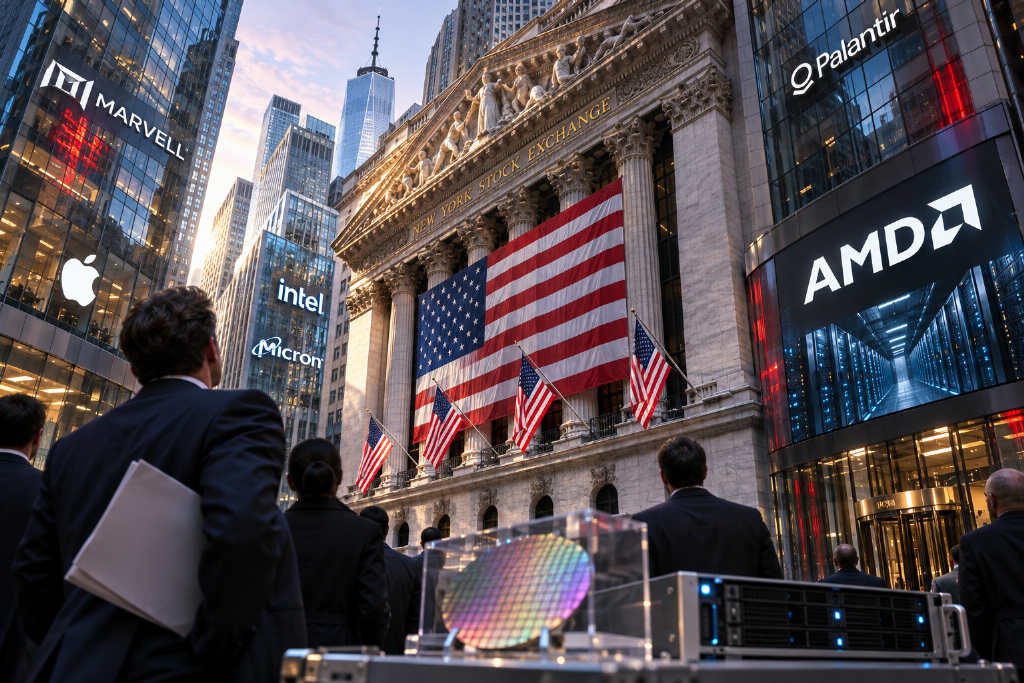
Indexes held up, but AI stocks were repriced
U.S. equities on Nov. 2 showed a clear split. The Dow Jones Industrial Average rose 0.41% to 51,983, while the S&P 500 fell 0.51%, the Nasdaq dropped 1.07%, and the Philadelphia Semiconductor Index lost 3.3%. Inside the AI supply chain, the selling was much heavier: Marvell fell 12.72%, AMD dropped 7.52%, Intel lost 8.8%, and Micron declined 5.78%.
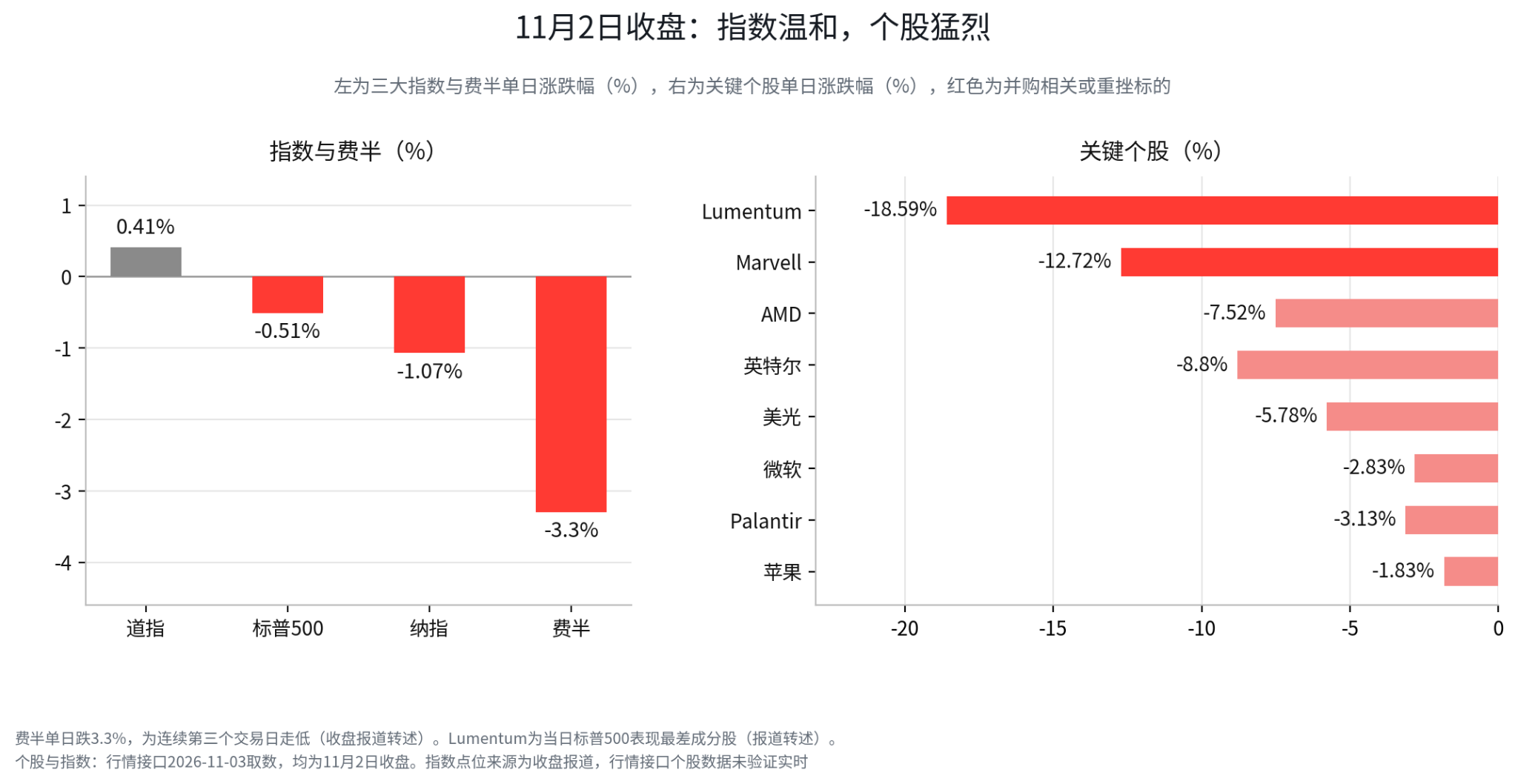
That did not mean the market suddenly stopped believing in AI demand. Microsoft’s latest quarterly capital expenditure came in at $45.2 billion, below the market expectation of $51.7 billion but still about 30% higher than a year earlier. Microsoft shares still closed down 2.83% on the day. After several rounds of large-scale spending, investors are asking more specific questions now: how long investment can keep rising, whether orders can remain durable, and whether incremental revenue can cover depreciation, energy, equipment and R&D costs.
The Marvell-Lumentum deal pushed that debate into the open. It was not just a large transaction. It also became a concentrated test of how the market is reassessing returns on AI infrastructure investment.
A $115 billion optical interconnect deal, and the first question was who pays the cost
According to the companies’ announcement, Marvell will acquire Lumentum in an all-stock transaction. Each Lumentum share will be exchanged for 4.5 Marvell shares, representing a premium of about 23.9% to Lumentum’s closing price before deal rumors surfaced on Oct. 28. The transaction implies an enterprise value of about $115 billion. After closing, existing Marvell shareholders are expected to own about 67% of the combined company, with Lumentum shareholders holding about 33%. The deal still requires shareholder and regulatory approval and is expected to close in the first half of 2028.
The industrial rationale is straightforward. Marvell supplies high-speed electrical chips, including DSP and PHY products, while Lumentum has laser arrays and photodetectors. A combination would extend integration across the chain from electrical signal processing to optical transmission. The report said Marvell disclosed a post-merger addressable market of about $550 billion, and Lumentum management had previously said some component capacity was booked out to early 2029, with customers locking in longer-dated orders.
But a sound industrial story and an acceptable deal price are not the same thing. Because Marvell is paying entirely with stock, the value received by Lumentum shareholders depends on whether Marvell’s share price holds up. Marvell’s existing shareholders, meanwhile, face dilution, execution risk and the possibility that synergies fall short. The timeline adds another layer: investors are being asked to price in operating results more than two years before the transaction is expected to close.
Lumentum’s own earnings were not weak. For the first quarter of fiscal 2027, revenue was $1.263 billion, up 136.5% year over year. Adjusted earnings per share were $4.57, above the market expectation of $4.21, and adjusted gross margin was 53.2%, ahead of the expected 51.3%. The company guided next-quarter revenue to $1.575 billion to $1.625 billion, also above expectations, and disclosed new NPO/CPO project orders and procurement commitments of more than $5 billion.
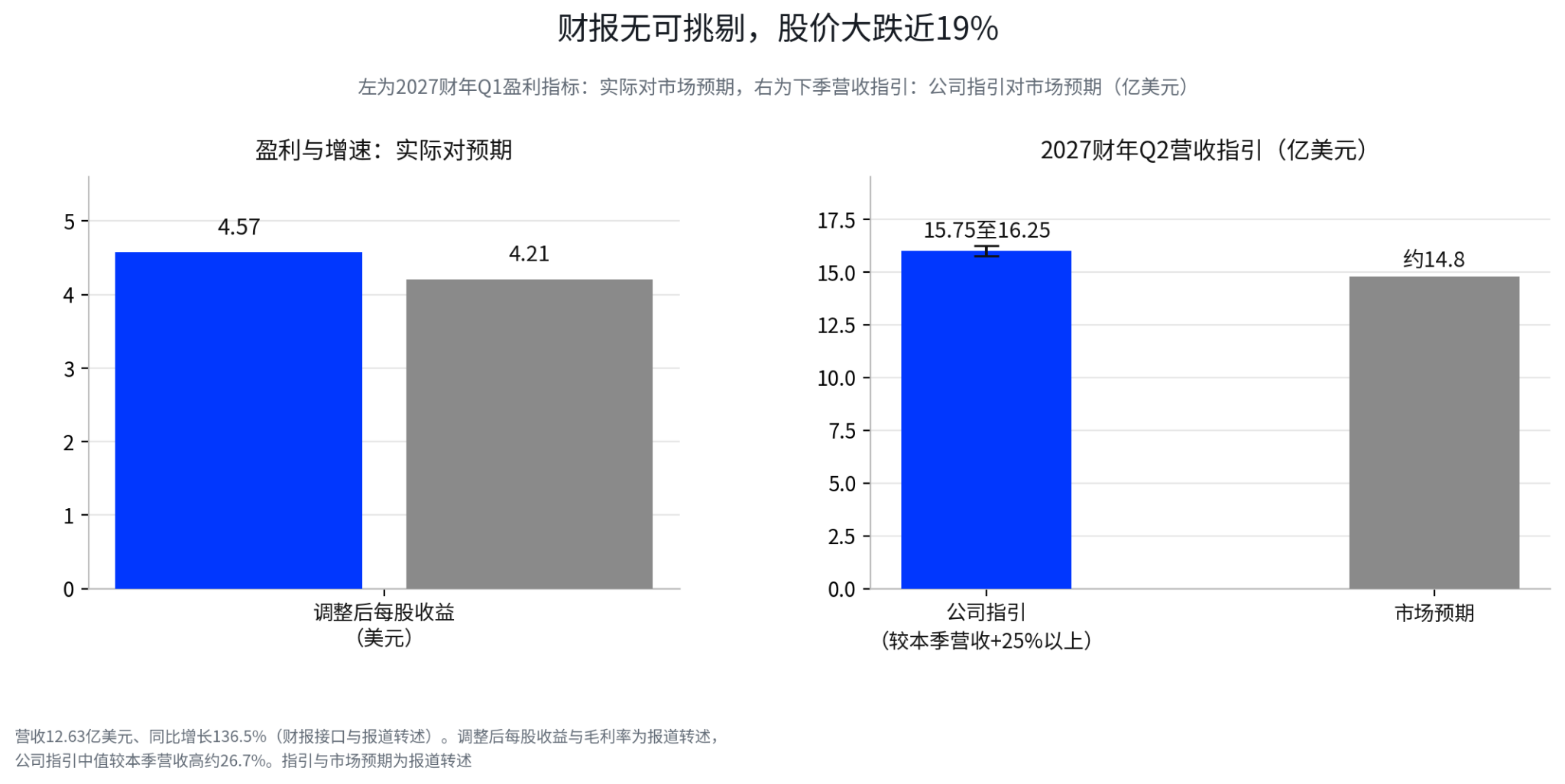
Even so, Lumentum shares fell 18.59% on the day the deal was announced. The selling was not centered on the company’s current operating performance. It was centered on what shareholders would ultimately receive after the transaction and what risks they would have to absorb along the way.
Marvell’s own stock move made that repricing even clearer. From a close of $251.65 on Oct. 28 to $171.41 on Nov. 2, the stock fell about 31.9% over three trading days. Because the exchange ratio is fixed, a decline in Marvell shares directly reduces the value of the stock consideration for Lumentum holders. The promised premium shrank quickly. Before the deal has even closed, the market has already reset its price.
The concerns are concentrated in three areas: dilution from an all-stock structure, a long closing schedule that runs into 2028, and whether the projected synergies can really be delivered. The companies set an annualized cost-synergy target of more than $1 billion, but the report noted that if operating overlap is limited, the room for cost savings may be smaller than the headline deal size suggests. Regulatory approval is another variable. Lumentum still supplies Marvell competitors, and the transaction includes a termination fee of as much as $5.8 billion, according to the report. That fee itself points to how much uncertainty both sides see in the approval and integration window over the next two-plus years.
The key issue in this deal is how much cost the market is willing to bear for long-dated growth. AI infrastructure demand may keep expanding, but if companies need large stock issuance, long integration periods and elevated valuations to capture that growth, shareholders will ask for more compensation in return.
Apple and Palantir: strong numbers, weak stock reactions
The merger highlighted the cost of capital allocation. Apple and Palantir showed a similar shift through earnings and valuation. The market is no longer looking only at how much growth a company delivered. It is also looking at what that growth cost and whether the result exceeded what was already embedded in the share price.
Apple reported fourth-quarter revenue of $114.48 billion, up 12% year over year and above the market expectation of about $113.4 billion. Earnings per share were $2.10, ahead of the expected $1.99. iPhone revenue was $57.58 billion, up 17%, and services revenue reached a record $31.57 billion. On the surface, it was a strong report.
But the stock did not get rewarded. Apple fell 1.83% on Nov. 2, with market capitalization slipping back to around $4.94 trillion, and the shares were at one point down more than 3% after hours. The market focused on gross margin and expense guidance. Overall gross margin fell from 50.1% in the prior quarter to 47.9% in the fourth quarter, and Apple said holiday-quarter gross margin would decline further to 45% to 46%. At the same time, holiday-quarter operating expenses are expected at $20.4 billion to $20.8 billion, up 11% to 13% year over year, driven mainly by higher AI-related R&D spending, according to the report.
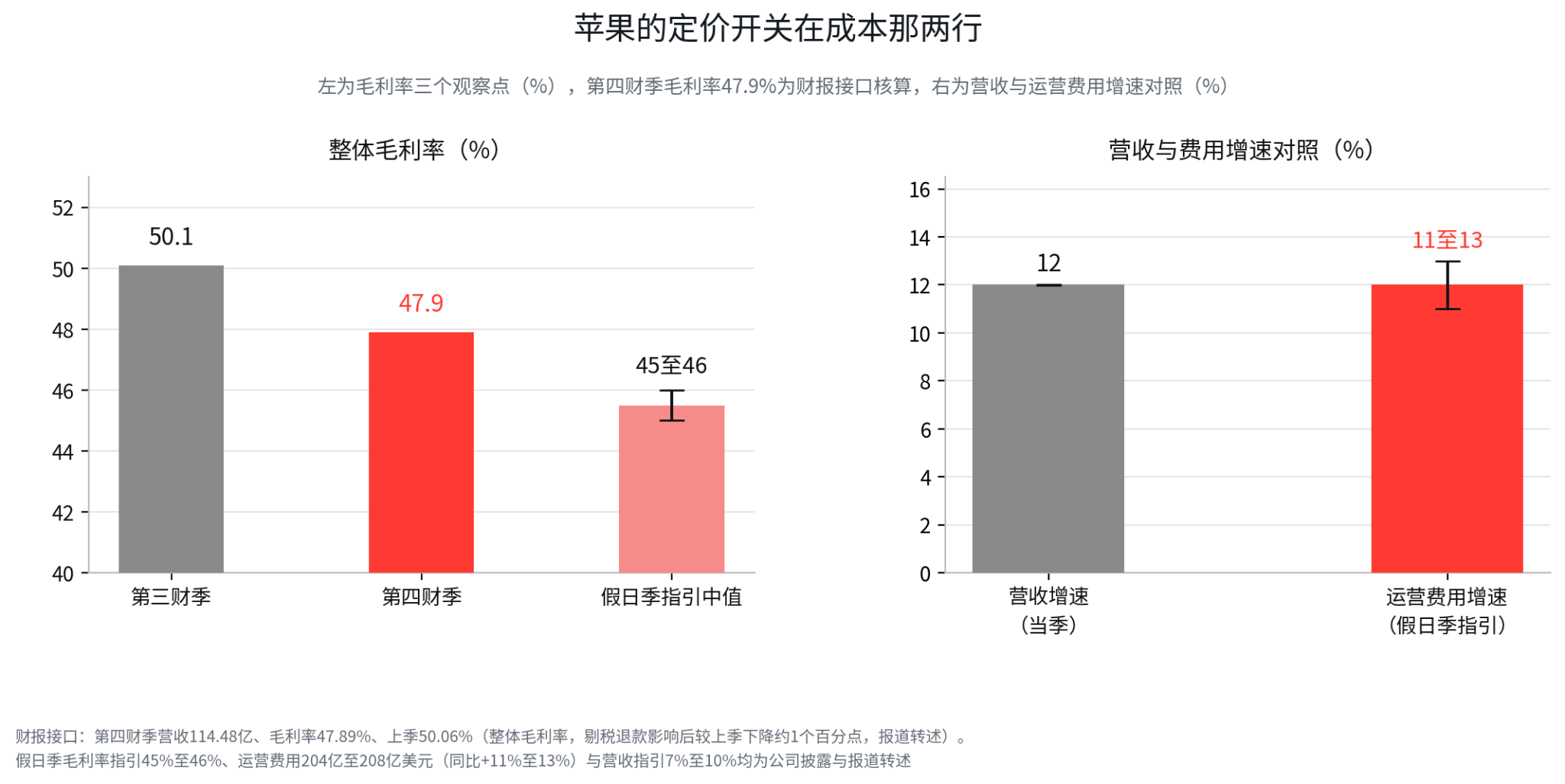
Revenue is still growing, but profit room is being squeezed by cost. Apple guided holiday-quarter revenue growth to 7% to 10%, while operating expenses are expected to rise 11% to 13%. If revenue growth does not reaccelerate, expenses and storage-related costs could keep pressuring margins. Apple does not need to spend on data centers the way cloud giants do, but AI investment still shows up in the income statement through R&D, memory costs and product mix changes.
The next checkpoints for Apple are not limited to iPhone sales. Investors are also watching whether gross margin can stabilize, whether storage costs keep rising, and whether AI spending can generate enough product and services revenue. A revenue beat is only the first hurdle. Margin durability determines the quality of that growth.
Palantir is dealing with a different kind of pressure. The issue is not a sudden deterioration in cost. The issue is that the market had already priced in a high level of growth.
The company reported third-quarter revenue of $2.313 billion, up about 96% year over year. U.S. commercial revenue was $984 million, up 148%. Adjusted earnings per share were $0.44, above the market expectation of $0.41, and the company raised full-year revenue guidance to $8.530 billion to $8.534 billion. Those figures point to a business still growing quickly.
Yet Palantir shares turned lower after a brief after-hours rise, and the stock had already fallen 3.13% in the regular session. High-valuation growth stocks are not priced only on how fast they are growing. They are priced on whether that growth keeps clearing a bar the market has already set. When investors have already paid a rich valuation for several years of rapid expansion, meeting expectations or beating them slightly in one quarter often confirms prior optimism rather than creating a new upside leg.
Palantir now has to show that rapid growth in U.S. commercial revenue can continue and that international commercial business can keep pace. Expense growth tied to hiring, product development and go-to-market expansion also remains worth tracking. For companies with elevated valuations, growth slope, margins and valuation need to be judged together. Year-over-year revenue growth is only one part of the picture.
Apple and Palantir share the same pattern: the earnings reports themselves did not clearly miss, but the market had already absorbed a large portion of the good news. To push shares higher from here, companies need to provide fresh evidence of growth.

AMD is next, and the market wants delivery proof
AMD is scheduled to report third-quarter earnings after the close on Nov. 3. The market expects revenue of about $13.0 billion to $13.1 billion, up roughly 41.5% year over year, and earnings per share of about $1.95, up about 62.5%. In the current setup, simply beating those figures may not be enough. Investors want confirmation on shipment timing for MI450 chips and Helios racks, along with the company’s outlook for data center business in 2027.
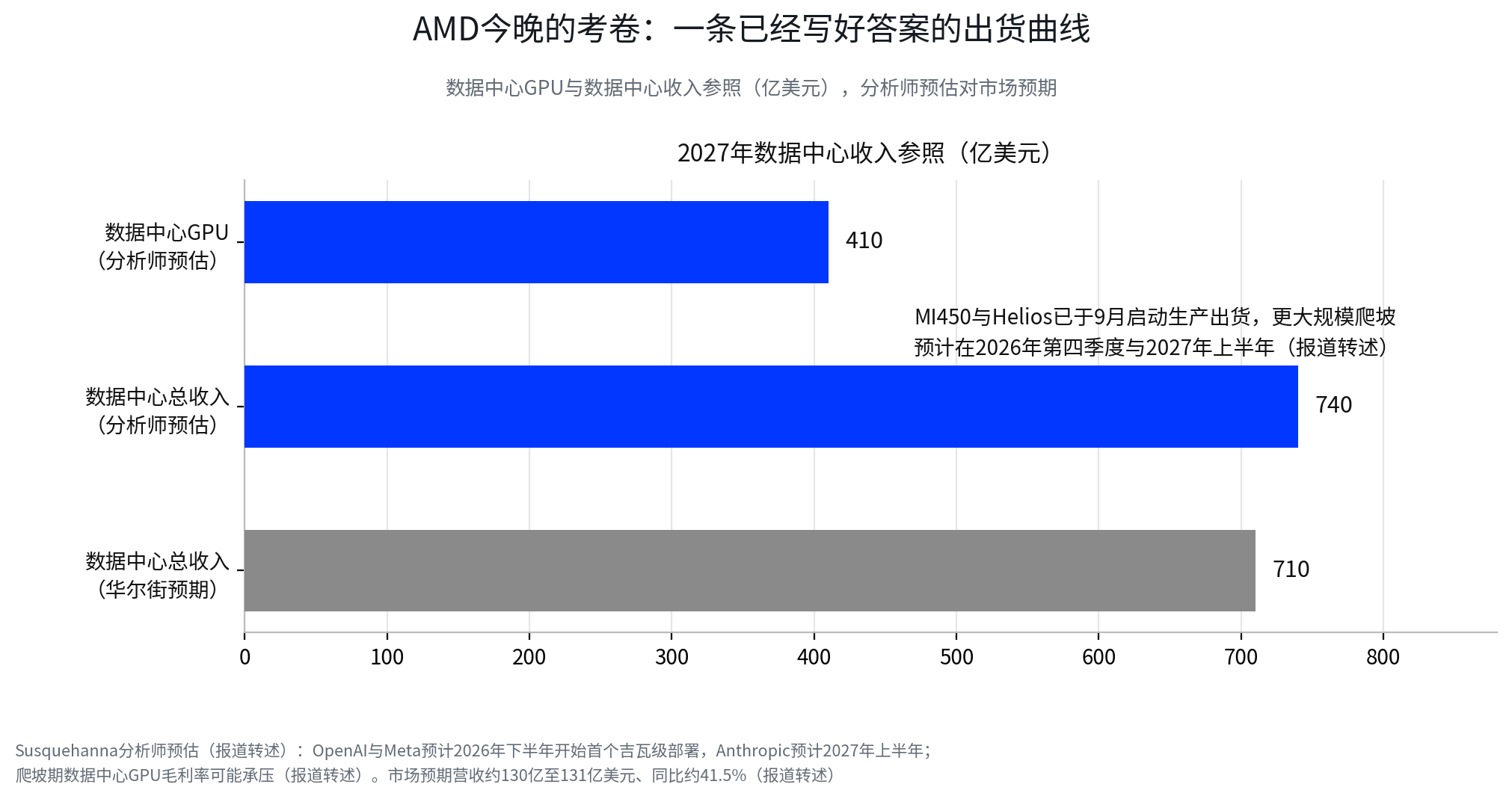
A Susquehanna analyst offered one path the market is watching. MI450 and Helios began production shipments in September, with a larger ramp expected in the fourth quarter of 2026 and the first half of 2027. OpenAI and Meta are expected to begin their first gigawatt-scale deployments in the second half of 2026, while Anthropic is expected to follow in the first half of 2027. That analyst estimates AMD’s 2027 data center GPU revenue could reach about $41 billion, with total data center revenue around $74 billion, above Wall Street’s roughly $71 billion expectation.
Still, those are analyst forecasts, not booked revenue. Higher GPU shipments do not automatically mean margins improve at the same pace. Product ramps, system delivery, customer deployment and supply-chain costs can all affect final profitability. The same analyst also warned that gross margin could come under pressure during a period of rapid GPU expansion.
AMD fell 7.52% in the previous session, with the compute complex already under pressure. If earnings confirm the MI450 and Helios shipment schedule and provide a confident 2027 data center outlook, the market may reassess AMD’s growth room as a second source of AI compute supply. If shipment timing slips or margin guidance comes in below expectations, investors may keep cutting the valuation they assign to future revenue and profit.
For AMD, the most important things to watch tonight are verifiable delivery progress, customer deployment and the margin path. Management’s broad description of AI market size matters less.
What the market is watching next: from AI narratives to orders and cash flow
This market move does not mean the AI infrastructure cycle is over. What has changed is the standard investors are applying to different parts of the chain. Companies with strong demand but heavy capital needs may be treated differently from companies already converting orders into revenue and free cash flow.
Within AI infrastructure, the report said power, cooling and data-center support equipment also deserve close attention, not just GPUs and chips. The Marvell-Lumentum transaction shows optical interconnect remains an important part of the stack, but that does not mean every optical communications company automatically deserves a higher valuation. Investors still need to separate real orders, capacity reservations and long-dated procurement commitments, then watch whether those orders become revenue and whether capacity expansion creates new capital spending and margin pressure.
The report pointed to suppliers such as Vertiv and Eaton in power and data-center infrastructure. Vertiv’s latest quarterly sales rose 61% year over year, organic orders increased 100%, adjusted free cash flow reached $652 million, and the company raised full-year guidance. Eaton’s second-quarter sales rose 21% year over year, or about 21.4% based on earnings-interface calculations. Rolling orders in its Electrical Americas business increased 41%, and backlog in the electrical segment rose 43%. Those indicators may offer more value than a simple AI label because they show data-center construction demand turning into equipment orders and corporate revenue.
But order growth and stock upside are still separate questions. The next things to watch are conversion speed, delivery timing for backlog, gross margin and whether valuation has already pulled future growth forward. Post-earnings stock reactions may also have already discounted some of that order growth.
For Apple, the focus remains gross margin, storage costs and services growth. For Palantir, the key is whether U.S. commercial revenue can maintain a high growth rate and whether international business improves. Both companies have already shown business growth. The market is now asking for a continued ability to create fresh expectation gaps.
For AMD, the most important variables are MI450 and Helios production, shipments and customer deployment, plus whether data-center revenue growth can turn into stable gross margin and cash flow. For Marvell and Lumentum, industry demand and merger risk need to be separated: optical interconnect demand may keep growing, but closing timing, stock consideration, regulatory approval and synergy delivery are independent variables.
The original report also noted that investors looking to reduce exposure to a single earnings release or M&A event may use broad-based indexes as a core position, while cash or short-dated Treasury-type assets can leave room for volatility during event-heavy weeks. In stock selection, the preference may shift away from chasing the next AI narrative and toward companies with visible orders, steadier margins and free cash flow that can keep up.
The real dividing line in this AI rally is how much investors are willing to pay for growth that sits far in the future. When an acquisition premium can shrink within days and earnings that beat across the board can still be followed by a stock decline, the market is signaling that growth still matters, but the cost of that growth, the time needed to realize it and the cash return attached to it matter more than before.



