
This article was originally published by Bit.Fan. For more cryptocurrency news and market insights, visit www.bit.fan.
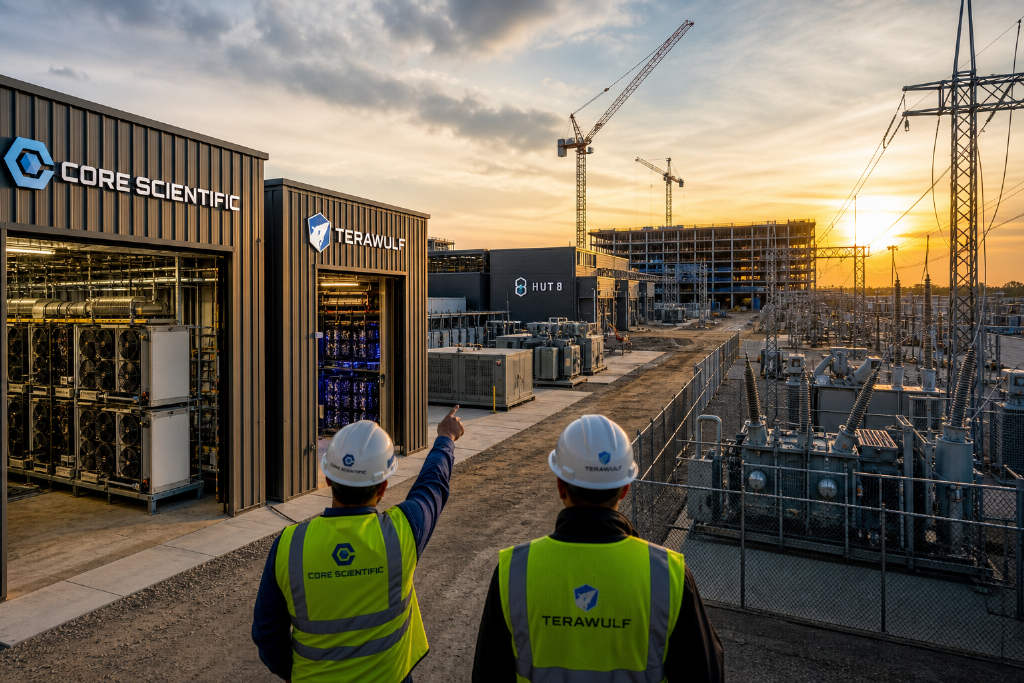
Wall Street Is Repricing Bitcoin Miners as Power Landlords for the AI Era
N
News EditorWall Street is changing how it values listed bitcoin miners that are moving into AI and high-performance computing. The market is shifting away from hash rate, bitcoin output and BTC holdings toward energized megawatts, signed IT load and delivery execution. Core Scientific’s latest quarter shows the new model in action: high-density colocation revenue reached $136.7 million, or about 83% of total revenue, while self-mining revenue fell 66% year over year. TeraWulf and Hut 8 have also signed multibillion-dollar data center leases, but much of that capacity will not be delivered until 2027 or 2028. VanEck says the industry’s biggest challenge is execution, not demand, and estimates a near-term funding gap of about $50 billion across the sector.
Bitcoin minersAI data centersWall StreetCore ScientificTeraWulfHut 8high-performance computingmarket analysis
Wall Street is no longer valuing bitcoin miners mainly by hash rate, daily BTC output or the coins sitting on their balance sheets. For a growing group of listed miners moving into AI and high-performance computing, the key questions are now energized capacity, signed IT load and whether projects can be delivered on time.
The shift is easy to see in Core Scientific’s latest numbers. In the second quarter of 2026, total revenue rose 109% year over year to $164.2 million. High-density colocation revenue reached $136.7 million, or about 83% of the total, while self-mining revenue fell 66% to $21.54 million. The company’s self-mining business posted a gross loss of roughly $12.17 million, while the colocation segment generated about $79.98 million in gross profit.
That kind of split is why investors are starting to look at miners more like power developers than hash producers. Core Scientific said it had 437 MW of customer power capacity already billing as of mid-July 2026, equal to about $635 million in annualized colocation GAAP revenue. It also had about 1.1 GW of contracted customer capacity, with potential contract revenue above $24 billion.
TeraWulf and Hut 8 are showing the same trend through long-term lease agreements. In July 2026, TeraWulf signed a 20-year data center lease with Anthropic covering about 401 MW of critical IT load at its Justified Data campus in Hawesville, Kentucky. The company said the deal is expected to generate about $19 billion in contract revenue over the initial term, with deliveries starting in the second half of 2027 and full operation expected in early 2028. It also said the arrangement is expected to receive investment-grade credit support.
In the same month, Hut 8 announced a second 15-year lease at its Beacon Point campus in Texas worth $9.8 billion, adding 352 MW of IT capacity and taking the same customer’s committed footprint there to 704 MW. The base-term contract value for Beacon Point reached $19.6 billion, but the first second-phase data hall is not expected to start delivery until the second quarter of 2028.
These deals point to a new reality in AI infrastructure: the hardest asset to secure is often not the GPU. It is the power, transmission and permitting needed to bring a large facility online on a fixed schedule. Chips can be bought and servers can be installed. Grid interconnection, substations, land rights and utility upgrades can take years.
That is where bitcoin miners now have an edge. Over the past decade, they have spent huge sums finding sites close to generation, with room for large loads and fast buildouts. Those assets once existed to run ASIC fleets. Now they can be repurposed for AI data centers, where power scarcity is the bottleneck.
The premium is not about reselling a kilowatt-hour at a markup. It comes from converting electricity into high-reliability critical IT load. The real value sits in the combination of energized or clearly interconnectable capacity, engineering execution, financing capacity and long-term customer credit.
That also changes the risk profile. Bitcoin mining revenue moves daily with bitcoin price, network difficulty and transaction fees. AI colocation revenue depends more on contract length, delivery progress and tenant performance. One business looks like commodity production; the other is drifting toward the model of a data center developer and infrastructure operator.
VanEck’s June 2026 framework for AI infrastructure value in the mining sector reflects that split. Based on data as of June 4, 2026, companies with signed AI or HPC leases were trading at more than 10 times its energized-power benchmark, while miners with little signed capacity and mostly future power optionality were closer to 2 to 6 times. The multiple is not a P/E ratio, EV/revenue or EV/EBITDA.
The market is also separating different stages of capacity. Planned capacity is still a development concept. Locked capacity has power agreements or interconnection arrangements but may not yet be energized. Energized capacity can actually receive power. Delivered and billing capacity has already been handed to customers and is producing revenue. Those stages are not interchangeable.
As more projects come online, the valuation debate will move again, from access to power and signed contracts to a more traditional set of questions: can the project be delivered on schedule and on budget, how much cash flow each MW can produce, and whether returns can cover financing costs.
The biggest risk is treating a power blueprint as if it were already revenue. VanEck estimates that, as of June 4, 2026, the companies in this group had delivered only about 25% of the capacity they had leased. It also estimates a near-term funding gap of about $50 billion versus existing cash, excluding future operating cash flow and any funds raised by selling or pledging BTC. VanEck put long-term capital expenditure needs near $221 billion, but did not describe that as a long-term funding gap. Much of the capacity being discussed in press releases is still tied to buildouts for 2027 and 2028.
That means a multibillion-dollar contract is not the same as immediate revenue. Projects can still run into grid upgrades, equipment delivery delays, construction inflation, financing terms, regulatory approvals and local opposition. For miners without much experience building high-density data centers, delays and overruns can hurt both cash flow and valuation at the same time.
Customer concentration is another issue. Long leases improve visibility, but they can also leave an entire campus, or even a company, dependent on a single tenant. If AI infrastructure spending slows, tenants cut capex, or next-generation chips change data center design, these miners could end up with heavy assets that are hard to redeploy quickly.
The transformation itself also requires major capital. Miners can raise money through equity, convertibles, project debt and customer prepayments, but those tools bring dilution, leverage and financing constraints. Control of power is only the entry ticket. The real test is whether the company can turn that power into billable assets at a reasonable cost.
Bitcoin mining has not disappeared. It still monetizes electricity quickly and can produce highly flexible returns when bitcoin prices rise. Unlike traditional data centers, mines can curtail load and participate in grid demand response, creating temporary revenue from capacity that has not yet been contracted.
But for a number of listed miners, bitcoin is moving from being the only core business to being one way to monetize power infrastructure. Hardware can be replaced and mined coins can be sold. What is much harder to replicate is the land, interconnection rights, transmission assets and large-scale power arrangements already secured.
That is why “power is the most valuable asset” needs a qualifier. It is not the gigawatts on a slide deck, and it is not simply cheap electricity. It is power that can be interconnected on time, financed, built into a high-density data center and leased long term to a creditworthy customer.
Miners once chased cheap power to produce more bitcoin. Now they are using data center leases to monetize scarce grid access and the time value of infrastructure. The industry is splitting in two: some companies will keep betting on bitcoin and hash cycles, while others may shed the miner label altogether and become the power landlords of the AI era.
11600
Disclaimer:
The market information, project data, and third-party content displayed on this platform are for industry information sharing only and do not constitute any form of investment advice or return commitment.
Cryptocurrency trading carries high risks. Users should fully assess their risk tolerance and make independent decisions. All profits, losses, and legal responsibilities are borne by the users themselves.