
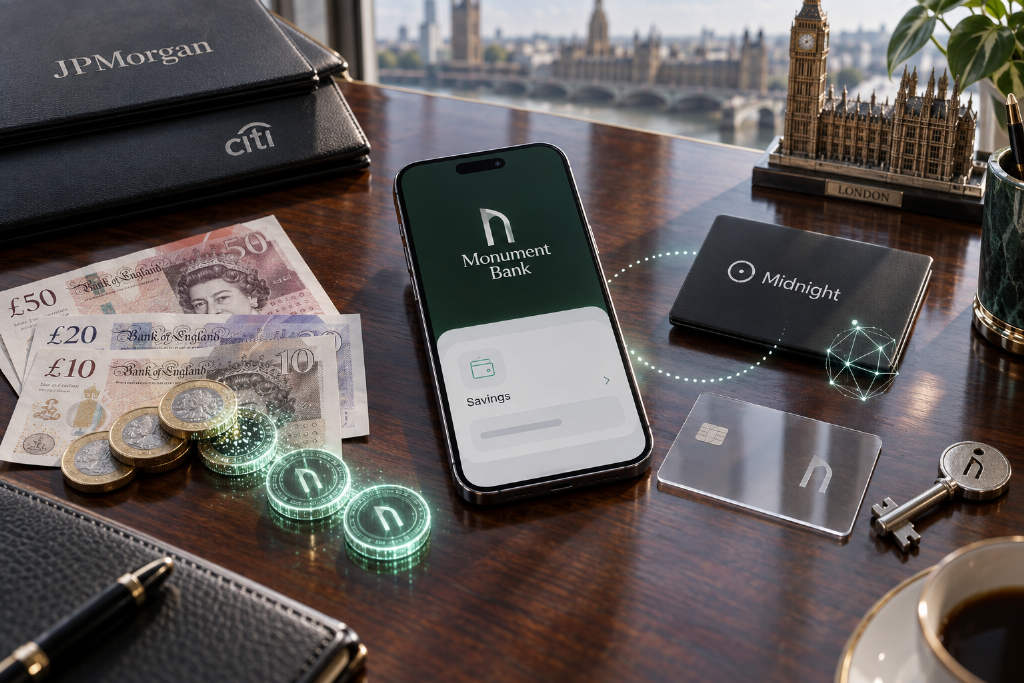
JPMorgan and Citigroup have already pushed large volumes of money through blockchain infrastructure, but their tokenized money services still sit mostly inside institutional channels and permissioned networks rather than in front of everyday savers.
According to CoinDesk, U.K. challenger bank Monument Bank plans to tokenize up to 250 million pounds of interest-bearing retail deposits on Midnight, a privacy-focused blockchain. The project would use zero-knowledge proofs to protect customer data while meeting regulatory requirements. Monument’s pitch is to give consumers access to tokenized investing and lending through a conventional banking app, without requiring them to understand or directly use cryptocurrency.
JPMorgan’s Kinexys blockchain platform has processed more than $3 trillion, and Citi Token Services handles billions of dollars in cross-border payments each day. Both examples show how large banks are using blockchain to update legacy systems and improve cross-border payments. Even so, neither service is built for the regular person with a savings account.
Institutional use has come first
Mintoo Bhandari, founder of Monument Bank, said most coins that have been minted and used for money transfer are internal bank projects. In his words, 「Is that really moving the needle for the whole bank and for the consumer? Not yet.」
That split sits at the center of the tokenized-money debate. Banks are placing tokenized deposits and payments on blockchain rails, but most efforts remain restricted to institutional customers or permissioned environments. Monument and Midnight are betting that regulated, interest-bearing bank deposits could eventually open tokenized investments and lending to retail clients without asking them to learn crypto first.
Legacy systems still hold banks back
Bhandari said 99% of banks around the world claim to be digital because they have an app, but in practice many are still stuck with legacy architectures that date back to the 1970s and are hard to leap over.
Jerald David, CEO of Lynq Network, said treasury desks at major institutions often have to manage three systems for the same job. One client may use a JPMorgan tokenized deposit, another a regulated stablecoin, and a third a conventional correspondent account. The money is moving for similar reasons, but over different infrastructure.
David said clients cannot afford to keep separate pools of liquidity locked on every network they access. Idle liquidity spread across five networks creates five times the capital inefficiency of idle liquidity sitting in one place.
Unlike a stablecoin, a tokenized deposit remains a claim on the issuing bank. It can pay interest, stay inside the regulated banking system, and potentially be programmed to settle against tokenized assets. The open question is whether banks can deliver those features to consumers while preserving privacy, compliance, and control over who can hold the deposit.
Interest-bearing deposits and privacy controls
Bhandari said Monument, unlike stablecoin issuers, holds a banking licence that allows it to pay interest on deposits. The bank plans to offer tokenized savings accounts that generate yield.
Fahmi Syed, president of the Midnight Foundation, said public blockchain infrastructure creates a separate problem for banks because they cannot expose client transaction data and commercial relationships.
He said that once a private blockchain is created, the next challenge is how to communicate with another private blockchain. That usually requires a bridge or another mechanism, and at that point data leakage becomes a risk. Syed said JPMorgan and Citibank have recognized this issue themselves.
Private bank blockchains can work as internal ledgers, but linking them to external ledgers without exposing sensitive information is harder. Syed said Midnight uses zero-knowledge proofs that let a bank verify whether a customer or a transaction meets set conditions without putting the underlying personal data onchain.
David gave an example involving a fund that gets repaid in stablecoins on a Saturday morning. Settlement on the crypto side works, but if the fund needs that money to meet a margin call before markets open on Monday, a problem appears because the prime broker’s treasury only operates during banking hours and does not accept digital assets. The cash is there, but it cannot be used where and when it is needed.
As David put it, 「The capital exists, it’s just dislocated. It’s simply not usable where and when it’s needed.」
Monument’s retail tokenization plan
Monument said it plans to tokenize up to 250 million pounds, or about $335 million, of retail customer deposits on Midnight. Those deposits would remain interest-bearing, fully backed by Monument, redeemable one-for-one in pounds sterling, and protected by the Financial Services Compensation Scheme subject to the scheme’s limits.
Bhandari said, 「Nobody yet has actually enabled retail to directly participate in tokenization.」 He said the platform is being designed so customers never know, and do not need to know, that they are using blockchain or cryptocurrency. From the user’s perspective, the experience would look like a normal sterling deposit that can be withdrawn on demand.
The longer-term goal is to give those customers access, subject to the relevant permissions, to fractional private equity, tokenized structured products, and Lombard lending inside a regulated banking app.
Bhandari also said that if the model works, Monument will license the infrastructure to other banks through a vehicle called Monument Technology. The larger test is not whether banks can tokenize money. They already can. The harder question is whether they can make that money useful to consumers without giving up the privacy, regulatory safeguards, and trust that separate a bank deposit from a crypto token.