
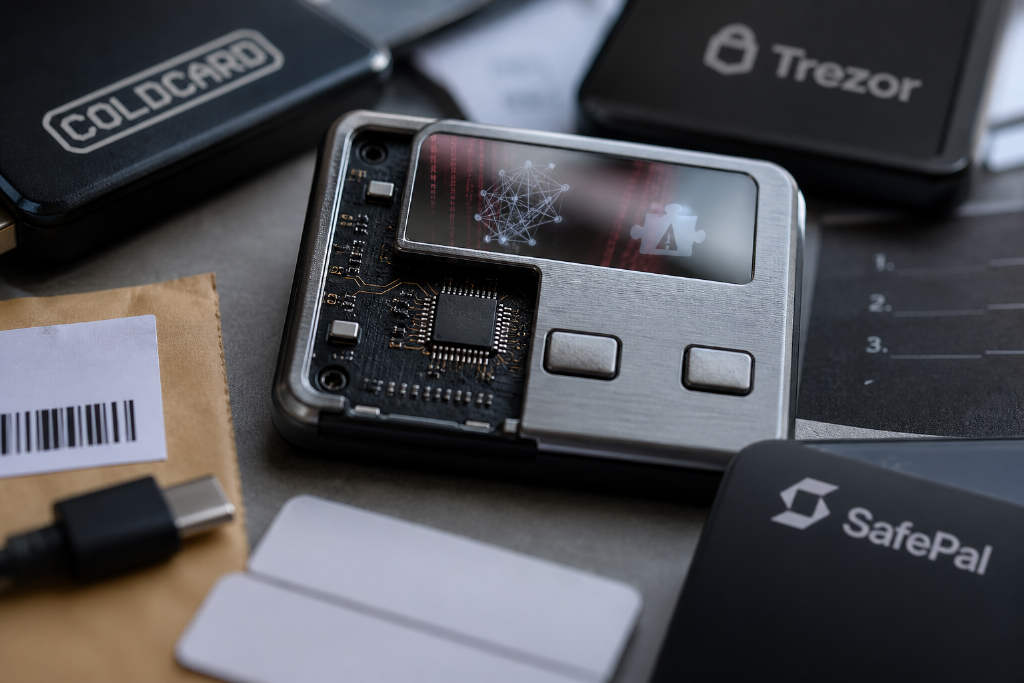
Crypto wallet security has come under renewed pressure over the past month after Coldcard was found to have a serious random number generation flaw, followed by risk disclosures involving user privacy data at Trezor and SafePal.

At first glance, the three cases do not share much in common. Coldcard’s issue centered on private key generation, making it a direct security failure. Trezor’s exposure was tied to a third-party logistics service, while SafePal’s case involved order systems and plugin permissions, placing it closer to privacy leakage and the downstream risks that follow.
Set against a longer timeline, though, they point to the same question: as AI makes bug discovery, exploit development and social engineering more automated, how many parts of a crypto wallet can still become the next weak link?
AI is turning hacking from specialized craft into repeatable workflow
The article argues that the most important shift is not that AI has suddenly invented an entirely new class of attacks. It is that AI is stripping cost and time out of many existing ones.
In the past, large-scale attacks were often constrained by a practical limit: human time. Digging through a large codebase, mapping call relationships and finding logic flaws that had sat unnoticed for years usually demanded long hours from experienced security researchers. Building a convincing phishing operation around a specific target could take months of identity gathering, habit analysis and script preparation.
That tradeoff meant attacks often fell into one of two categories. They were either highly automated but crude, cast broadly in the hope that a few users would take the bait, or they were carefully tailored to a small set of high-value targets and difficult to scale.
According to the piece, fast-moving AI capabilities are eroding that divide. AI can help attackers analyze smart contracts, client software and even firmware more quickly, making it easier to spot zero-day issues and logic defects. Once identity data has leaked, AI can also generate highly customized phishing emails, text messages and even voice or video content. Target selection, malicious content creation and multichannel delivery can increasingly be folded into one automated pipeline.
The result is a lower-cost attack chain from start to finish. Finding a vulnerability is cheaper. Profiling a target is faster. Producing a thousand variations of a phishing message is far easier than it used to be.
That matters because some systems were not attacked in the past not because they were flawless, but because the flaws were expensive to find, the targets were not worth the effort, or the operation required more time than attackers could justify. In that sense, an invisible line of defense built on attacker limitations is getting thinner.
Viewed this way, the security battle around crypto assets is no longer just a contest over private keys. It now stretches across code, devices, supply chains, user identity and everyday interaction. AI is accelerating that expansion.
The wallet attack surface goes far beyond a seed phrase
The three incidents stand out because they hit different stages of the wallet lifecycle, showing that wallet risk now reaches well beyond the simple question of whether a private key has been stolen.
Coldcard is the clearest example. Its issue appeared before the user had meaningfully begun using the wallet. A seed phrase could still look normal, with 12 or 24 ordinary words. The device could still sign transactions and transfer funds as expected. A user might notice nothing unusual at all. But if the randomness used to generate that phrase was not actually random, the wallet could still be exposed even if the seed phrase was never shared with anyone.
That goes to a basic assumption in self-custody: keeping a seed phrase safe only works if the phrase itself was generated through a secure and unpredictable process in the first place.
Trezor and SafePal illustrate another category of risk. Their hardware was not broken into, and their seed phrases were not exposed. What leaked instead were purchase-related details, including names, phone numbers, email addresses and delivery addresses.
The danger is obvious. An attacker does not need to break cryptography if an order record already identifies a person as someone who bought a hardware wallet for storing crypto assets. With that information, an attacker can impersonate wallet support, send an “urgent firmware update” notice, build a phishing page tailored to the exact device model, or call the user with a fabricated order problem. From there, the attacker may connect social media profiles, public identity trails and on-chain addresses.
The article references the long-circulated “$5 wrench attack” idea in crypto: no matter how strong the cryptography is, it does not solve the problem of an attacker locating the asset holder directly.
It also cites data that Chainalysis provided to the Financial Times. As of mid-August 2026, at least 46 violent attacks against crypto holders had been recorded this year, with kidnappings accounting for more than half and home invasion attacks for more than one-third.

Taken together, the article says, wallet security is now a long chain. It starts with wallet code, randomness and key generation, runs through chips, firmware and devices, then extends to official sites, purchase channels, supply chains, logistics and order databases. Once users begin interacting, the chain also includes RPC connections, dApps, browser extensions and smart contracts, followed by approvals, signatures, support channels, social media and even AI agents.
Any one of those links can become the weakest point and bypass defenses built elsewhere.
Static rules are becoming less effective against adaptive attacks
If AI continues advancing at its current pace, the article suggests that the issues visible today may only be the start. One of AI’s strengths is persistent pattern finding inside large and messy systems.
Attackers can deploy agents to keep scanning open-source code, test websites, APIs and extension permissions at scale, and gather information from social media and public databases before filtering for likely high-value targets. Phishing itself may also evolve from generic prompts such as “your wallet is about to expire, enter your seed phrase” into live interactions shaped around who the victim is.
If attackers know a user recently bought a specific hardware wallet model, they can generate a matching “firmware security notice.” If they know the user recently interacted with a DeFi protocol, they can pose as that project and push the user toward a new vault migration. If they obtain social accounts and public statements, they may even mimic familiar team members, key opinion leaders or support staff.
That raises a central problem for wallet security: once attacks move from fixed rules to systems that can analyze, adapt and change, can defense still rely mainly on static rule sets?
The article notes that many wallet security mechanisms still resemble a rule library. A known phishing address triggers a warning. A blacklisted domain is blocked. A riskier approval pattern brings up an extra prompt. Those tools still matter. But if detection depends mostly on what has already happened, it becomes harder to catch what is changing in real time.
The article points to AI as a necessary layer on the defense side
In that context, AI can become an important addition for defenders as well. The article says this is not a brand-new idea and points to earlier discussions by imToken around “AI × Web3 security.” In that framework, a wallet’s security system should not stop at blacklists, risk labels and fixed pop-ups. It should push security judgment further forward into the full transaction flow.
That could mean AI reviewing code dependencies, call paths and abnormal logic before software reaches production. When a user visits a dApp, AI could assess whether it looks suspicious by combining domain history, frontend behavior, contract addresses and on-chain relationships. Before a signature is given, the wallet could simulate the actual transaction outcome instead of showing the user only a block of hard-to-read hexadecimal data.
The article goes one step further and suggests that wallets may gradually build dynamic security models for individual users. An account that usually moves only a few hundred dollars but suddenly attempts to approve all assets to an unfamiliar contract deployed just 2 hours earlier is itself an anomaly. An address a user has never interacted with that suddenly requests unlimited Approval should receive a higher-priority warning. An email claiming to come from the wallet team and asking for a seed phrase should be treated as high risk regardless of how convincing it looks.
Under that model, AI is not simply a tool for deciding whether a single address is safe. It becomes a way for wallets to evolve from passive key storage and signing tools into systems with active risk judgment.
The article draws a line, however. AI may help users understand and carry out complex actions, but that does not mean asset control should be handed over without limit. For large transfers, approvals to new addresses and sensitive contract interactions, the piece says wallets still need least-privilege design, human confirmation, pre-execution simulation and clear explainability so that AI remains inside an explicit authorization boundary.
Especially when something unusual happens, the wallet should be able to tell the user why it is dangerous, what will happen if the action is executed and where the actual risk sits. In that sense, the role of AI defense is to help wallets actively understand transactions, detect anomalies and constrain execution, rather than simply sign what is placed in front of them.
Self-custody still matters, but security has to keep evolving
The article closes by arguing that the recent wave of wallet security incidents does not mean self-custody has lost its value, nor does it mean users should hand full control of their assets back to centralized platforms.
What these incidents show instead is that self-custody has never been the same thing as automatic safety. It gives users direct control over assets, but protecting that control requires a security system that keeps changing with the environment.
Security, in the article’s framing, is not a one-time product delivery. It is a long-running process of adjustment involving users, project teams and wallet providers. Attackers can use AI to understand code, users and context. Defenders can do the same. The contest between offense and defense around crypto wallets is set to keep escalating.