

Zcash (ZEC) is still in the middle of a sharp rally, but the move is being met with a new round of criticism over the project’s history and governance.
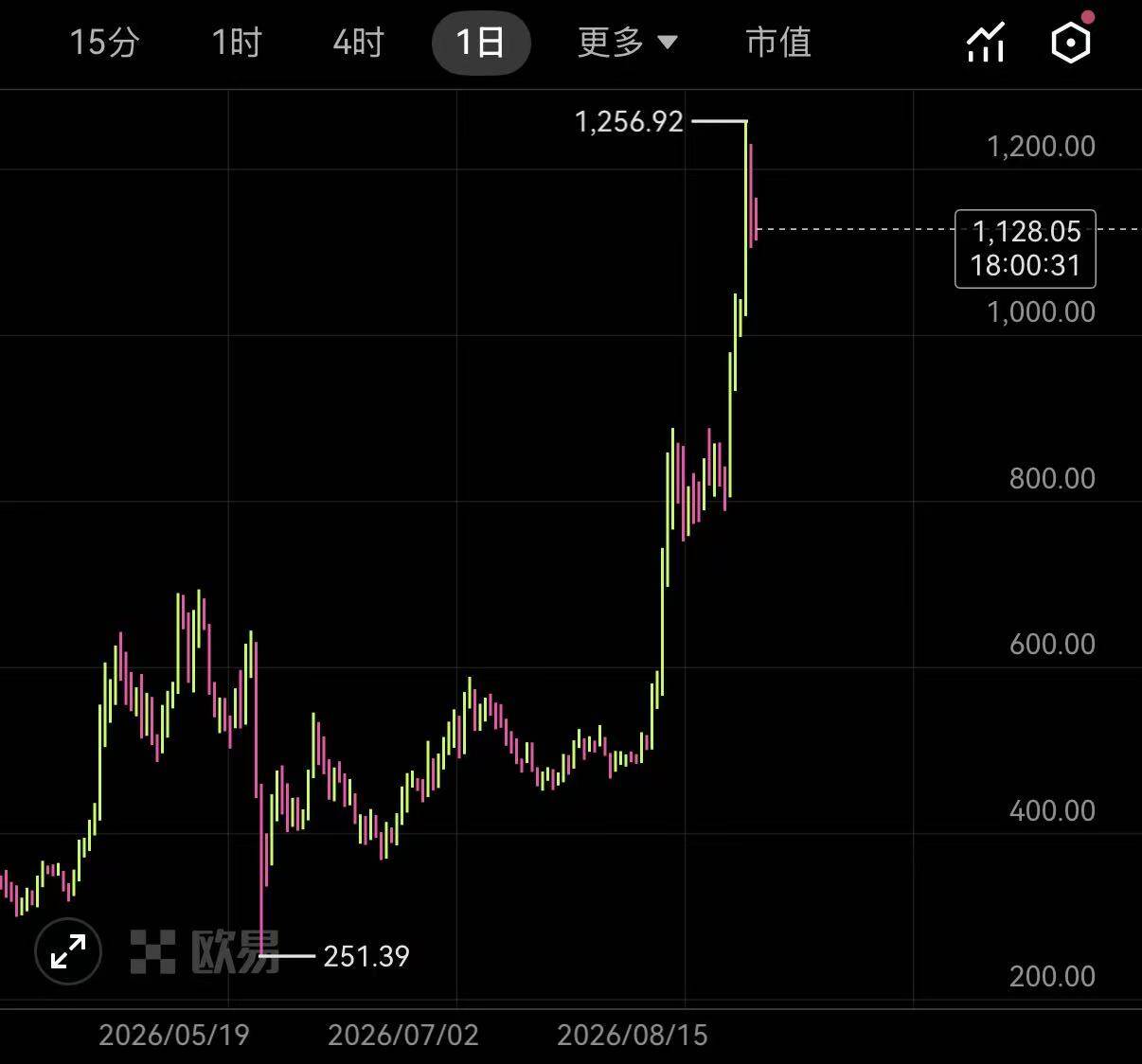
According to OKX market data cited by Odaily, ZEC broke above $1,000 on Sept. 6 and climbed as high as $1,256.92. As of 14:00 on Sept. 8, it was quoted at $1,128.05. Measured from the early June low of $251.39, when concerns around the Orchard vulnerability hit the market, ZEC’s peak gain in roughly three months came close to 400%.
That price action has not translated into broad consensus. On Sept. 8 at midday, Wang Chun, the F2Pool co-founder and a longtime Bitcoin figure, posted several messages on X attacking Zcash and revisiting what he sees as the project’s major weak points.
Wang Chun revives old complaints about the team and the token
Wang first reposted one of his own messages from six years ago at 12:52, using it to question the professionalism of the Zcash team. He wrote that a team member had repeatedly confused EST and EDT in email exchanges, making communication impossible. Wang said he ended up blocking the entire company and, looking back six years later, still viewed that as one of his best decisions.
He also brought up the well-known BlockFi transfer mistake, saying the firm was supposed to send a user $701.4 but instead transferred 701.4 BTC. In his telling, someone who cannot tell EDT from EST might also confuse BTC with USD.
At 13:17, Wang escalated his criticism and argued that ZEC’s latest surge was driven by narrative rather than fundamentals. He said market capitalization alone does not justify a token’s place and argued that sitting near names like Solana and Hyperliquid in the rankings does not mean Zcash can do what those projects do.
Odaily noted that Wang is now also known more broadly for another reason. In May, SpaceX announced that he would join Starship’s first crewed interstellar Mars mission. The plan calls for a two-year deep-space flight that would leave the Earth-Moon system, fly past Mars without landing, and return to Earth.
Four points of controversy highlighted in the latest criticism
Beyond the issue of professionalism, Wang’s criticism centered on four recurring debates around Zcash: its 20% reward diversion in the early years and the later development fund, privacy that is available but not mandatory, open conflict inside the project’s governance structure, and the Orchard vulnerability that surfaced this year.
The 20% founders’ reward and the later development fund
One of the oldest criticisms of Zcash concerns its launch design. After the mainnet went live in 2016, 20% of each block reward during the first four years did not go to miners. Instead, that share was allocated as a Founders’ Reward to founders, early employees, advisers, investors, and related parties including Electric Coin Company (ECC).
Odaily said the total from that mechanism came to about 2.1 million ZEC, equal to 10% of the network’s 21 million maximum supply. Wang’s argument is that Bitcoin pays miners, while Zcash built in a stream of rewards for a company and the parties behind it.
That arrangement did not fully disappear when the Founders’ Reward expired in 2020. Through ZIP 1014, the Zcash community introduced a new Dev Fund that continued to direct 20% of block subsidies from 2020 to 2024 to Bootstrap, the Zcash Foundation, and Major Grants.
Supporters and critics do not describe that second phase in the same terms, but the criticism cited by Odaily is straightforward: Zcash has maintained a developer-oriented carve-out for years, which makes it look very different from Bitcoin’s reward structure.
A privacy coin where privacy is not mandatory
The second issue goes to the core of Zcash’s identity. Zcash supports both shielded transactions and transparent transactions. It does not require every transfer on the network to use privacy protections.
Whether users actually get privacy depends in part on wallet and exchange support. Odaily said some wallets and trading venues still support only transparent transactions. The Zcash side has also stated that users who want to keep transaction and financial history private need wallets or services that enable shielded transactions by default.
That design has led to a lasting debate. Zcash clearly has privacy technology, but privacy is not a compulsory feature at the protocol level for every transaction. For users, skipping privacy can be simpler. For exchanges and wallets, transparent addresses are easier to support and easier to supervise.
Wang’s point was not that Zcash lacks privacy tech. His criticism was that if a large share of activity can still take place openly, the project’s “privacy money” narrative may not be enough on its own to justify where the token trades now.
Governance conflict and the ECC split
If the first two issues are rooted in historical design choices, the conflict around ECC this year exposed tension in Zcash’s governance structure more directly.
In January 2026, the entire team at Electric Coin Company, the core development company behind Zcash, left. ECC CEO Josh Swihart said at the time that the team had been forced out after severe disagreements with the board of Bootstrap, the nonprofit body overseeing ECC. Bootstrap, for its part, attributed the dispute to governance arrangements and legal constraints tied to its nonprofit structure.
The conflict did not stop Zcash development. The former ECC team later set up a new company and continued working on Zcash. By late February, Bootstrap said both sides had reached a solution, ECC would wind down over time, and related technical assets would be transferred.
Still, the optics were difficult. A public clash between a project’s core builders and its governance body, followed by the whole team walking out together, is hard to square neatly with the image of a mature and highly decentralized protocol. Odaily presented that episode as one of the reasons Wang argued Zcash does not merit its current standing.
The Orchard flaw that stayed hidden for about four years
The sharpest part of the criticism focused on the Orchard vulnerability disclosed in May. On May 29, security researcher Taylor Hornby identified a serious flaw in the zero-knowledge proof circuit used by the Orchard shielded pool.
According to disclosures from the Zcash side cited by Odaily, the flaw could in theory have allowed an attacker to create unlimited counterfeit ZEC without leaving clear traces. The bigger problem was tied to the pool’s privacy properties: even after the bug was fixed, there was no cryptographic way to prove whether anyone had actually exploited it while it existed.
Zcash then moved quickly, temporarily disabling Orchard-related operations and later restoring the fixed circuit through the NU6.2 upgrade. Odaily said the emergency response was completed within a matter of days.
For critics, though, the underlying trust problem remained. For an asset marketed around scarcity, privacy, and digital cash, the fact that unlimited issuance was theoretically possible, and that no one can prove after the fact whether it happened, is a major blow. Odaily linked that issue directly to the price slide that pushed ZEC to around $250 in early June.
Garrett Jin is still pressing a large short position
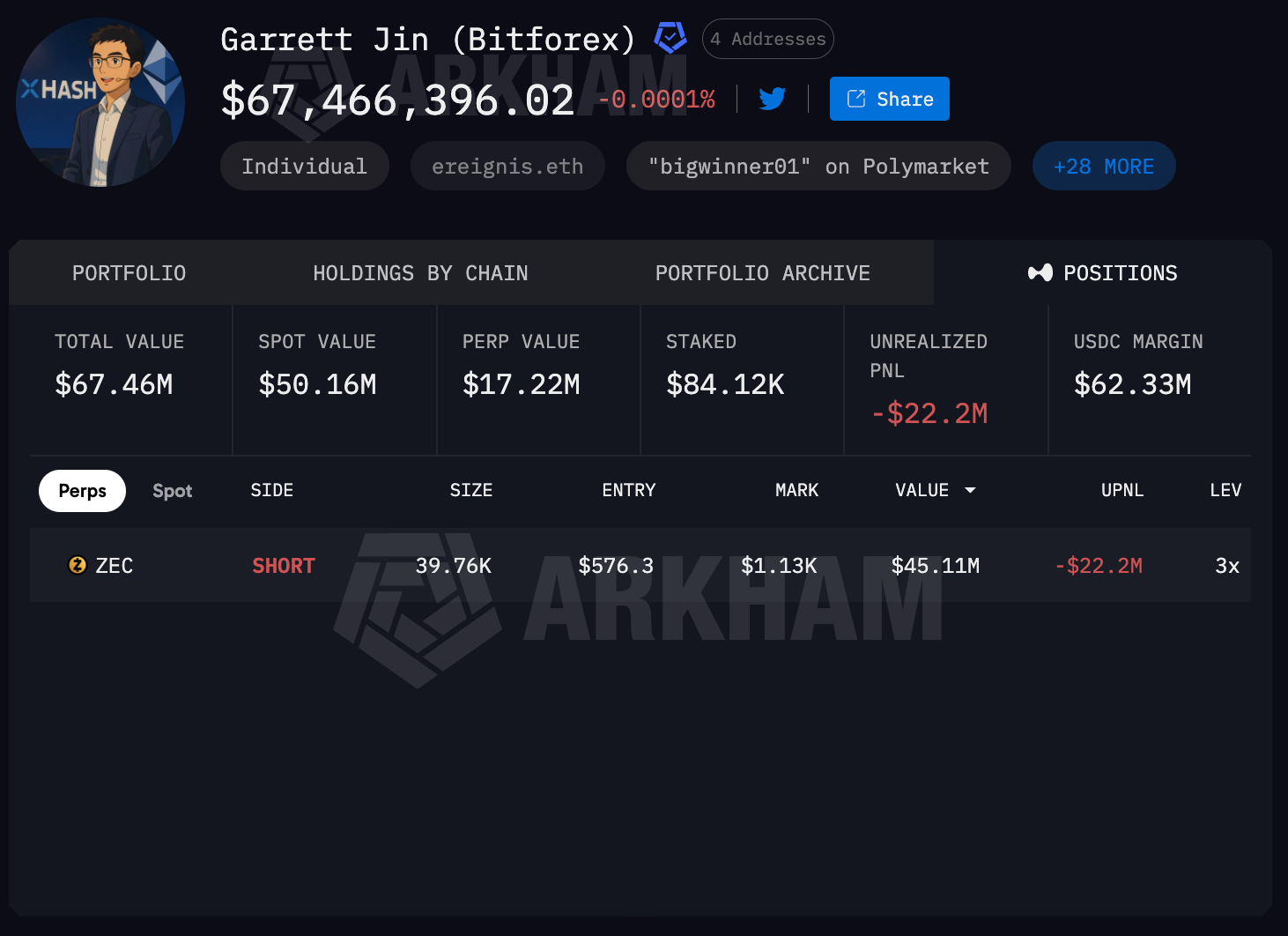
Wang was not the only high-profile figure taking a negative view. Odaily also pointed to trader Garrett Jin, described in the article as the “1011 insider whale agent,” saying he is now the largest on-chain ZEC bear.
According to the report, Garrett Jin closed a BTC long with a notional value of $106.18 million on the morning of Sept. 8 and then kept adding to his ZEC short.
He is currently short ZEC with 3x leverage on a position worth $45.11 million, with an average entry price of $576.3. The position is now showing an unrealized loss of $22.2 million. Even so, Odaily said he has remained firm and has added to the trade more than once while ZEC kept climbing.
A rally that has widened, not settled, the argument
ZEC’s move from roughly $250 to above $1,200 shows that a returning privacy narrative, fresh capital, and short-covering can outweigh concerns around fundamentals in the near term.
Odaily also made clear that neither Wang Chun’s criticism nor Garrett Jin’s short position can determine price by themselves. If market sentiment keeps heating up, ZEC could still push higher.
The harder question comes after a near fivefold rise. Odaily argued that it is increasingly difficult to explain the current price simply through an “undervalued” thesis. Once the squeeze loses force and profit-taking grows, the market may return to the same issues now being debated again: the launch mechanism, optional privacy, governance disputes, and the Orchard flaw.
The article ends there rather than with a price call. Its point is that what matters most may not be whether ZEC reaches $1,500 or $2,000 next, but how much premium the market is willing to leave on the asset after fast money retreats and short sellers are no longer forced to cover. That is likely to shape whether this run is seen as a revaluation of a legacy privacy coin or as a rally driven mainly by narrative and liquidity.