
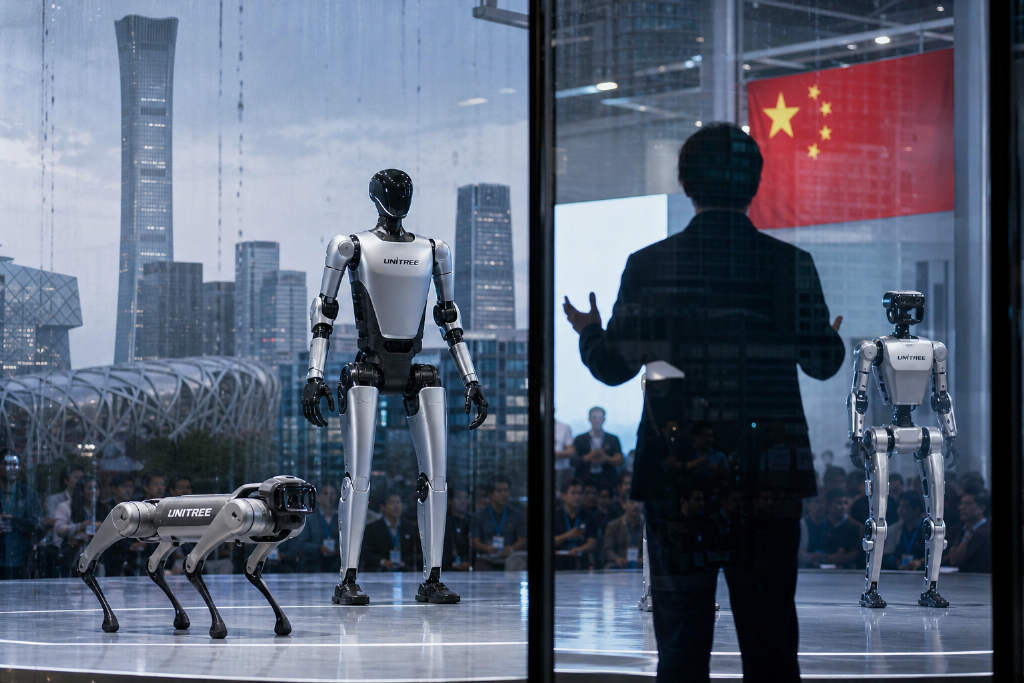
Unitree Robotics founder Wang Xingxing said the embodied AI industry could reach a ChatGPT-like inflection point in as little as two to three years, though he added it may take five to ten years depending on how quickly generalization improves.
Wang made the remarks in a speech titled From Exhibits to Products: The Next Decade of Humanoid Robotics at the 2026 World Robot Conference, one day after Unitree went public. He said robotics is entering a new starting point shaped by rapid progress in artificial intelligence, but argued that the biggest bottleneck at this stage remains the lack of generalization in embodied intelligence.
On the question of when general-purpose robots will truly enter homes, Wang said the core problem worldwide is still insufficient generalization. He offered a concrete benchmark: if a robot can be taken into an arbitrary unfamiliar environment and complete about 80% of tasks, that would be close to the “ChatGPT moment” for embodied intelligence.
Unitree’s 10-year path from quadrupeds to humanoids
Wang opened by revisiting Unitree’s development history. The company was founded in August 2016 and will mark roughly 10 full years by August 2026. It started with quadruped robots and moved into humanoid robots in recent years.
He highlighted G1, launched in 2024, as one of Unitree’s more successful products. In Wang’s view, G1 quickly became one of the representative products in the global humanoid field, and many humanoid robots now seen on the market share similarities with it in overall form and design thinking.
Earlier this year, Unitree appeared in the Spring Festival Gala performance WuBOT. Wang said the program combined Chinese kung fu and martial arts culture with humanoid robotics. The team collected dozens of representative kung fu movements in advance, trained the system with AI, and then put selected moves on stage. He described it as a strong example of technology blending with culture, and said the video performed very well overseas, possibly reaching tens of billions of views.
In February, Unitree also staged a demonstration at the Temple of Heaven, where about 49 robots performed in full automatic mode. Wang said the site’s centuries of history created a striking contrast, bringing together China’s cultural past and current technology in the same visual space.
He said Unitree has spent the past several years pushing robots into real-life settings and factory environments. In 2024, the company began working with auto plants on implementation projects and also deployed robots in its own factory for basic testing and use cases. Wang said most of the company’s AI teams are now focused on how robots can actually work in homes or factories.
As for why large-scale adoption has not happened yet, he pointed to two issues: robot efficiency and weak generalization. Current robots can already carry out some simple assembly work, but their efficiency still trails humans. At the same time, new tasks often require retraining, which drags down productivity even more. Wang said Unitree wants to improve generalization before pushing for broad deployment, and described that as a shared bottleneck across the global robotics industry.
He also said Unitree set a new humanoid robot running speed record in April. The robot was modified from H1, Unitree’s first-generation humanoid released in 2023. Wang called H1 the company’s first humanoid and one of its classic products. The team has continued to test different variants based on that platform, including wheeled structures for greater flexibility in some scenarios.
AI, data and real-world tasks
Wang said robots today are essentially driven by AI, and AI itself is driven by data. The amount of data available, especially high-quality data, determines how far AI capabilities can go. Unitree is collecting data on its own while also working with third-party companies to obtain more, both for its own use and for the industry.
He said training data for AI robots should rely on large volumes of human data or internet data as the main pretraining source, with real-robot data layered on top. In his view, both are necessary. Human data is larger in scale and more important, but real-robot data is still indispensable because the final system has to align with the physical world.
In May, Unitree released GD01, which Wang described as the world’s first mass-produced passenger-carrying transforming mech. He said the machine stands more than 3 meters tall and weighs about 500 kilograms with a rider. As for use cases, he compared it to an off-road vehicle rather than a machine aimed at homes or urban daily use. He said it is better suited to outdoor, complex, and transport-related scenarios, such as hiking or moving supplies across difficult terrain.
GD01 can also transform into a quadruped mode. Wang said that mode offers better stability and stronger obstacle-crossing ability, which is one reason Unitree was willing to put it into presale. He said the quadruped form already has relatively solid stability and terrain traversal capability, and described it in simple terms as a robot-shaped off-road vehicle.
In recent months, Unitree also demonstrated an end-to-end AI motion generation system built on a multimodal model. Wang said many robot motion demos in the past relied on movements collected and trained ahead of time, while this system can generate actions from real-time voice commands. At present, though, there is still a delay of several seconds because speech has to be recognized first, uploaded to the cloud for AI motion generation, validated, and then sent back to the robot.
He said the company wants future robots to generate actions fully in real time rather than depend on pre-programmed routines. Another feature of the current setup is that even with the exact same command, generated movements may vary slightly from one run to another. The same spoken instruction today and tomorrow may not produce identical motion.
Unitree is also pushing robots into routine settings such as conference rooms. Wang said meeting-room cleanup is a clear task with practical value, since company rooms can become messy. The training goal is for a robot to restore a room to a clean and orderly state even after it has been randomly disturbed.
He said this task is currently implemented in a fully end-to-end way, which means movement efficiency is still slow. It is not a single-task system, though. In that environment, Unitree set up about seven to eight different tasks and used one model to let the robot switch between them automatically and execute them directly, while keeping some resistance to interference. Because the AI has to perceive, generate and reason continuously in real time, motion is not yet smooth. Every step and every action still requires inference. Wang added that the demo video was a single take with no editing and included environmental interference.
On top of that, Unitree combined voice control with multimodal models so the robot could do more than just generate motion from spoken instructions. In the live demo, Wang said, the robot could identify the color of objects in front of it, determine the positions of different medicine boxes, and then retrieve the specified item based on a language command. That means it was not carrying out a fixed pre-set action; it had to understand language, recognize the environment, and then act.
Wang also discussed Unitree’s latest wheeled-quadruped robot, As2-W. He described it as lightweight, with a battery-included weight of about 25 kilograms, strong payload and endurance, and IP54 dust and water resistance for both indoor and outdoor scenarios.
He said Unitree has applied some of the technology accumulated in humanoid robots back into quadrupeds, with the aim of improving flexibility while also strengthening payload, endurance and adaptation to complex environments. The company hopes As2-W can eventually be used in outdoor hiking, transport and industrial settings.
At the same time, Unitree continues to upgrade lightweight humanoids such as R1 to improve mobility and agility. Wang said R1 offers relatively strong value for money and can already be purchased through JD.com and Taobao.
He also mentioned a newly shown robot that has been in development for only a little more than three months and is not yet an officially released version. Its top speed has reached 12.65 meters per second, he said, exceeding the peak running speed of the fastest athletes in human history. Based on current test results, its jump height has also surpassed the highest jump level in human history. Wang added that in 2025 he personally, the company’s products, and Unitree Robotics all appeared on related lists published by Time.
The core bottleneck: generalization and alignment with the physical world
Turning to embodied AI models, Wang said the main technical routes in recent years include VLA models and world models. This year, he said, world models have been one of the most discussed directions.
He said Unitree has consistently invested heavily in AI models and that this is now one of the company’s biggest areas for capital and staffing. Unitree began exploring video-generation-based world models as early as the start of 2020. By the end of that year, results were not especially strong, so the effort was paused for a period. Since last year, Wang said, the company has stepped up investment in that direction again.
He returned to a question often asked in the industry: when will truly general-purpose robots, whether humanoid or semi-humanoid, move into everyday life and households? His answer was direct. The biggest bottleneck, he said, is still insufficient generalization in embodied intelligence.
Many AI models can reach close to 100% success in fixed settings if they are trained with enough data, he said. But when the manipulated object changes even a little, or the environment changes slightly, success rates fall sharply.
That is why Wang believes the key threshold has not yet been reached. In his framework, if a robot can be taken into a completely unfamiliar setting, such as a home it has never seen before, and complete about 80% of tasks through voice or language instructions alone, then embodied AI will be close to its ChatGPT moment. He said that point would become the critical threshold for a real industry breakout.
He reduced the benchmark to a simple metric: in roughly 80% of unfamiliar scenarios, the robot should be able to complete roughly 80% of tasks through spoken or language instructions alone. Wang said that would be a very important threshold.
Why is the field still short of that level? One of the biggest constraints, he said, is that AI model inputs and outputs are not yet aligned closely enough with real robots and the physical world.
For example, when a robot is asked to move, assemble two items, or carry an object from one place to another, it often gets the broad direction right. It can usually understand the task and has a rough idea of how to execute it. The real problem is often in the last few centimeters, or even the last few millimeters.
When a robot reaches for something, its hand may appear to be almost in place, but it still cannot reliably correct the final touch feedback or final positional error. If that last bit of error is not corrected, the whole task may fail, and the success rate can drop in a very visible way.
Wang described this as one of the most central problems facing embodied intelligence globally: there is still a gap between AI model inputs and outputs and the real world.
He also explained why this issue is more pronounced in robotics than in language models or standard multimodal models. Language models work on digitally encoded content. Their inputs and outputs are constrained within a numeric or vector space, so errors do not accumulate in the same way.
Robots are different. Every input and output interacts with the physical world. Each action introduces some deviation and loss, and those deviations affect the next round of perception and the next action. Over time, the errors accumulate. Wang said that is one reason robot models still have not reached a high enough level of generalization or real-world task success.
He added that he believes the problem will be solved in the next few years, though it still needs time.
Using AI to rebuild robot R&D workflows
Wang also described a separate effort now underway at Unitree: pushing physical AI robot models toward self-evolution.
He said AI has already been used broadly for coding and many forms of AI development over the past several years, but that AI’s role inside robotics R&D workflows is still relatively limited. Unitree is trying to use frontier large models to drive robot development more directly.
The process, as he outlined it, starts by giving AI a set of rules, experience, constraints and tools. The model can then search for the latest papers, stronger research results and open-source approaches online, and write robot control code by itself.
Once the control code is generated, it can be run and trained in simulation first. It can also be linked with models and control systems and then deployed to real physical robots.
If that deployment reaches real machines, Unitree can run real-world tests and score the outcome. Part of the evaluation can be done by the robot AI model itself, Wang said, and another part can be done by humans. Human judgment still matters because people can often tell quickly whether an action was performed well.
If this logic can be systematized and kept running, he said, robot development efficiency would rise sharply and iteration would speed up. After the loop runs for some time, it could meaningfully improve a robot’s self-evolution capability.
Wang gave a simple example: a coding agent can write robot control code on its own. For relatively simple deep reinforcement learning algorithms, he said, automatic programming by a coding agent is already producing decent results.
From there, the code is tested and trained in simulation. Once performance reaches a certain level, it is deployed to a physical robot. After testing, AI models can score the result and human evaluators can also assign ratings. Those results are then fed back to the coding agent for another round of code generation and optimization, forming a continuing positive loop.
He added that this was only the simplest example, and that actual deployment would be much more complex. Even so, Wang said this is one of the most worthwhile directions for the global robotics industry now and over the next several years.
He gave four reasons for that view.
- First, foundation models improve every month and every year, and the self-evolution loop improves with them. In other words, the system can naturally get stronger as core AI capabilities advance worldwide.
- Second, it can make fuller use of diverse data. Manual data handling has low overall efficiency, he said. A self-reinforcing loop would let the system use training data, real-world data and human data together, with better efficiency.
- Third, it can form a closed loop with broader real-robot deployment. As more physical robots are deployed, the system can keep collecting new test data and more evaluation metrics, supporting both data utilization and data growth.
- Fourth, it can keep accumulating robot skills over time. New skills can be added daily or monthly instead of being built once and then wasted or rebuilt from scratch. Skills, data, control strategies and evaluation results can all accumulate in the same system.
Wang said using AI to materially raise robot development efficiency and evolutionary efficiency is highly important. In his view, it could become an important path for the continued evolution of physical AI robots and may open a new phase.
Near the end of the speech, Wang reflected on Unitree’s roughly 10-year journey. The company first attended the World Robot Conference around 2017 or 2018, he said, and the pace of change now feels much faster. With AI advancing quickly and global attention on robots running high, the speed of robot evolution has already accelerated. Wang added that future progress may come even faster than he currently estimates.
He closed by saying this is “a completely new starting point” and “a completely new beginning,” before thanking the audience.