
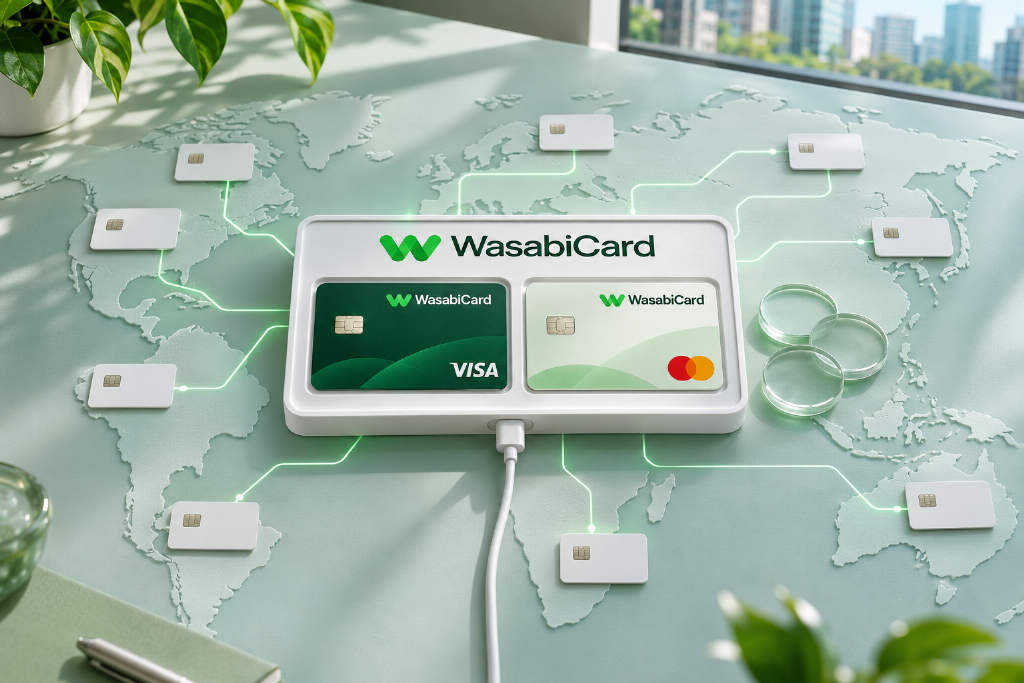
Stablecoin payments and card-issuing provider WasabiCard has launched WasabiCard Local Issuing Solution, allowing businesses to establish and manage local card programs across more than 100 markets through a single API.

The offering is built to accommodate regulatory compliance requirements in different markets. It also supports settlement in USDT, USDC and Open USD (OUSD), while giving businesses access to Visa and Mastercard commercial and consumer card program options.
One API for local card programs
Ray Yang, co-founder and chief executive officer of WasabiCard, said businesses expanding internationally have often had to issue cards in one market first and then hope the same model would work elsewhere. That approach can add friction around compliance, payment acceptance and costs, he said.
With Local Issuing Solution, companies can use one API to help their business customers establish local issuing programs in more than 100 markets. The product also gives them flexibility over stablecoin settlement, branded user experiences and payment methods that cardholders already know.
WasabiCard said the infrastructure behind the product has gone live through partnerships with local financial institutions in multiple regions. Businesses can use BINs from different markets and build card programs around local issuing systems.
Local issuing can reduce cross-border charges and foreign-exchange conversion costs, according to the product description. It is also intended to give businesses more competitive rates and a smoother payment experience.
Card and lifecycle management across markets
After completing a single API integration, a business can issue and manage cards across markets, oversee the card lifecycle and set control rules for its issuing program. The company can also use a local issuing structure suited to the requirements of each market.
After the required information is submitted and KYB, compliance and partner reviews are completed, account opening can take as little as 24 hours. Businesses can choose between enterprise BINs and individual BINs based on their needs.
Cardholders can use virtual or physical cards through Apple Pay and Google Pay. Businesses can also select a white-label service, embedding issuing capabilities into their own products and payment flows. That option allows them to offer the card experience under their own brand while adapting the program to local market requirements.
Stablecoin settlement with familiar card payments
Local Issuing Solution combines stablecoin settlement with card payments. WasabiCard supports USDT, USDC and Open USD (OUSD) for settlement at the issuing-program level, along with Visa and Mastercard commercial and consumer card programs.
Screening before funds can be spent
WasabiCard said compliance screening begins before deposited funds become available for spending. The company cross-checks blockchain data, reviews the source of funds and checks for links to known risks such as fraud and stolen assets.
Deposits directly linked to high-risk sources will be rejected. If a deposit has an indirect connection that requires additional review, it will be held before being credited while the compliance team evaluates the specific circumstances.
The process is intended to keep high-risk funds outside card programs while allowing legitimate activity to receive a fair review. WasabiCard said every decision is supported by an auditable record for issuing partners. The company described traceability and accountability as a basis for long-term trust.
Use cases from payroll to AI subscriptions
The product targets payment needs that arise as corporate teams, business platforms and digital services operate across borders. Its stated use cases include payments to global personnel and platforms, digital advertising, subscriptions to AI services, corporate procurement and employee expense management.
For personnel and platform payments, businesses can pay salaries or operating funds to Web3 team members, contractors and partners in different regions. Content platforms, livestreaming platforms and guilds can use the cards to settle creator income, commissions, revenue shares and incentive payments.
Human resources companies, staffing agencies and flexible-work platforms can also use the service to manage payments to employees and workers across regions.
For digital business spending, companies can create and manage cards in bulk by advertising account, team or marketing campaign for use on digital media platforms. Teams using cloud services, generative AI tools and AI agents can manage related subscription payments with cards, giving them a way to organize service expenses.
Businesses can also configure cards and budgets for procurement, everyday employee spending, travel and other operating expenses. These controls are designed to make the different categories easier to track and manage.
More than 700 enterprise customers
WasabiCard said it now serves more than 700 enterprise customers, with more than 700,000 cards issued and transaction volume exceeding $1 billion. Its business covers more than 200 countries and regions, and the company supports more than 70 card BINs.
WasabiCard describes itself as a global payments infrastructure platform. Its stablecoin-powered infrastructure provides issuing, global payout and cross-border payment capabilities to businesses, fintech companies and internet-native businesses.
The platform supports global issuing, multi-currency settlement, stablecoin funding and embedded payments. Its listed payment applications include advertising spend, AI tools and SaaS subscriptions, global payroll, treasury management and digital financial applications.
WasabiCard said updates on its products, partnerships and industry insights related to the future of stablecoin payments are available through its official X and LinkedIn accounts.
This article is for general information and educational purposes only. It does not constitute legal, tax, financial or other professional advice from WasabiCard and should not be used as a substitute for such advice. WasabiCard makes no express or implied representation, warranty or commitment regarding the accuracy, completeness, sufficiency or timeliness of the content. Suggestions for content updates can be sent to [email protected].



