

U.S. markets ended last week with a sharp reset in rate expectations after July nonfarm payrolls unexpectedly contracted, while AI investors rotated toward optical networking and software and away from storage.

The July payroll report showed a decline of 23,000 jobs, far below expectations for an 80,000 increase. Payroll data for May and June were also revised down by a combined 103,000, and the labor-force participation rate fell to its lowest level in more than five years. After the release, markets cut the probability of a September Federal Reserve rate hike from about 55% to 40%.
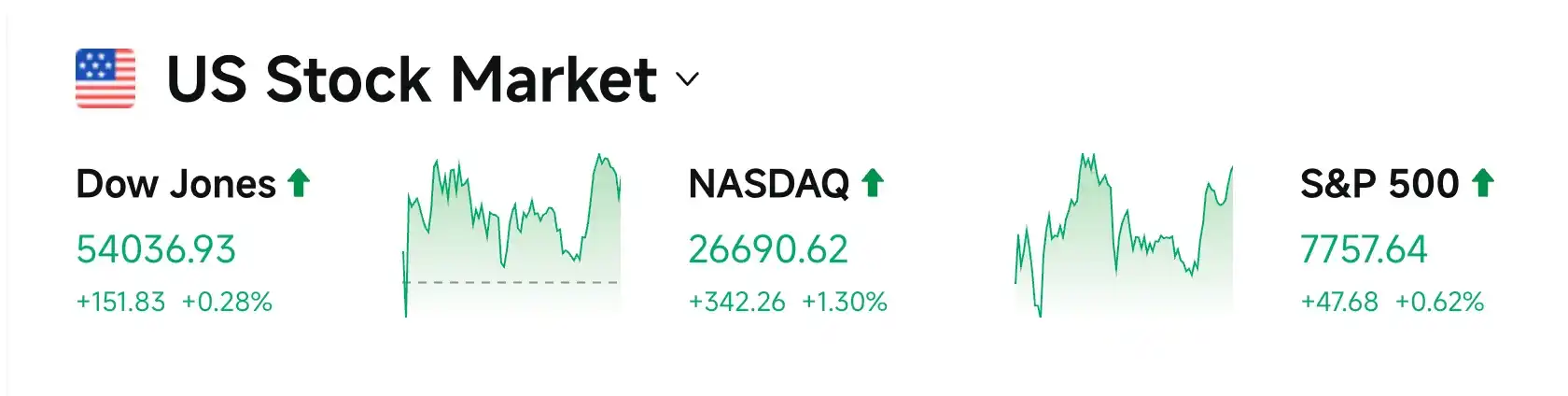
By Friday’s close, the Dow Jones Industrial Average had gained 0.28%, the Nasdaq rose 1.30%, and the S&P 500 added 0.62% to finish at another record closing high. Tom Siomades, chief market economist at AE Wealth Management, said weak employment would normally worry investors, but strong earnings are currently driving pricing.
Attention shifts to Wednesday’s U.S. CPI report
With payrolls out of the way, investors are now focused on U.S. July CPI due Wednesday. A Reuters survey expects headline CPI to slow to 3.4% year over year from 3.5% in June, while core CPI is seen easing to 2.5% from 2.6%. FactSet pointed to a similar direction.

Citi said a second straight softer core inflation reading would effectively remove a September hike from the picture. Bank of America, though, warned that core services inflation could rise 0.3% month over month, meaning the hiking option cannot be fully dismissed.
Oil picks up a geopolitical premium as U.S.-Iran talks fail to reach a final deal
Weekend talks involving the United States and Iran did not produce a final agreement. Iran and Oman said a new shipping route was “very close,” but Iran tied reopening the strait to sanctions relief, the release of assets, an end to the blockade, the removal of military threats, and compensation for losses. Trump told Axios that Washington is handling the matter “quietly,” leaning on economic pressure and a semi-negotiation state rather than rushing into military escalation.
At the same time, a personnel change involving the secretary of Iran’s Supreme National Security Council, a claim by the Houthis that they struck the Jizan refinery in Saudi Arabia, and an attack on a UAE oil tanker all added to oil’s move higher on Monday. Brent crude briefly climbed more than 2% above $84, while WTI traded near $78. Goldman Sachs still sees a fair Brent range of $80 to $90, but said prices are likely to keep swinging with geopolitical headlines until a formal agreement is reached.

Gold extends its rally, silver posts a strong weekly gain
Precious metals remained firm. Spot gold rose 2.3% on Friday to move above $4,300, with an intraday move through $4,370. For the week, gold gained more than 7%, its best weekly performance of the year. Silver rose about 3% on the day and finished the week up 10%.
Since July 20, global gold ETF holdings have increased by 24 tonnes. UBS said gold could reach $5,000 in the first half of 2027.
“Short memory, long optics” becomes a live debate in AI infrastructure
Capital inside the AI trade shifted again last week. Software, optical communications and broader AI infrastructure names outperformed, while storage and memory stocks came under pressure. Coherent rose 13.44%, AAOI gained 9.2%, Credo added 8.45%, Lumentum climbed 6.22%, and Corning advanced 5.4%. On the other side, Seagate fell 4.71%, Western Digital dropped 3.8%, SanDisk lost 3.68%, SK Hynix fell 3.9%, and Micron slipped 0.44%.
The market has started openly debating a “short storage, long optical” trade. Jukan, previously bullish on storage, turned cautious in the short term, citing redemption pressure in Korean leveraged ETFs, the possibility that Rubin Ultra may lower HBM content per rack, and concern that storage pricing could peak over the next two quarters. Serenity, known in the market as “white-haired stock god,” argued that storage fundamentals have not fundamentally changed and that investors are simply rotating from one bottleneck to another.
Goldman Sachs TMT trader Peter Callahan described the move as a structural revaluation within AI infrastructure. In his view, network traffic generated by AI agents is now exceeding human traffic, optical components are outperforming storage, and enterprise AI budgets continue to expand. The Nasdaq 100 rose 5% last week while the VIX eased to around 14, showing a renewed appetite for risk.
Software joins the rebound as earnings beat rates stay high
Software stocks also staged a strong rebound. Atlassian surged 35% after earnings, while Palantir climbed nearly 40% for the week. The software group is up 19% over the past two weeks, its strongest two-week run since 2020.
So far, 436 S&P 500 companies have reported results, and 85.1% have beaten analyst profit expectations, well above the long-term average. GPUs, optical modules, power, networking equipment and software applications are emerging as the main areas where investors are seeing earnings confirmation.
Key stock moves and company-specific developments
SpaceX
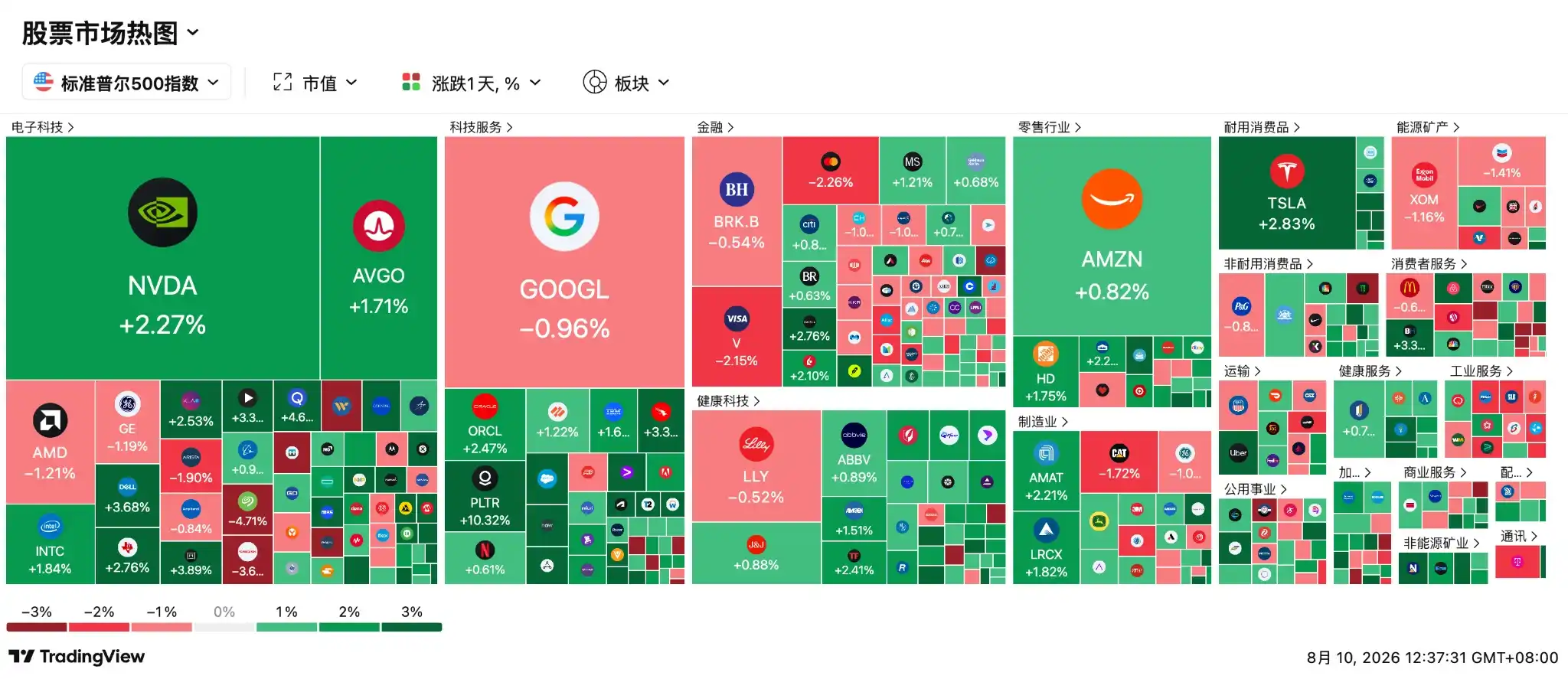
SpaceX rose 15.83% on Friday and gained about 23% over two sessions. A large lock-up expiration had been seen as a potential source of selling pressure, but the move instead turned into a short-covering rally. Tradable shares increased from about 639 million to 1.55 billion, yet the stock moved back toward its $135 IPO price. More than 250 million shares remain short, and options volume reached 2.24 million contracts, including 1.3 million calls, a record high.
Palantir
Palantir rose 10.32% and nearly 40% for the week. Its U.S. commercial business grew 149% year over year, while total contract value in U.S. commercial operations topped $2 billion in the second quarter, up 153% from a year earlier. Deutsche Bank upgraded the stock to Buy, with its sovereign AI positioning receiving institutional support.
Nvidia
Nvidia added 2.27% and finished the week up more than 11%. Alongside ongoing support from the AI capex cycle, the market is also focusing on a reported $2 billion investment in AI data-center power developer Lancium, with another $1 billion to be added after extra power-access milestones are met, bringing the potential total to $3 billion. Lancium has already locked in 4 GW of power resources in Texas. The move suggests the AI arms race is spreading from chips into power infrastructure.
Optical communications
Optical communications has become the market’s new AI hardware focal point. Coherent rose 13.44%, AAOI gained 9.2%, Credo added 8.45%, Lumentum climbed 6.22%, and Corning rose 5.4%. The trading logic is shifting from HBM capacity expansion toward high-speed interconnect across racks and 800G/1.6T optical communications.
Callahan said optical names have outperformed storage stocks by more than 20 percentage points since the third quarter began. Coherent has now risen for seven straight sessions, gaining 73% over that stretch. Earnings from Lumentum and Coherent this week will be a key stress test for real AI optical-module demand.
Storage and memory
Storage shares stayed under pressure. Seagate fell 4.71%, Western Digital lost 3.8%, SanDisk dropped 3.68%, SK Hynix declined 3.9%, and Micron was down 0.44%. The market is worried that the storage pricing cycle is getting close to a peak, while deleveraging in Korean leveraged ETFs may increase short-term share supply across chip names. Citi’s cut to Micron’s price target added to concern over where DRAM and NAND pricing goes next.
Apple and ChangXin Memory
Apple rose 0.29%. The Wall Street Journal reported that Apple is testing memory chips from ChangXin Memory for use in iPhones and MacBooks as it tries to ease memory shortages tied to the AI boom. The report also said Apple has started preliminary talks with ChangXin Memory on component supply, targeting the use of those chips in some devices sold in China.
Berkshire Hathaway
Berkshire returned to net stock buying in the second quarter, purchasing $23.5 billion in equities and selling $3.7 billion, its first quarter of net equity buying in more than three years. As of June 30, Alphabet had become Berkshire’s largest holding, followed by American Express, Apple, Bank of America and Coca-Cola. The market read the move as an important sign that the Buffett system is increasing equity risk exposure again.
Other major names
Google fell 0.96% after a major internal restructuring. DeepMind CEO Demis Hassabis moved into a chairman role, and day-to-day management authority was shifted to accelerate Gemini commercialization, a move that triggered internal cultural disruption. Tesla rose 2.83% and launched the $16.8 billion Terafab project together with SpaceX.
What the market is watching this week
Monday, Aug. 10
- Unitree begins subscriptions for its STAR Market listing. It is one of the most closely watched humanoid robot IPOs of the year, and the strength of demand is expected to reflect risk appetite across China’s robot supply chain, including reducers, servo motors, sensors and controllers.
- ChangXin Technology’s inclusion in the MSCI China All Shares Index takes effect after its IPO listing. The market is watching passive fund flows and whether sentiment spills over into the domestic storage supply chain. The Apple testing report has also added attention to local DRAM, packaging and testing, equipment and materials names.
Tuesday, Aug. 11
- 12:30 p.m. RBA rate decision; 1:30 p.m. press conference by RBA Governor Michele Bullock. Markets broadly expect the cash rate to stay at 4.35%, with attention on whether cooling inflation, softer employment and property risks prompt any signal on future rate cuts.
Wednesday, Aug. 12
- Lumentum, CoreWeave and Super Micro Computer are scheduled to report after the U.S. close. Results and capex guidance from Lumentum and CoreWeave will test real AI infrastructure demand. For Super Micro, gross margin expectations of 15% to 17% and order conversion will shape sentiment around AI servers.
- Monthly reports from the U.S. EIA, OPEC and the IEA are due. Together they will test the outlook for global crude supply and demand, inventories, OPEC+ discipline and consumption trends.
- 8:30 p.m. U.S. July CPI. The market expects headline CPI to slow from 3.5% to 3.4% and core CPI to ease from 2.6% to 2.5%. A softer number would likely cool September hike bets further, while a hotter print could force a repricing of tightening risk and pressure U.S. equity valuations, especially in AI and tech.
- 8:00 p.m. Tencent’s second-quarter earnings call. Investors are focused on game recovery, video-account ad monetization, fintech margins, AI capex, the Hunyuan model, Yuanbao and WeChat AI features.
- Unitree’s IPO payment process will also stay in focus as another gauge of sentiment in robot-related names.
Thursday, Aug. 13
- Cisco, Coherent and Cerebras report after the U.S. close. Cisco will test AI demand for networking gear, while Coherent will test conditions in high-speed optical communication and 800G/1.6T modules. Strong orders, margins and guidance could keep the long-optics trade going. A miss could trigger profit-taking after recent sharp gains.
- 6:00 a.m. Google product launch event. The market expects the Pixel 11 series, Pixel Watch 5 and Pixel Buds Pro, with attention on Tensor G6 and deeper Gemini integration.
- 8:30 p.m. U.S. July PPI. The report will show whether corporate cost pressure is still passing through to end demand.
- 9:00 p.m. SanDisk investor day. The market is watching NAND supply and demand, enterprise SSDs, capex, high-bandwidth flash roadmaps and long-term margin goals. Because storage shares have recently weakened, SanDisk’s tone could directly affect Micron, Western Digital, SK Hynix and related China-listed names.
- JD.com’s second-quarter earnings call, as well as results from SMIC and Hua Hong Semiconductor, are also on the calendar.
Friday, Aug. 14
- Deadline for U.S. SEC 13F quarterly holdings disclosures. The filings will reveal long equity positions held by hedge funds and other institutions as of June 30. Investors will be watching whether large institutions increased exposure to AI, optical communications, power, energy, gold and financials. The disclosures lag by about six weeks and only cover long positions, but they remain an important window into style rotation.
- Applied Materials reports after the U.S. close. The market is focused on demand for DRAM, advanced packaging and wafer-fab equipment, as well as order trends in China.
- Bill Gates will visit South Korea and hold talks with SK Group and HD Hyundai on SMR cooperation. Investors are watching how nuclear power and small modular reactors may tie into power demand from AI data centers.