
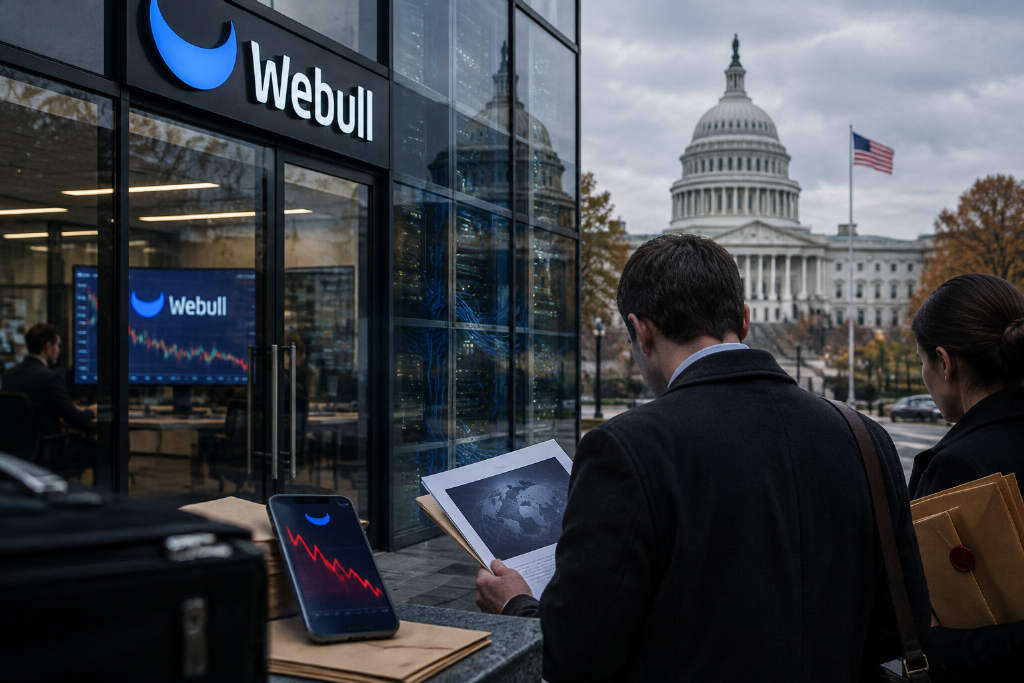
A bipartisan U.S. House Select Committee on China released a report on Oct. 7 alleging that online brokerage Webull is structurally tied to the Chinese government through its ownership structure, technical personnel, data transfers and financing arrangements, and that those links pose a national security risk to the U.S. financial system. CNBC obtained the report exclusively.
According to Yahoo Finance pricing cited in the story, Webull shares fell as much as 24% intraday, dropping from the previous session’s close of $7.28 to $5.51.
Committee says Webull’s public positioning differs from its actual control structure
The committee said Webull has presented itself publicly as a U.S. company, but that there is a "huge gap" between that image and the company’s actual control structure. The report said, "Webull’s ownership structure, technical personnel, technical infrastructure, cross-border data transfers, corporate financing, and compliance architecture are structurally tied to the People’s Republic of China."
The report argued that Webull’s software development, data pipelines and core engineering depend on infrastructure governed by Chinese law, and that Chinese law can require companies to cooperate with the government, including by handing over data.
Employee disclosures and operating footprint drew scrutiny
The committee also accused Webull of making inaccurate statements about its workforce. According to the report, Webull initially told the committee that it had no offices or employees in China and that all employees were in the United States. The committee said the company’s operations remain concentrated in China and that its Hunan subsidiary, Hunan Weibu, had grown to 863 employees, representing 62% of Webull’s global workforce.
The committee had previously sent a letter to Webull’s chief executive in 2024 seeking information.
Report says risk increased after Webull began directly holding customer cash
The report said national security concerns had increased since Webull began directly custodying customer cash in October 2025, creating what it described as a structural exposure involving billions of dollars in U.S. funds.
Committee Chair John Moolenaar said in a statement: "Webull’s use of mainland Chinese technology vendors, combined with a China-linked and opaque ownership structure, exposes data to our foremost adversary, and investors should take that information into account when deciding whom to do business with."
Webull rejects the report
A Webull spokesperson said, "It is deeply disappointing that the Select Committee released a report that is materially inaccurate and unsupported in its conclusions without first verifying the facts with Webull."
The spokesperson said Webull’s U.S. business is run from its global headquarters in St. Petersburg, Florida, and its New York office. The company said U.S. customer data is stored in the United States, and access to sensitive customer data is controlled in the United States. Webull also said it is willing to answer any questions with the same level of transparency it provides to the U.S. Securities and Exchange Commission and the Financial Industry Regulatory Authority.
Company background
Webull was founded in 2016 by Wang Anquan, who previously worked at Alibaba and Xiaomi, and is listed on Nasdaq. The company says it has 28 million users globally, operates in 18 markets, and offers trading in stocks, ETFs, options, futures and digital assets. The report identified Robinhood, Charles Schwab and E-Trade as its main competitors.