

Week 37 put inflation, oil and AI earnings on the same trade line
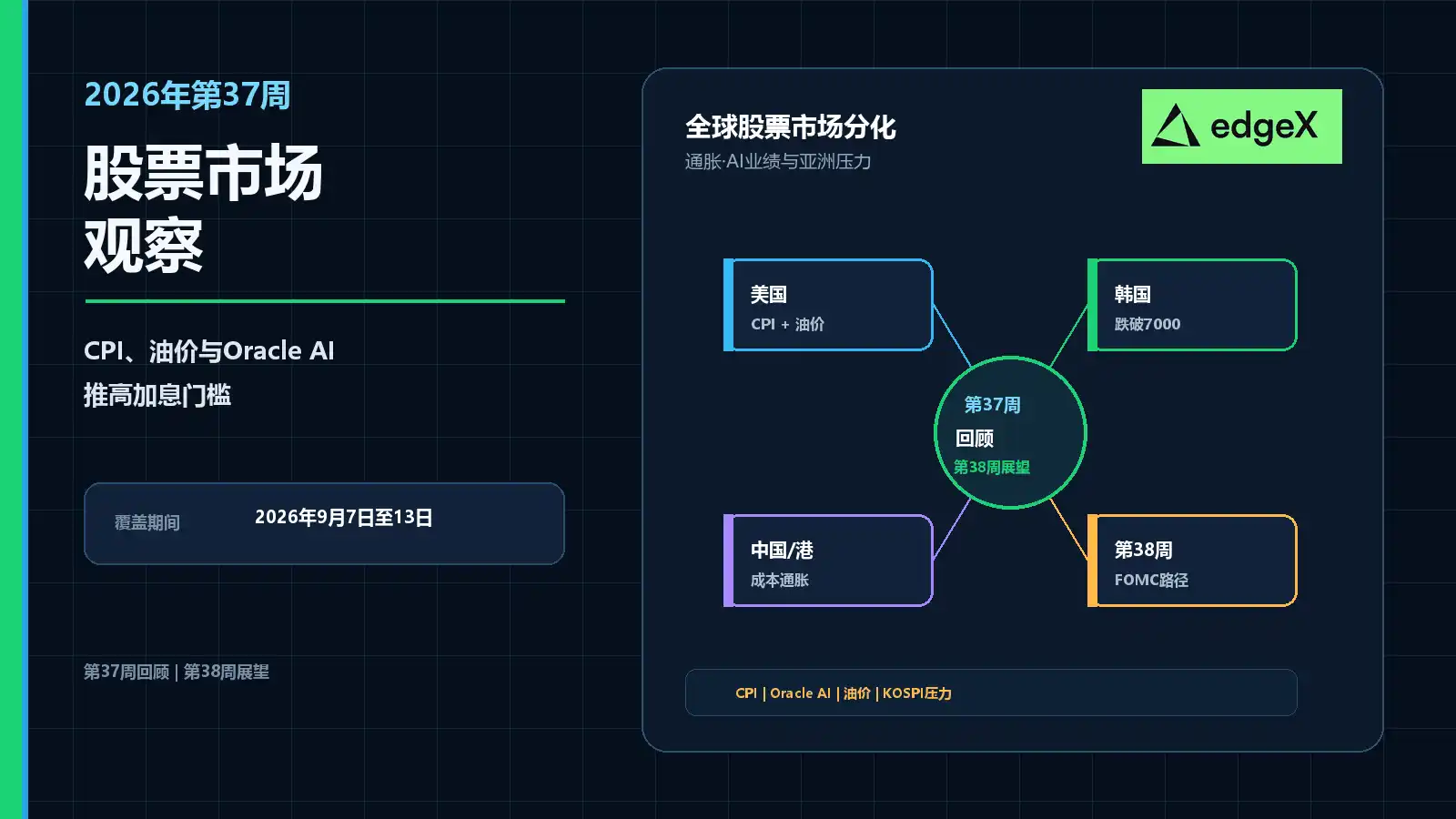
Week 37, covering Sept. 7-13, 2026, was a holiday-shortened trading week in the United States. By the end of it, equities were lower after investors shifted toward a firmer view of the Federal Reserve’s September path, with oil, producer prices and consumer inflation all feeding into that move.

The week’s central question was no longer a single data release. It became a linked pricing exercise across inflation, energy, rates and technology earnings. Before the U.S. inflation data arrived, investors were effectively testing whether price pressure had cooled enough to reduce the policy burden. What they got was not a clean all-clear. Instead, markets were left with a more durable message: rate pressure remained in place, oil was still adding input-cost stress, and big technology still had support from company-specific AI results such as Oracle’s.
That left a mixed picture. AI earnings strength held up through a hawkish inflation week, but it did not protect index-level returns. Oracle’s triple-digit cloud infrastructure growth reinforced the case that AI capital spending is still translating into real demand. At the same time, August U.S. PPI and CPI readings, crude oil pushing above $100 a barrel and equity fund outflows lifted the discount-rate hurdle going into the September Federal Open Market Committee meeting.
That is why the opening setup for Week 38, covering Sept. 14-20, is not an open-ended AI rerating. It is a policy decision week. The FOMC path, yields and any easing in Asian market pressure will determine whether selective AI leaders can broaden out into the global market.
U.S. indexes rebounded on Friday but still finished the week lower
U.S. equities spent most of the shortened week giving back prior gains. Rising yields and higher crude prices were the main drags. Higher yields increased valuation pressure through the discount rate, while stronger oil forced investors to rethink how quickly inflation could cool.
By Friday, the consumer price index matched consensus on the headline figure and oil pulled back somewhat, allowing stocks to recover part of the week’s losses. Even so, the move looked more like a repair after several down sessions than a rejection of the broader macro pressure that had built through the week.
At Friday’s close, the S&P 500 stood at 7,656, up 0.86% on the day. The Dow closed at 52,657, up 0.98%, the Nasdaq ended at 26,333, up 0.96%, and the Russell 2000 finished at 2,903, up 0.45%. For the week, the S&P 500 fell 0.8%, the Dow lost 1.6%, and the Nasdaq slipped 0.7%. A weekly note cited by Seeking Alpha said the S&P 500 closed at 7,656.98, about 1.8% below its Aug. 13 record high.
Taken together, those numbers show that Friday’s rebound stopped the slide from extending in a straight line and ended a four-session losing streak. It did not change the weekly direction. Indexes still ended below the prior week’s level, and the retreat from record highs remained visible. The issue for investors was not whether buyers appeared on Friday. It was whether that buying could offset the combined pressure from oil, yields and Fed tightening expectations. The answer remained cautious.
South Korea broke below 7,000 as Hong Kong and mainland China stayed under pressure
Asia did not get meaningful relief either. South Korea saw the sharpest pressure among the region’s equity markets. The KOSPI closed at 6,909.91 on Sept. 11, down 1.76% on the day and below 7,000 for the first time in months. Samsung Electronics fell 3.9% and SK Hynix dropped 3.4%.
The move showed that the pressure was not confined to one stock or one industry. Oil, hotter U.S. inflation and near-certain pricing for a Fed rate increase were all moving through the market at the same time. South Korea faces input-cost stress when crude rises because it is an energy importer. Its chip exporters are also highly sensitive to global rates, dollar conditions and technology demand expectations. That meant energy-import pressure and export-valuation pressure landed together in the same session.
Foreign flow and the won added to the pullback, underscoring that cross-border investors were not treating AI-linked memory names as safe havens against a macro shock. Even with their place in the AI supply chain, theme strength did not make the benchmark index immune.
Hong Kong equities also finished the week lower. Trading Economics showed the Hang Seng near 24,806 on Sept. 11, down 0.60% on the day and clearly below the previous Week 36 Friday close of 25,651. Session commentary also showed the Hang Seng down about 0.66% on Friday, while the Shanghai Composite fell about 1.20%, with onshore pressure running deeper than offshore weakness.
That distinction mattered. It suggested the selloff was not only about global sentiment spilling into the region. It also reflected a heavier mainland response to the combination of cost pressure and growth uncertainty. In mainland China, August CPI rose 0.8% year over year and PPI increased 3.8%, but the report did not provide a clear, verified signal of household-demand recovery. Energy and commodity effects explained more of the price move than a broad consumer rebound.
For investors, that difference is important. If inflation is driven mainly by energy and input costs, margins may come under pressure before revenues improve. Only a genuine improvement in household demand is more likely to support both top-line recovery and market breadth.
Week 37 global stock dashboard
| Market | Week 37 evidence | What it meant |
|---|---|---|
| S&P 500 | Down 0.8% for the week; closed at 7,656.98 after a 0.86% Friday rebound | AI support and Friday’s recovery did not offset oil, PPI and rate-hike pressure |
| Nasdaq Composite | Down 0.7% for the week; rose 0.96% on Friday to 26,333 | Cloud and AI earnings remained credible, but duration valuations still paid a higher rate cost |
| Dow Jones Industrial Average | Down 1.6% for the week; gained 0.98% on Friday to 52,657 | A broader sector mix absorbed more of the oil and yield shock than pure AI beta |
| KOSPI | Closed at 6,909.91 on Sept. 11, down 1.76% and below 7,000 | Oil, flows and Fed rate expectations outweighed the global AI demand story |
| Mainland China | Energy-driven CPI at 0.8% and PPI at 3.8%; no consistently verified full-week index percentage | Cost inflation appeared, but there was no clear consumer-led equity confirmation |
| Hang Seng | Near 24,806 on Sept. 11 versus the Week 36 close of 25,651 | The offshore benchmark reversed the prior week’s repair under global yields and China pressure |
Oracle kept the AI infrastructure case alive under higher discount rates
Oracle’s fiscal first-quarter release offered the clearest company-level AI test of the week. In a market repricing long-duration growth assets at a higher discount rate, the significance of the report was not simply that the AI story still existed. Oracle showed, through confirmed revenue growth, cloud acceleration and backlog, that AI infrastructure demand is showing up in enterprise orders and financial results.
Total revenue came in at $19.35 billion, up 30% year over year. Cloud revenue rose 62% to $11.6 billion, and cloud infrastructure revenue jumped 121% to $7.4 billion. Adjusted earnings per share were $1.92, also up 30%. Remaining performance obligations climbed to $664 billion, up $209 billion from a year earlier, and the company added more than $30 billion in AI cloud contracts.
Those figures extended the market’s focus beyond current-quarter confirmation and into forward revenue visibility. In other words, hyperscale and AI-related demand was not just helping present growth. It was also building a longer runway through backlog and new contracts.
Oracle shares rose about 7% after hours, a sign that investors first rewarded the combination of AI cloud orders, cloud infrastructure growth and full-year revenue guidance. That reaction did not mean the market had fully absorbed the cost of funding this buildout. Free cash flow was negative $5.4 billion, and capital expenditure was about $28.5 billion to $28.6 billion, showing Oracle remains in a heavy investment phase.
The company raised the floor for full-year revenue to at least $90 billion and guided for second-quarter revenue growth of 30% to 34%. That mix lowered concern over a sudden drop-off in AI capital spending because orders, revenue and management’s outlook all pointed to continued demand. It did not remove the other side of the debate: heavy capex can amplify free-cash-flow pressure in a higher-rate setting and keep valuations sensitive to execution, financing conditions and future profit delivery.
Earnings certainty improved, but index certainty did not
Oracle strengthened confidence that hyperscale demand is still turning into cloud revenue and backlog. That matters for AI trading because it moves the question from whether capital spending will continue to whether that capital spending is already tied to visible revenue.
For large U.S. suppliers, Oracle’s data still supported the earnings-duration argument. As long as AI cloud demand continues to convert into contracts, remaining performance obligations and infrastructure revenue, companies in that chain can still argue that their multi-year profit path has not been fully discounted away.
That company-level certainty does not automatically create index-level certainty. South Korean memory names remain exposed to flows, oil and the won. Even if stronger AI demand helps the memory cycle, external liquidity and currency pressure can dilute the equity response. Hong Kong technology shares remain sensitive to offshore liquidity. Mainland Chinese technology stocks still need local order confirmation. Regional markets are still short of a synchronized fundamental and flow backdrop.
That is why Week 37 looked the way it did: stronger AI evidence at the company level, but weaker participation and weaker confirmation at the global index level.
Inflation and oil forced a fresh look at discount rates
August price data was the key macro event for U.S. equities because it directly changed expectations for the policy-rate path, Treasury yields and equity discount rates. Producer prices rose 0.4% month over month and 5.4% year over year. Friday’s CPI report showed headline inflation up 0.4% month over month and 3.4% year over year, in line with expectations. Core CPI rose 0.3% on the month and 2.4% on the year.
By itself, that inflation set may not have been enough to rewrite the market narrative. Combined with oil moving higher at the same time, it sent a firmer message. The disinflation process can still be restrained by energy prices, and that gave the Fed more room to keep a tighter stance. The probability of a September hike was pushed to about 90%, while the 10-year Treasury yield held near 4.975%.
For equities, that meant the market had to reprice not only earnings expectations but also the valuation side, where a higher risk-free rate and higher capital costs weigh directly on multiples.
Oil’s role in this repricing was at least as important as the inflation prints themselves. WTI settled at $100.05 on Friday and Brent at $104.61. Both benchmarks were up about 8% for the week. Middle East-related developments continued to embed a risk premium in crude, making it difficult for investors to treat the move as noise. Even though Friday’s retreat in oil helped stocks recover, the level of energy costs still altered expectations for future inflation, corporate margins and the policy reaction function.
At the same time, growth had not disappeared. The data did not point to a simple recession trade. Capital costs were rising, though, leaving equities with a more complicated setup: economic activity still had support, but future cash flows had to be valued using a higher discount rate. The University of Michigan consumer sentiment index stood at 47.8, and one-year inflation expectations were 4.6%, reinforcing a cautious tone in the household sector.
Fund flows confirmed a reset in risk appetite
A Friday market summary cited Lipper data showing net sales of $32.27 billion from stock funds, the biggest weekly outflow since mid-December 2025. Large-cap funds accounted for a record $40.44 billion in outflows.
That flow pattern confirmed that the reset in risk appetite was not only showing up in price volatility. Investors were actively cutting equity exposure, especially in large-cap shares. If the FOMC delivers another rate increase while yields are already elevated, that policy shock would land on a market that has already started to de-risk, not one with abundant risk-absorbing capacity.
For investors, the implication is straightforward. Index-level pressure can persist even while select AI stocks keep outperforming on their own earnings narratives, expectations or concentrated flows. Stock-specific strength and index-level distribution can exist at the same time, and Week 37 showed exactly that.
Asia still needs demand confirmation beyond the AI transmission channel
China’s midweek inflation mix did more to clarify the source and intensity of cost pressure than to prove that end demand has recovered. According to reporting tied to the National Bureau of Statistics, August CPI accelerated from 0.5% to 0.8% year over year, while PPI rose from 3.5% to 3.8%.
The structure was the important part. Consumer-price gains were mainly driven by energy. Food prices stayed soft, and producer-price increases reflected commodity moves more than a broad improvement in household demand feeding through into corporate pricing power. That helps explain why the prior recovery in Hong Kong reversed and why mainland equities were already showing fragility before a deeper onshore decline on Friday.
What regional markets saw was not a repricing built on a broad China demand recovery. It was a transition phase that still needs more evidence. As Week 37 closed, the key unresolved question in Asia remained the same: ahead of the FOMC week, markets need confirmation outside the AI channel before they can judge whether regional risk assets have a firmer fundamental base.
KOSPI below 7,000 highlighted the transmission from oil to equities
With Samsung Electronics and SK Hynix leading the drop and the index falling through 7,000, the KOSPI became the clearest regional stress marker in Asia. The issue for South Korea was not only that semiconductor leaders sold off. The economy also has meaningful exposure to imported energy costs. When Middle East supply risk pushes oil higher, that external shock can move through trade terms, corporate margins, inflation expectations and risk appetite, then show up in equities, the currency and foreign-investor positioning.
Oracle and the broader AI infrastructure demand story still support the longer-term earnings case for memory chips and provide a medium-term narrative for Samsung Electronics and SK Hynix. That longer-duration earnings logic, however, does not automatically stabilize South Korea’s market in a setting where oil is up about 8% for the week and the probability of a U.S. rate increase is near 90%.
For investors, the AI demand story is still there. When energy shock and rate expectations rise together, though, South Korea is more likely to reflect the macro pressure first.
How Week 37 changed the global stock-picking framework
AI earnings strength and inflation pressure kept pulling global equities in opposite directions. On one side, Oracle’s results and guidance reinforced confidence that AI infrastructure demand is continuing, allowing investors to pay for earnings duration in that segment. On the other, CPI, PPI, oil and fund outflows all pointed to tighter financial conditions, with higher discount rates and higher capital costs weighing on broader equity valuations.
That left regional allocation as a balancing act rather than a simple risk-on trade. The U.S. market still leans on a longer earnings realization cycle. South Korea carries higher memory-cycle beta. Mainland China still needs evidence that demand is flowing through to corporate revenue. Hong Kong remains more tightly bound to liquidity conditions and capital direction.
A healthier and more durable global equity rally would normally require several conditions at once: gains in the U.S. broadening beyond the largest AI leaders, South Korean breadth improving after the drop below 7,000 rather than relying on a handful of heavyweights, and stronger consumer demand in China proving that price and income improvement is coming from end demand rather than cost-push inflation. Week 37 did not meet that standard.
Week 38 outlook: FOMC, global tightening and Asian stabilization need to widen the signal
Week 38 runs from Sept. 14 to Sept. 20. The main test is whether the shock triggered in Week 37 by firmer inflation and higher oil turns into a multiweek valuation repricing, or starts to stabilize once the FOMC decision is delivered. For Asia, an equally important question is whether the earlier pullback in the KOSPI and Hang Seng can be repaired without another leg up in crude.
The base case is not a full recovery in risk appetite. It is selective volatility around a widely expected U.S. rate increase. Oracle’s data still gives part of the growth complex support through the AI demand chain, but elevated yields and energy risk continue to limit the width of any valuation expansion. In that environment, markets are more likely to reward sectors with stronger earnings support and higher certainty than to re-rate the whole market together.
The U.S. calendar centers on the Sept. 15-16 FOMC meeting, followed by retail sales, industrial production, regional manufacturing surveys and jobless claims. With the S&P 500 down 0.8% for the week and the 10-year Treasury yield near 5%, even a hike that is already priced in can still trigger a fresh move in risk assets through the statement, the dot plot or the press conference language on inflation, oil and the chance of further tightening.
If the Fed delivers what the market expects and real yields stay controlled, high-quality growth shares and AI infrastructure-linked assets may stabilize because investors would conclude that the discount-rate shock is not broadening. If the decision or communication is more hawkish than expected, or if oil jumps again, market leadership could narrow further and flows could concentrate in a smaller group of names seen as able to withstand rate and cost pressure.
In South Korea, the won, foreign-investor flows and chip leaders will test whether Oracle’s demand signal can carry into memory semiconductors without being canceled out by energy and currency pressure. In China and Hong Kong, activity data and liquidity conditions will show whether energy-driven CPI and PPI readings lead to better policy support and earnings expectations, or keep squeezing margins through the cost side.
Week 38 decision map
| Week 38 scenario | U.S. equities | South Korean equities | Mainland China and Hong Kong |
|---|---|---|---|
| Rate hike delivered, yields stable, oil eases | AI and high-quality leaders stabilize; breadth can improve if credit holds | Chip and export shares repair if the won and flows stabilize after the break below 7,000 | Lower global rate pressure helps Hong Kong; mainland China still needs demand proof |
| Hawkish FOMC language and higher real yields | Earnings leaders outperform while duration and small-cap multiples face pressure | Memory chips may stay relatively firm, but oil and outflows limit index repair | Hong Kong tech faces valuation pressure; onshore policy trades may diverge |
| Oil spikes again and sticky inflation persists | Energy shares rise and broad equities fall; AI duration stays expensive to hold | KOSPI remains one of the most exposed major benchmarks | Cost-push inflation without demand repair leaves China and Hong Kong fragile |
| South Korean flows improve and China demand strengthens | U.S. industrial and semiconductor suppliers gain confirmation | Leadership broadens beyond the two chip manufacturers | CSI 300 and the Hang Seng get stronger earnings and liquidity support |
A constructive Week 38 requires an orderly FOMC outcome, controlled oil, broader participation in South Korea after the break below 7,000 and stronger demand in China. If those conditions fail, Oracle’s Week 37 confirmation could look more like a brief AI rebound under a higher policy hurdle than the start of a broad risk recovery.
Three lines to watch: Fed language, Korean flows and Chinese demand transmission
If real yields stabilize and the Fed avoids turning policy into an open-ended cycle that keeps chasing higher oil, a widely expected rate increase does not automatically have to be negative for equities. The key is not the hike itself. It is whether policy communication suggests that the new inflation baseline set by August CPI and PPI will keep discount rates structurally higher for longer.
After Oracle’s backlog update, AI demand still leaves markets with evidence of continued earnings and capital spending. Strong labor and inflation data do not necessarily force an immediate collapse in AI multiples. The problem emerges if crude stays near $100 a barrel and the Fed keeps broad room for repeated tightening. In that case, investors are more likely to connect energy prices, inflation expectations and higher real rates into a more durable pressure chain, extending the multiple compression already seen in Week 37.
South Korea needs relief in both foreign selling pressure and won weakness after the break below 7,000. Otherwise, even with the global AI demand story intact, investors may stay focused on currency risk, the energy bill and external financing conditions. Mainland China and Hong Kong, meanwhile, need evidence from activity and earnings rather than price indexes alone. If consumption, investment or exports improve, investors would have a stronger basis to lift revenue and margin expectations, helping support onshore benchmarks and steady the Hang Seng after its move from 25,651 toward the 24,800 area. Without that demand transmission, price indexes themselves can be read as cost pressure instead of recovery.
Key questions from Week 37
What defined stock trading in Week 37?
Oil, U.S. inflation and Oracle’s stronger-than-expected AI cloud business defined the week. Crude rose about 8% over the period, PPI and CPI remained firm and pushed up the probability of a September Fed rate increase, while Oracle’s cloud infrastructure business grew 121%, keeping the AI earnings case alive. U.S. indexes finished lower in the holiday-shortened week, South Korea fell below 7,000 and Hong Kong reversed the prior week’s repair.
How did U.S. stocks perform in Week 37?
The S&P 500 fell 0.8% for the week, the Dow lost 1.6% and the Nasdaq fell 0.7%. Friday’s post-CPI rebound lifted the S&P 500 by 0.86% to 7,656.98 and ended a four-day losing streak, but it did not erase the weekly decline ahead of the FOMC meeting.
Why did the KOSPI still break below 7,000 even with Oracle confirming the AI case?
Oracle supported the long-term demand logic for memory chips and cloud infrastructure, but South Korea remained exposed to oil, foreign flows and the currency backdrop. The KOSPI closed at 6,909.91 on Sept. 11, down 1.76% on the day, while Samsung Electronics and SK Hynix both fell by more than 3% in that session.
What happened in mainland China and Hong Kong stocks?
Under energy and commodity pressure, China’s August CPI rose to 0.8% year over year and PPI increased to 3.8%, but that did not mean a full demand recovery had been completed. On Sept. 11, the Hang Seng was near 24,806, clearly below the previous week’s 25,651 close, and Friday’s onshore decline was deeper than Hong Kong’s.
What is the base case for Week 38?
The base case is selective volatility around a widely expected FOMC rate increase. AI earnings still have support after Oracle, but before a synchronized global rally becomes credible, U.S. policy language, oil, South Korean flows and Chinese demand all need to provide broader confirmation.
What would break the constructive Week 38 setup?
A hawkish FOMC surprise, another oil spike, weak semiconductor follow-through, continued outflows from South Korea after the break below 7,000 and disappointing Chinese activity data would all pressure duration equities and expose the unresolved problem of weak global market breadth left by Week 37.