
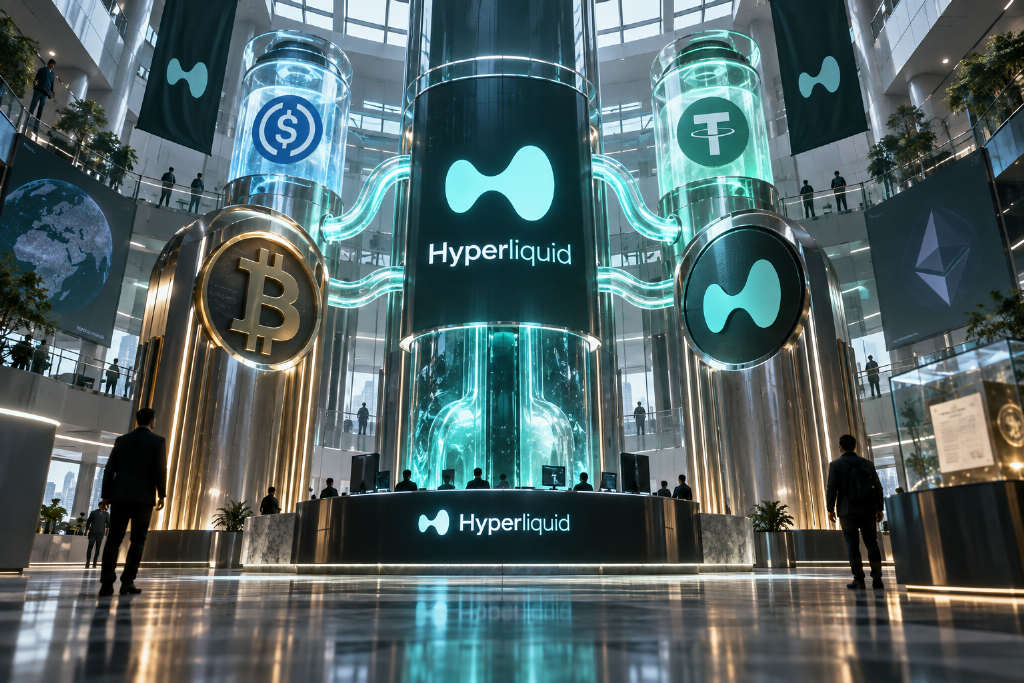
Hyperliquid launches manual lending
Hyperliquid has launched a manual lending feature that allows users to post HYPE and BTC as collateral and borrow quoted assets including USDC and USDT. Borrowers pay interest, while users supplying quoted assets earn interest, with rates determined by capital utilization. The feature shares HyperCore infrastructure with cross margin, and lending assets on the day reached $269 million.
Hyperliquid co-founder Jeff Yan said the platform uses a modular design: it first builds a standalone lending protocol on HyperCore, then integrates lending with perpetuals, spot trading and trading outcomes through the cross-margin system. He said that setup lets lending risk be managed independently, gives idle stablecoin collateral a way to earn interest, and makes system-wide risk easier to analyze.
Polygon plans to permanently burn 100 million POL
Polygon Foundation CEO Sandeep Nailwal said Polygon plans to permanently burn 100 million POL. The relevant contract has already been deployed to testnet and will go live on mainnet after the Security Council completes its final signature. After that, the community may continue burning POL that flows into the fee collector on a quarterly basis.
Nailwal also said POL has been in a deflationary state since January 2026, with base network fees continuing to flow into the fee collector. The total collected so far is about 121 million POL. Polygon's revenue so far in 2026 stands at $24.5 million.
Solana cuts block target interval to 250 milliseconds
Solana has shortened its block target interval from 300 milliseconds to 250 milliseconds, with a target of processing four slots per second. Because the compute and data capacity of each slot was reduced at the same time, total transaction throughput is largely unchanged.
The change is expected to give wallets, exchanges and trading applications more timely on-chain data, and it shortens epoch length to about 30 hours. At the same time, it reduces the time window for offline signing and delayed approvals. A proposal to move to 200 milliseconds has not yet been given a mainnet launch date.
Inheritance dispute around Ondo Finance escalates
Ondo Finance founder Nathan Allman died in May this year without leaving a will. His parents then inherited an estate that included Ondo holding company equity and a large amount of ONDO tokens. Nathan's half-sister, Lani Clinton, and Ondo investor David Chen recently asked a Hawaii court to establish a limited conservatorship over the related inheritance rights of his 77-year-old mother, Kathleen Allman.
The filing says Kathleen has had long-term alcohol abuse issues as well as declining cognition and judgment, and asks the court to assess whether she has dementia. Kathleen denied the allegations and said the filing is another move by the camp of acting CEO Ian De Bode in a fight for control of Ondo.
Kathleen had previously sued De Bode, accusing him of trying to seize control of the company after Nathan's death and of arranging more than $10 million in compensation and equity awards for himself.
World launches World Money
World said it has launched World Money, a self-custodial finance app now available in more than 150 countries and regions. The app includes stablecoin payments, investing, yield-earning functions and global cross-border transfers, and it supports balances across eight fiat and digital currencies.
Through an integration with Stripe, World Money also gives U.S. users a path to quickly fund through Apple Pay and convert into stablecoins. The app also includes deep integrations with prediction market platform Kalshi and decentralized lending protocol Morpho.
Lido proposal seeks emergency CEX market-making mechanism
A new Lido community proposal would authorize an emergency LDO centralized exchange liquidity market-making mechanism. The stated purpose is to address the risk that falling LDO trading volume could weaken organic market-making incentives, leading to deteriorating liquidity or even exchange delistings.
If approved, the authorization would remain available for a two-year window. Once the Growth Committee determines that exchange liquidity for LDO is insufficient and activates the mechanism, the plan would allocate up to $1.5 million worth of LDO from the Lido DAO treasury as a recallable market-making inventory lending line, along with up to 480,000 USDC for fixed market-making service fees and related expenses for as long as 12 months.
The proposal says the Lido Ecosystem Foundation would prioritize using foundation-controlled CEX accounts with API-restricted permissions. It would not allow market makers to withdraw funds, would prohibit the use of borrowed LDO for governance voting, and would bar market manipulation and attached structures such as call options.
Aave proposes custodied collateral lending for institutions
Aave has submitted a new governance proposal to introduce Custodied Collateral Lending based on Aave V4. The design would let institutions borrow stablecoins against assets held in custody at Anchorage. During the life of the loan, the underlying collateral would remain under Anchorage custody, with Anchorage maintaining the collateral management system, recording balances and loan lifecycle events, and selling the underlying assets through OTC channels if liquidation occurs.
Chainlink CustodySync would sync custody balances on-chain through non-transferable receipt tokens, while Chainlink price oracles would provide consistent pricing data to both Aave and the custodian so loan-to-value ratios stay aligned. Borrowed stablecoins could be sent directly to the borrower's address in a single transaction.
The proposal would run inside an isolated Liquidity Hub on Aave V4, separate from existing markets.
Starknet brings privacy prediction market trading to mainnet
The Starknet ecosystem said Off Market, a privacy-focused prediction market trading service based on Polymarket, has gone live on Starknet mainnet. The service allows users to build prediction market positions without publicly linking trading activity to their accounts.
The stated goal is to reduce the exposure of on-chain holdings and trading behavior. Starknet had previously introduced the STRK20 privacy framework to support privacy features for on-chain assets and applications.
Linera halts operations over funding shortfall
The Linera team said in a Discord announcement that it is stopping operations immediately because of insufficient funding. Its token sale on Sonar drew nearly $900,000 in commitments, but that did not reach the minimum threshold required to complete the sale, and all subscription funds have been returned.
The team then sought emergency financing to keep the company going through mainnet launch, but failed to raise the required capital. Linera is now gradually shutting down its application and Discord community. User point balances will remain recorded, though the team said it cannot promise any future rights tied to those points.
The team added that it still hopes to complete protocol development and launch the application in the future, but it cannot provide a timeline at this stage. Linera was founded by former Meta researcher Mathieu Baudet and raised about $12 million across two rounds in 2022 and 2023. a16z participated in both rounds, with other investors including Borderless Capital, GSR, Matrixport Ventures and Flow Traders.
Cronos proposal would route revenue into CRO buybacks and burns
lezzokafka, a maintainer of the Cronos GitHub repository, has published a governance proposal that would direct all revenue from Cronos Labs products Ult and Cronos Launch toward buying back CRO on the open market and burning it on-chain every month, with the hash of each burn transaction disclosed.
The proposal also says operating, infrastructure and growth-related spending would be covered by existing capital. It further seeks to use strategic reserves to support future staking rewards on Cronos POS, topping up rewards as token issuance declines while keeping current staking parameters unchanged.
The measure has entered voting as on-chain governance Proposal 37. Voting is set to end at 10:02 Beijing time on Oct. 3, and the buyback-and-burn contract is still under development.