
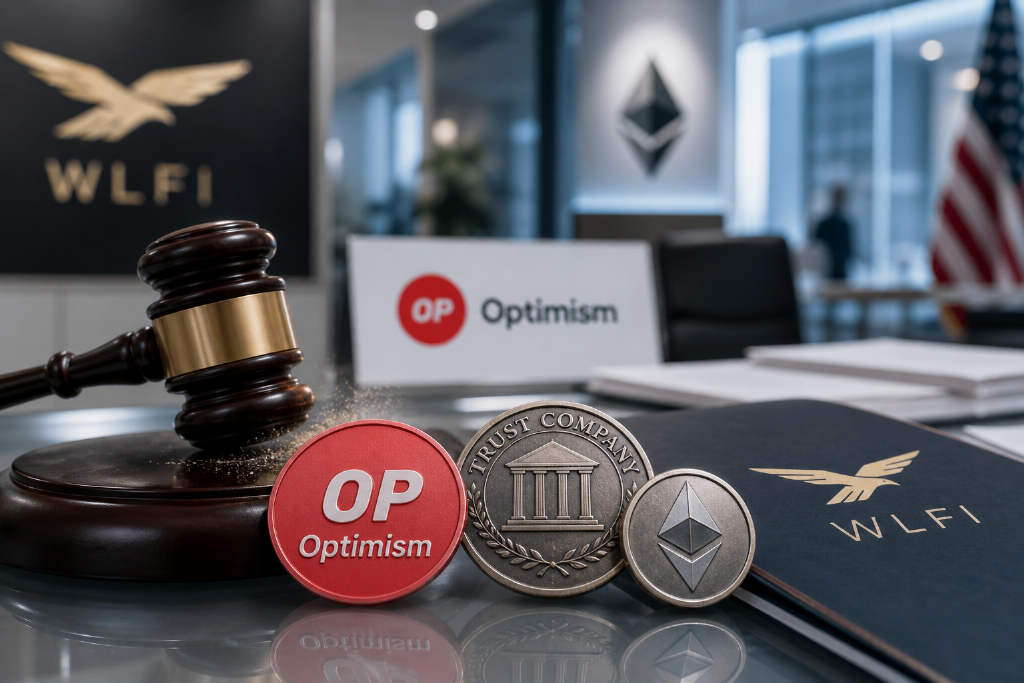
From Aug. 16 to Aug. 22, crypto project updates clustered around governance, compliance tooling, token allocation changes and product rollouts. The most closely watched items included WLFI’s trust company plan, Optimism’s decision to redirect 546.9 million OP from user airdrops to a strategic ecosystem fund, and Linera’s new push around the LNRA token sale.
Ethereum Foundation opens post-quantum research challenge
The Ethereum Foundation launched the Better Codes open challenge to advance post-quantum Ethereum research. Participants can use AI agents, toolchains and prompts to explore mathematical optimization approaches for hash-based SNARKs.
Submissions will be verified through Lean 4 formal proofs, and selected work may qualify for the Ethereum Foundation’s $1 million Proximity Prize. ZK Security, EigenLabs and Yukon Research are supporting the program.
WLFI sets up trust structure and expands USD1 RWA markets
Trump family-linked project WLFI said it promoted former general counsel Mack McCain to chief legal officer and chief administrative officer across WLFI and its affiliated entities. He will also serve as chief trust officer of the planned World Liberty Trust Co., N.A.
McCain previously served as chief of staff to the chief legal and compliance officer and associate general counsel for regulatory affairs at Robinhood. He was also general counsel at Arta Finance and held senior legal roles at Charles Schwab and Scottrade. In his expanded role, WLFI said he will oversee legal strategy, management and governance across the broader ecosystem and lead trust and fiduciary governance operations for World Liberty Trust Company under the supervision of the U.S. Office of the Comptroller of the Currency.
WLFI also introduced its first batch of USD1-denominated RWA perpetual markets. Aster DEX has listed pairs including SPCXUSD1, CLUSD1, XAUUSD1, SNDKUSD1 and SKHYNIXUSD1.
The project said it will provide liquidity support with 250 million WLFI and $12.5 million in USD1. The launch covers RWA exposure tied to gold, crude oil and global equities, with more USD1-denominated RWA perpetual markets planned.
Arbitrum activates ArbOS 61
Arbitrum activated the ArbOS 61 “Elara” upgrade on Aug. 20 after governance approval. The release adds optional protocol-level transaction filtering for dedicated chains, support for priority fees and an alternative data availability interface. It also raises the Stylus contract code size limit from 24 KB to 96 KB.
The compliance filtering feature is off by default. Dedicated chain owners must choose a compliance service provider and turn it on themselves. Arbitrum One and Nova have not enabled it. Priority fees on Arbitrum One still require a separate DAO vote, and the base fee management range has been adjusted to 0.01 to 0.10 gwei.
Optimism redirects 546.9 million OP after late decisive vote
Test in Prod, a core development team funded by Optimism, cast a decisive 8.486 million OP support vote about 17 minutes before the deadline. That lifted support from 45.77% to 61.84%, and the proposal passed with 17.974 million votes in favor against 10.931 million against.
The approved proposal moves 546.9 million OP that had been allocated for user airdrops into a strategic ecosystem fund managed by the Optimism Foundation. The fund is meant to support OP Mainnet and enterprise partnerships and growth efforts.
The Optimism Foundation said broad user airdrops no longer fit its institutional strategy. L2BEAT and researchers including Polynya opposed the move, citing limited oversight transparency and unclear value for tokenholders. Test in Prod said enterprise expansion bids require reserve capital and confidentiality to compete in the market.
Linera outlines new product push around LNRA
Layer-1 blockchain Linera said it will launch a new round of products tied to the LNRA token sale and openly stated its goal of becoming “the next Hyperliquid.”
Linera focuses on real-time prediction markets built on a Microchain architecture, with markets that can open and settle within one minute. The project was founded by former Meta Libra/Diem researcher Mathieu Baudet, and its core team currently has five people. Linera said LNRA will serve as the network’s native token, with full sale details to be released later.
Prop AMM daily volume tops $100 million on Ethereum
Dark pool Prop AMM recorded more than $100 million in daily trading volume on Ethereum for the first time, accounting for about 10% of Ethereum spot DEX volume. FermiSwap and Metric held the main market share.
Uniswap fee switch shows no negative effect on LPs
According to the update, Uniswap’s fee switch has not produced negative effects for LPs and instead resulted in gains for LPs, traders and the protocol.
Nearly one month after protocol fees were fully rolled out on Uniswap V4, LP TVL has remained almost unchanged, including on Base where the protocol competes with Aerodroem. Ethereum-based Uniswap V3 has shown a similar pattern, while price impact has kept improving in native asset-to-stablecoin and stablecoin-to-stablecoin pairs.
Uniswap co-founder Hayden Adams said the platform hosts a large number of active pools. Eight pools post more than $1 billion in monthly volume, 57 exceed $100 million, 284 exceed $10 million, 1,039 exceed $1 million, 2,419 exceed $100,000, and 4,324 exceed $10,000. He said the figures only include pools with stronger price data reliability, meaning the actual scale may be higher.
Gnosis Chain approves transition from standalone L1 to Ethereum L2
Gnosis Chain formally approved GIP-153, the proposal to move from a sovereign independent L1 to an Ethereum L2 aligned more closely with Ethereum. Just before voting closed, several officially linked addresses, including one associated with Gnosis co-founder StefanDGeorge, cast support votes that helped the proposal reach quorum.
The proposal was initiated by Gnosis founder tw_tter and core contributors. Its stated aim is to move away from the weaker security model and inflation subsidy trade-offs of a traditional PoS L1, inherit Ethereum validator security directly, and become the first Ethereum L2 with synchronous composability.
Arthur Hayes returns to lead Flop Labs
Arthur Hayes said he is ending his retirement and will lead Flop Labs. Hayes said Flop Network is built for the AI Agent economy, and that its native token FLOP will be used by AI Agents to pay for compute resources and related network services. He said the project will follow a no-presale, no-VC, 100% fair-launch model.
The project is expected to conduct a large-scale airdrop in Q4 2026 and launch its genesis block in Q1 2027. FLOP is intended for compute access and other services inside the network.
Harmony confirms network-wide rollback
Harmony released its rollback plan for the attack incident, restoring the state of Shard 0 and Shard 1 to Aug. 11 at 23:25:37 UTC in order to fully remove 2.385 trillion illegally minted ONE created by the attacker. The incident had at one point sent ONE down more than 30%.
Harmony said the forged ONE had already moved through exchanges, DEXs, bridges and staking addresses. Because targeted burns, blacklisting or selective transaction recovery could affect unrelated funds, the project said a fixed-window rollback was the lowest-risk option. More than 109,000 user transactions will be permanently discarded.