
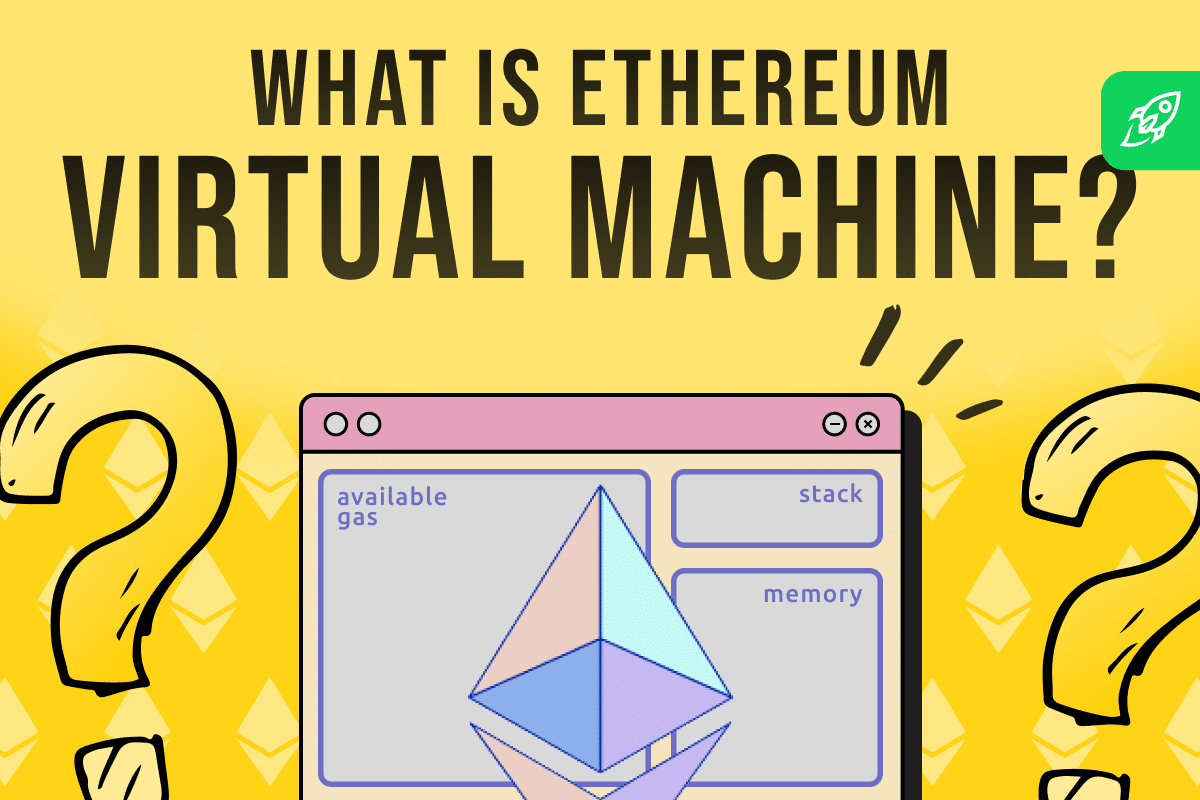
The Ethereum Virtual Machine, or EVM, is the execution environment that runs smart contracts and dApps across Ethereum. When a user sends a transaction, the EVM reads the instructions, checks the available gas, and applies the resulting state changes. Its role is larger than simple code execution. It gives every node the same rules for processing transactions so the network reaches the same result independently.
How smart contracts become executable
Developers usually write contracts in Solidity or Vyper, but the EVM cannot run that source code directly. Before deployment, the contract is compiled into EVM bytecode, a low-level set of opcodes the virtual machine can execute. Wallets and applications interact with deployed contracts through an ABI, or Application Binary Interface, which standardizes how data is passed between contracts and the EVM. Inside the EVM’s stack-based design, memory stores temporary data while storage keeps persistent data across transactions.
How transactions change Ethereum’s state
Once a contract is deployed, users can interact with it by sending transactions that transfer ETH, call a function, or do both in a single action. Each transaction is signed and includes a nonce to preserve ordering for an account. The EVM verifies the signature and nonce, then executes the instructions and updates blockchain state. Ethereum distinguishes between externally owned accounts controlled by users and contract accounts that contain code and run when triggered. During execution, one contract can also call another contract within the same transaction.
Why gas matters in execution
Every EVM operation consumes gas, the unit used to measure computational work on Ethereum. Users submit a gas limit and pay fees in ETH, covering a base fee plus a priority fee. A simple transfer needs little gas; a complex contract interaction may require much more. If gas runs out during execution, the EVM stops and the transaction is reverted. The mechanism is basic but important. It discourages abuse and gives developers a reason to write efficient code.
Why nodes stay synchronized
After transactions are included in a block, validators execute them through the EVM under Ethereum’s proof-of-stake system. Each node runs the same opcodes in its own client and applies the same state transitions. Because execution is deterministic, honest nodes reach the same output. If one node arrives at a different result, the network rejects it. The source also notes that Ethereum’s consensus layer selects the accepted block, while the execution layer applies smart contract logic.
EVM compatibility beyond Ethereum
The EVM now extends well beyond Ethereum mainnet. Many blockchains market themselves as EVM-compatible, meaning Ethereum smart contracts can run on those networks with little or no code changes. For developers, that reduces the cost of redeploying existing Solidity contracts on other chains. For users, it often means familiar applications, lower fees, and faster confirmations. The same execution model also supports a wide set of use cases, including DeFi protocols, NFTs, blockchain games, and enterprise deployments tied to supply chains, trade finance, or digital identity.
The trade-offs around the EVM
The source highlights several limits as well: gas costs, scalability constraints, performance bottlenecks, and smart contract security risks. Since every node must execute every transaction, Ethereum’s base layer can struggle with high-frequency or computation-heavy workloads. Work on Layer 2 rollups and Ethereum improvement proposals continues to target cheaper execution and better efficiency across the broader ecosystem.