

For most of financial history, the hard part was not moving information. It was moving money from point A to point B. Transfers often passed through multiple banks, with each layer taking a fee, and the process became even more cumbersome across borders. Crypto and stablecoins spent the past decade promising to reduce that friction through wallets and crypto apps. But cheap and fast transfers do not solve much if the funds cannot be used across the broader economy once they arrive. Dollar value parked inside a crypto wallet is not the same as dollar value that can move directly through everyday financial rails.

That is why crypto is increasingly being framed not as a wholesale replacement for traditional assets, but as infrastructure for moving them. As traditional finance and blockchain-based systems start to converge, a new middle layer is forming. The article asks a simple question: who captures value in that layer?
Why Web 2.5 matters
The piece argues that the industry spent more than a decade trying to persuade people to download wallets, bridge assets across chains, and store money in new applications. Most people were never going to abandon bank accounts, credit cards, and payroll systems they had used for decades just to try something new. Merchants were not going to accept blockchain-based payments only to watch the money sit in a wallet while they figured out how to convert it back into funds usable for rent, payroll, or operating expenses.
The issue was never whether crypto could move funds in seconds. The issue was that its architecture often asked people to leave the systems they already used and trusted. On-ramps, off-ramps, and bridges are friction points that should be hidden, not sold as features. In practice, users adopt technology that moves the money they already have into the accounts they already use, only faster and at lower cost.
The article calls that model “Web 2.5.” In this version, traditional finance keeps the parts that already work: regulation, licensing, verification, and the user interfaces people know. Crypto supplies low-cost, programmable, always-on settlement underneath. One side does not need to eliminate the other. Banks remain banks. Blockchain systems refresh the rails beneath them.
Once crypto becomes the invisible settlement layer and traditional finance stays on the visible surface, the next question follows naturally: where does the economic value build up?
The middle layer as a profit center
The article argues that the layer connecting traditional finance to onchain settlement has historically been worth more than many of the institutions it links together. Visa posted $24 billion in operating profit in the fiscal year ended September 2025. Its fee on each transaction is less than 1%, yet its operating margin still reached 60%.
It points to the Depository Trust & Clearing Corporation, or DTCC, as another example. According to the article, DTCC processed $4.7 quadrillion in securities transactions in 2025 and generated $2.9 billion in profit. The broader point is that the most lucrative position is not always the one holding deposits or underwriting risk. It may be the one routing, coordinating, and validating that transactions can move from one system into another.
The translation layer between banks and blockchains
Both sides of the market are now building conversion layers that let banks preserve existing infrastructure while translating ISO 20022 instructions into onchain settlement.
On June 23, Chainlink and a consortium of more than 50 banks from Europe and South Korea announced Project Pangea. The article says those banks hold around $10 trillion in combined assets. The project is testing real-time settlement for foreign-exchange trades and aims to move FX infrastructure from the traditional T+2 cycle toward T+0.
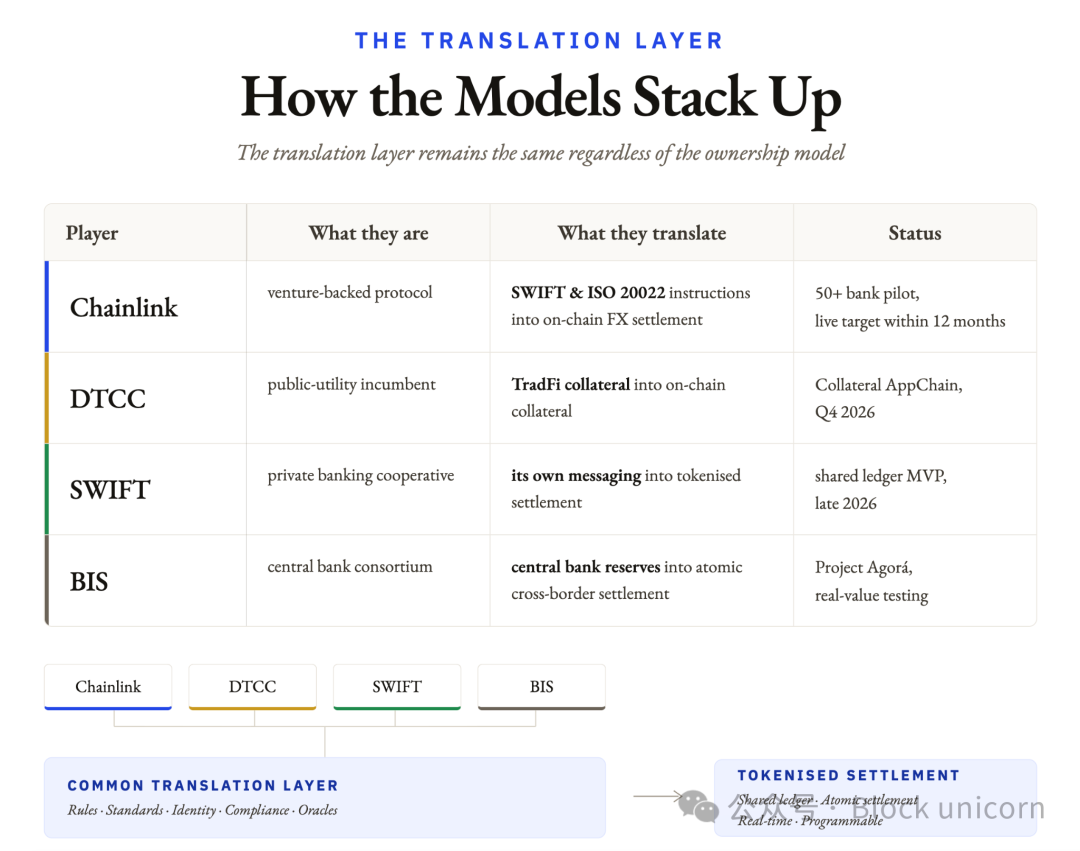
In that structure, Chainlink Runtime Environment, or CRE, acts as the orchestration layer. It connects blockchains to external payment systems without manual routing or bridging, converts ordinary instructions into onchain atomic swaps, and sends the results back to bank systems for reading and processing.
Chainlink is still a relatively new technology provider in this context. Yet DTCC, a 50-year-old market utility at the center of US finance, has chosen the same runtime to support its collateral AppChain. The article again notes that DTCC processed about $4.7 trillion in securities transactions last year.
SWIFT is not being replaced. It is building its own layer.
SWIFT serves as the article’s leading example from traditional finance. Early crypto narratives often cast SWIFT as a network blockchain would eventually displace. Stablecoins were also expected by many to route around its messaging monopoly. Eight years ago, SWIFT described blockchain as “not ready for prime time.”
Now it is building a blockchain-based shared ledger with more than 40 banks. The article stresses that this is not a replacement for SWIFT’s network. It is an orchestration layer built on top of it. Money moving onchain was never the main threat to SWIFT. The bigger risk was being shut out of the layer that decides how funds move onchain. As long as it can participate in that decision-making process, it remains central to the system. So it is building that layer itself.
Sovereign institutions are moving into the same territory. The Bank for International Settlements, or BIS, has brought together seven central banks and more than 40 private-sector institutions to launch Project Agorá, which tests atomic settlement using tokenized central bank reserves.
Why the bridge can be worth more than the endpoints
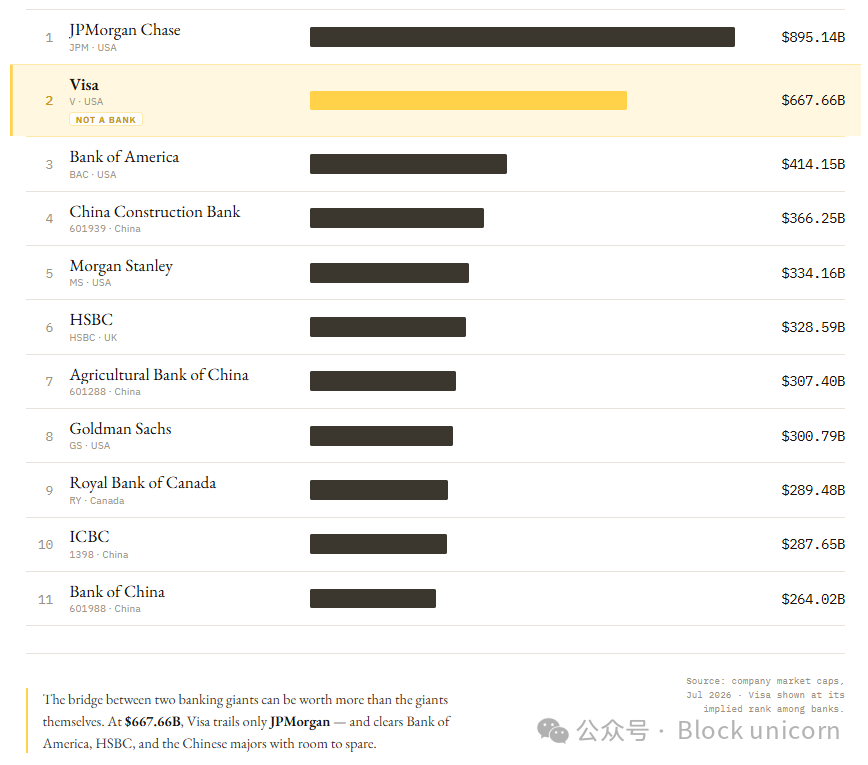
The article then pushes the argument further. The real prize may not be the institutions on either side of a transaction, but the translation layer that gets them talking. Visa and Mastercard began as routing networks between banks and merchants. Even today, they do not hold deposits, issue cards, or absorb the core credit risk. Even so, Visa’s market capitalization exceeds that of every bank in the world except JPMorgan.
Running the translation layer brings more than revenue. Whoever determines how money flows also has power over when that channel is shut. SWIFT was created in 1973 as a standardized bank messaging system. Fifty years later, it has become a powerful tool in sanctions policy. The article notes that over the past decade SWIFT has played an important role in economic warfare, including sanctions tied to Russia’s war in Ukraine. It also references European Union sanctions on Iranian banks aimed at slowing the country’s nuclear program, followed by later easing after progress on a nuclear agreement.
Against that backdrop, the article says Chainlink’s pilot with Project Pangea matters because it tests addressable liquidity pools for real-time FX settlement. Cross-border payments total between $150 trillion and $190 trillion a year, it says, and are expected to exceed $250 trillion by 2030. If Chainlink and its consortium of 50 banks were to capture even 1% of that volume, the total addressable market would exceed $1.5 trillion. At a 0.1% fee, that would translate into $1.5 billion in revenue from acting as the bridge between traditional finance and onchain settlement.
The author adds a warning. SWIFT and Visa became dominant because each emerged as the standard in its category, and eventually the wider system had to adopt them. In markets like this, there is often only one winner, and that winner can entrench itself for decades.
Right now, four models are competing for that same role: protocols, market utilities, bank cooperatives, and central-bank clubs. All are trying to own the single translation layer that links the financial worlds of Web 2.0 and Web 3.0.
Permissions and float
The article says the economics behind this layer are not new. As money movement technology improves, transaction processing itself becomes more commoditized. As the cost of moving funds falls, the value that remains concentrates in two places.
The first is permission: the power to decide whether a transaction can happen and under what conditions. The second is float: the interest earned while funds sit idle awaiting transfer. The author notes that the same logic previously discussed in the context of payments between AI agents now applies to interbank settlement as well.
That is what makes the coordination layer worth fighting over. It creates a two-sided network effect. The more banks connect on one side, the more attractive the system becomes to settlement institutions on the other side, and the reverse is also true. Each new participant raises the switching cost for those already inside. Individual banks compete with one another, and blockchains compete with one another, but the entity running the coordination and conversion layer can serve all of them and charge fees across the network.
The article compares that model to Stripe in card payments. Stripe simplified online acceptance and payment management through developer-friendly APIs, hiding the complexity of processors, acquirers, and payment networks in the background. Then it charged users for removing that friction.
That is also why connection layers become acquisition targets. Once one company builds them, others often prefer buying the layer instead of rebuilding it from scratch. The article points to Visa’s agreement five years ago to acquire Plaid for $5.3 billion. The deal was later blocked by an antitrust lawsuit from the US Department of Justice, but the intention was clear: Visa wanted the market share of the connection layer Plaid ran between thousands of fintech apps and bank accounts.
A more practical version of crypto adoption
The piece closes by arguing that Web 2.5 is more plausible than a fully decentralized Web 3.0 vision because it does not require capital to leave existing institutions in order to benefit from crypto-based services. Instead, it uses crypto as more efficient infrastructure underneath the current ecosystem for moving money and assets.
Projects such as Pangea, DTCC’s AppChain, and Agorá are still in pre-production, the article says. Even so, the author is positive on the direction taken by participants such as Chainlink. For years, the crypto industry argued over how to build better native applications that might persuade users to abandon traditional payment methods. Developers also debated which blockchain had the lowest gas fees and which token was best suited to hold value. In the Web 2.5 model, those arguments lose force because the infrastructure is pushed into the background.
The article compares this to the internet itself. The internet is, at base, a system of data packets moving across a global network of computers. That matters as technical knowledge, but not to someone who simply wants to go online. In the same way, end users may not care whether the technology behind fast, low-cost transactions is crypto or something else.
Its final conclusion is that blockchain is becoming commoditized: interchangeable, less visible, and lower margin as a component of transactions. The value now sits in the business models built around money movement, and in the power to shape how money moves and whether it moves at all.