


Patrick Witt, executive director of the President's Council of Advisors for Digital Assets, left the White House on Oct. 14 after his detail expired, and the administration has not named a replacement. With Witt's exit, the body widely referred to as the White House crypto council no longer has any remaining staff.

He was the last holdover. Before him, executive director Bo Hines left in August 2025, White House AI and crypto lead David Sacks departed in March 2026, and deputy director Harry Jung exited in July 2026. All four core members of the council have now left within 14 months.
Witt's detail ended and the White House left the post vacant
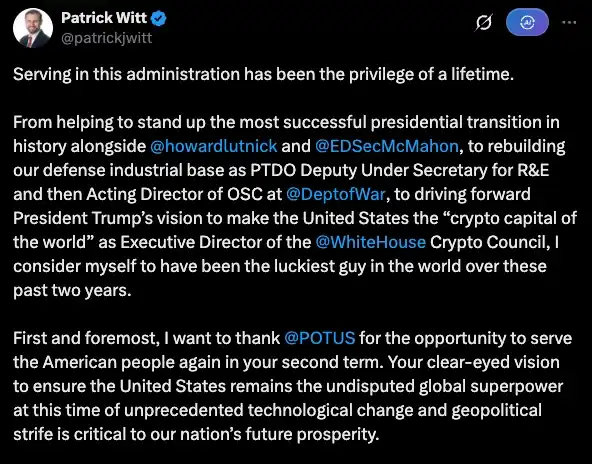
On Wednesday, Oct. 14, a White House official told The Block that Witt's "detail had expired." Later that night, Witt wrote on X that serving in government had been "the honor of a lifetime" and said he looked forward to advancing the same mission in the private sector, though he did not disclose where he was headed.
Eleanor Terrett, the journalist behind Crypto In America, had previously reported that Witt was in fact an employee of the U.S. Department of Defense and that his role on the White House crypto council was temporary. The White House later confirmed that his detail had expired.
Witt's formal title was executive director of the President's Council of Advisors for Digital Assets. The White House did not say who, if anyone, would replace him. A White House official told The Hill that cryptocurrency and the CLARITY Act "will continue to be priorities for the president."
In his farewell post, Witt thanked Donald Trump, David Sacks, whom he called a mentor, and regulators including SEC Chair Paul Atkins and CFTC Chair Michael Selig. He also said the GENIUS Act had already passed and that the CLARITY Act remained a legislative priority.
Four departures in 14 months
The council's personnel timeline is now complete.
- Bo Hines left in August 2025 and later joined Tether.
- David Sacks departed in March 2026 and then became co-chair of the President's Council of Advisors on Science and Technology, or PCAST.
- Harry Jung left government in July 2026.
- Patrick Witt's detail expired in October 2026, and he signaled a move to the private sector.
From Hines to Witt, the White House crypto council has seen all four of its core members leave in a 14-month span.
Patrick Witt's path ran through Yale, the Pentagon and then crypto policy
Witt's background did not match the usual profile of a crypto policy official. He graduated from Yale University and Harvard Law School. At Yale, he played quarterback on the football team, was invited to the NFL Scouting Combine, and signed with the New Orleans Saints as an undrafted free agent.
During Trump's first term, Witt served as deputy chief of staff at the U.S. Office of Personnel Management. After leaving government, he became a managing director at a small to mid-sized private equity firm.
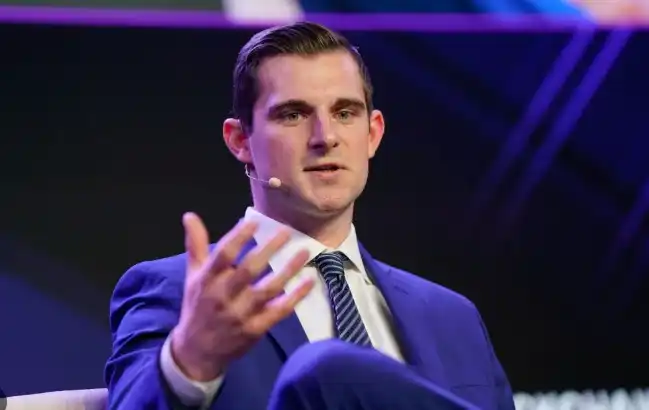
When Trump's second term began, Witt moved into the Defense Department orbit. According to bios published by ETHDenver and BigWhale, he served from January to May 2025 as the acting official performing the duties of the under secretary of defense for research and engineering, overseeing the defense technology apparatus including DARPA. He also led the Office of Strategic Capital at the Pentagon and served as a judge advocate in the Georgia Army National Guard.
After Hines left in August 2025, Witt, who had been deputy director, took over as executive director. CoinDesk noted at the time that he did not come in with a major crypto industry background, though the same had been true of Hines.
His central assignment in the role was to push the CLARITY Act through the Senate. He also led White House work tied to the strategic bitcoin reserve and said at Consensus 2026 that there would be a major update on the reserve. Multiple media outlets also reported that because his National Guard training was delayed, his White House tenure was extended by several months beyond the original plan so he could keep working on the bill.
Bo Hines left the first executive director post and then joined Tether
Bo Hines was the first executive director of the White House crypto council. He was appointed in December 2024 and left in August 2025. Before entering government, he had been a college football player, a Republican congressional candidate and a Yale-trained lawyer.
His tenure overlapped with the passage and signing of the GENIUS Act, which created a federal regulatory framework for stablecoins. Hines also oversaw the release of a 166-page policy report that made recommendations on taxes, banking rules and crypto regulation. He announced his departure on Aug. 9, 2025.
What came next triggered discussion about the revolving door between government and industry. On Aug. 19, 2025, Tether said it had hired Hines as its adviser for digital assets and U.S. strategy. On Sept. 12, Tether then named him chief executive of its U.S. business, where he was tasked with launching the U.S.-regulated dollar stablecoin USAT.
According to the report, the USAT team is based in Charlotte, North Carolina. Anchorage Digital is issuing the token and is also a shareholder in the U.S. company. Tether CEO Paolo Ardoino said Hines' deep understanding of the legislative process would be valuable as Tether entered the U.S. market. Bankless described the top White House crypto council job as looking "more like a springboard than just a policy role."
Hines struck an industry-friendly tone while in office. In his departure statement, he said the team had made the United States the "crypto capital," language that matched the line he had used throughout his public profile.
David Sacks was the council's real line to the president
David Sacks is a venture capitalist, technology entrepreneur and podcast host, and a co-founder of Craft Ventures, where he remains a partner. At the start of Trump's second term, he was appointed White House lead for AI and crypto, becoming the first official to oversee both areas at once.
He served as a special government employee, or SGE. Under the law, that status allows no more than 130 days of service in any 12-month period, and the days do not have to be consecutive. The arrangement let him keep his private-sector work, but it also drew criticism. TechCrunch reported that he received an ethics waiver allowing him to retain financial interests in AI and crypto companies, an arrangement criticized by ethics experts and lawmakers. Questions had also been raised because he remained in the role for more than a year and observers disputed how the 130-day cap was being counted.
In March 2026, Sacks told Bloomberg Television that he had "used up" that time. He then moved to become co-chair of PCAST alongside Michael Kratsios, director of the White House Office of Science and Technology Policy. PCAST members include Jensen Huang, Mark Zuckerberg and Marc Andreessen.
Inside the White House crypto council structure, Sacks was the line that could report directly to the president. When Hines left, he wrote on X that the White House had deep bench strength and that Witt and Jung were ready to take over and push the CLARITY Act forward. Both are now gone.
Harry Jung came to the White House from CFTC work
Harry Jung's background leaned toward regulation and compliance. A profile compiled by IQ.wiki says he holds a J.D. from Michigan State University College of Law. Early in his career, he worked at FINRA as an examiner in member regulation, then joined Citigroup, where he rose to senior vice president in the CEO's office from March 2020 to July 2023.
In 2023, Jung joined the CFTC as senior policy adviser to then-Commissioner Caroline Pham. After Pham became acting chair in January 2025, she named Jung acting chief of staff and put him in charge of the agency's engagement with the crypto, DeFi and digital asset sectors.
Jung moved to the White House crypto council in June 2025 as a senior policy adviser and was promoted to deputy director in August that year, taking on Hines' former workload alongside Witt. In July 2026, he said he would leave two weeks later. According to reporting by Phemex at the time, Jung had been expected to fill in while Witt was on military leave, and his departure ended that backup plan.
CLARITY Act is stalled and the White House side has no one left to handle it
After Witt's departure, the White House no longer has anyone in place to handle the bill, and the CLARITY Act still has not cleared the Senate.
On Sept. 15, the Senate voted on a motion to proceed to debate on the CLARITY Act. The result was 49 in favor and 50 against, short of the 60 votes required. Every Democratic senator voted no, and several Republicans also opposed it. The dispute centered on ethics provisions tied to crypto assets connected to the Trump family and on whether stablecoins should be allowed to pay interest.
Witt had been one of the main White House-side advocates for the bill. His departure now comes after that setback.
DLA Piper said a restart during the remainder of the current congressional session appears unlikely, with the next possible opening not expected until January 2027. On the executive branch side, the White House crypto council that would normally coordinate those talks no longer has a single active staff member. Any follow-up arrangement, according to the report, may have to wait until after the midterm elections.