
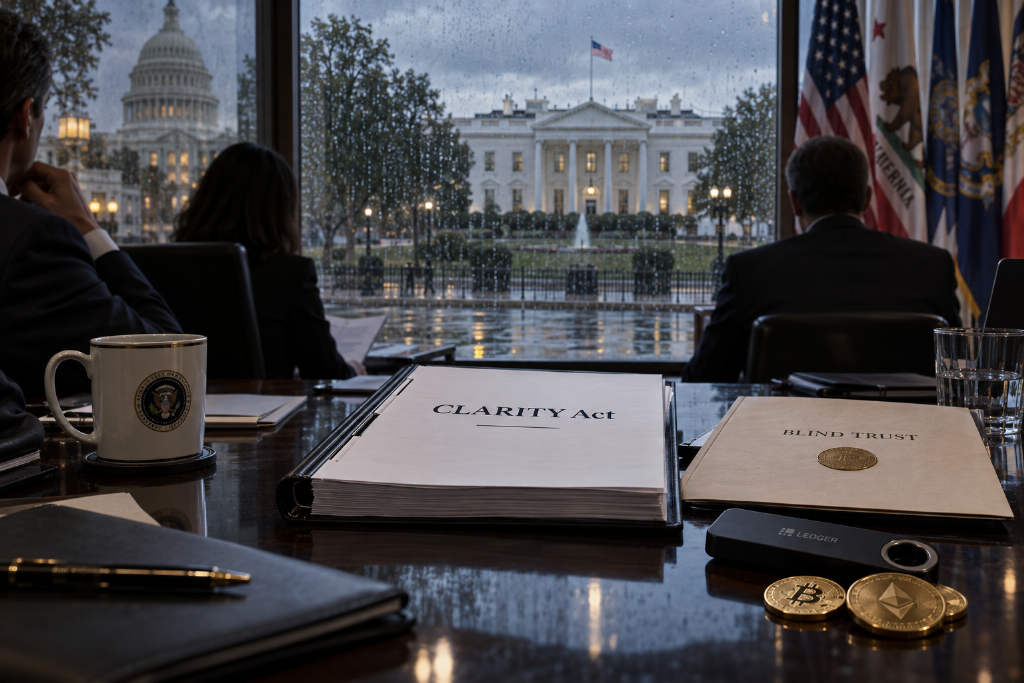
White House crypto adviser Patrick Witt said White House officials met with Trump last Friday and walked him through the latest government ethics provisions in the CLARITY Act, after which Trump agreed to make additional concessions.
Witt said the restrictions could require Trump to move his crypto investments into a blind trust and give states some authority to pursue accountability. He called the arrangement the strongest set of provisions in federal ethics law and described it as 「historic」 and 「unprecedented」. He also said Trump was told the language could not be used to target him politically.
Senate Republicans released a new draft
Witt said Senate Republicans published a new version of the bill on Sunday night and made additional compromises with Democrats on government ethics issues and criminal liability involving DeFi projects.
According to Witt, Republicans have accepted about 95% of the demands made by Democratic negotiators. He said that if lawmakers still oppose the bill at this stage, the decision may be driven more by politics than by policy differences.
Democratic staff still object to the text
Staff for Democratic members of the Senate Banking Committee said the new draft still gives too much authority to officials appointed by Trump, especially the U.S. attorney general, and that this could block enforcement of the ethics provisions.
Under the current design, state attorneys general would not be able to directly pursue violations by the president, vice president, members of Congress, or federal judges. They could, however, take action against crypto trading platforms that list improper assets and against the U.S. attorney general.
In addition, attorneys general from multiple states, banking industry groups, and some people in the crypto industry have raised objections over enforcement authority, stablecoin yield, and DeFi-related provisions.
The bill still faces several votes
The Senate will first hold a procedural vote. The measure needs at least 60 votes to advance to the next stage of consideration. Even if it clears that threshold, it would still face amendment debate and other votes. If the Senate ultimately approves it, the bill would still need to go back to the House.
Witt also said that even if the bill fails, the U.S. Securities and Exchange Commission, or SEC, and the Commodity Futures Trading Commission, or CFTC, will continue working on crypto rulemaking.