
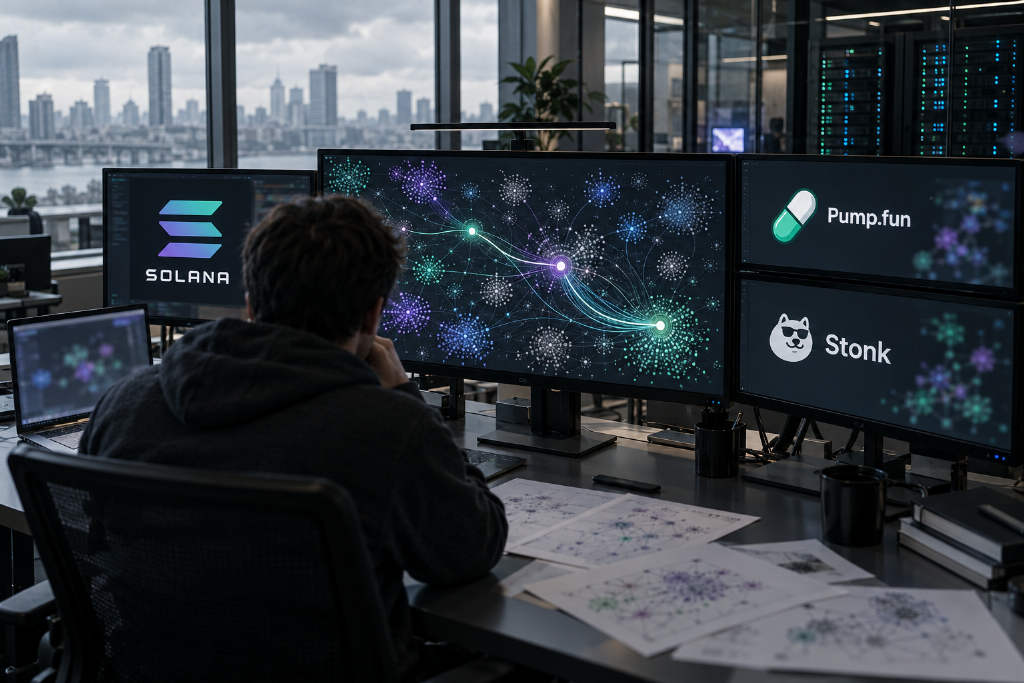
White Whale Labs has released a study, The Audit Of The Memecoin Casino, saying it has tracked all new-token trading on Pump.fun and Stonk on Solana since late August.
The dataset covers more than 1 million liquidity pools, 7.7 million wallets, and 384 million swaps. The firm said the data exceeds 56 GB and 820 million rows. It adds 18 million to 25 million transactions a day, as many as roughly 1 million wallets, and more than 60,000 newly issued projects.
How first buys performed
The study said about one in 10 tokens with real trading activity went on to double within the following 24 hours.
Across 22.8 million first buys over two weeks, 17% doubled before falling 40%. Using a strategy that takes profit at 2x, cuts losses at 40%, and includes costs, the average trade still lost about 19%.
Wallet clusters showed stronger early entries
According to the report, clusters made up of 450 to 2,000 wallets often bought within one to two minutes after launch. Tokens associated with those clusters posted doubling rates of 28% to 46%.
Measured from the entry points of those cluster wallets, 50% to 60% of trades doubled before a 40% decline, compared with 17% for other wallets. On a daily basis, the number of such groups ranged from 9 to 33.
Copy-trading tests still lost money
The study said entering two minutes behind large clusters led to losses in a test covering 93 tokens, with a per-token loss of 41% and a median drawdown of 95%.
Following groups with positive records still produced an 11% loss per token. Backtests that followed a single wallet showed a 20% loss per trade. A small number of tightly coordinated groups did make about 10% per token across 16 tokens.
Model-based selection did not create a monetizable edge
White Whale Labs said a neural network lifted the doubling rate from about 10% to 26%. Even so, across 771 selections over eight days, daily results remained negative, with an average loss of about 11% per trade, a median drawdown of 45%, and 55% hitting the stop-loss within 24 hours.
The firm said that after spending thousands of dollars on APIs, VPS services, and model costs, it still did not find a monetizable edge. Its conclusion was that memecoin trading is driven almost entirely by cluster wallets.



