
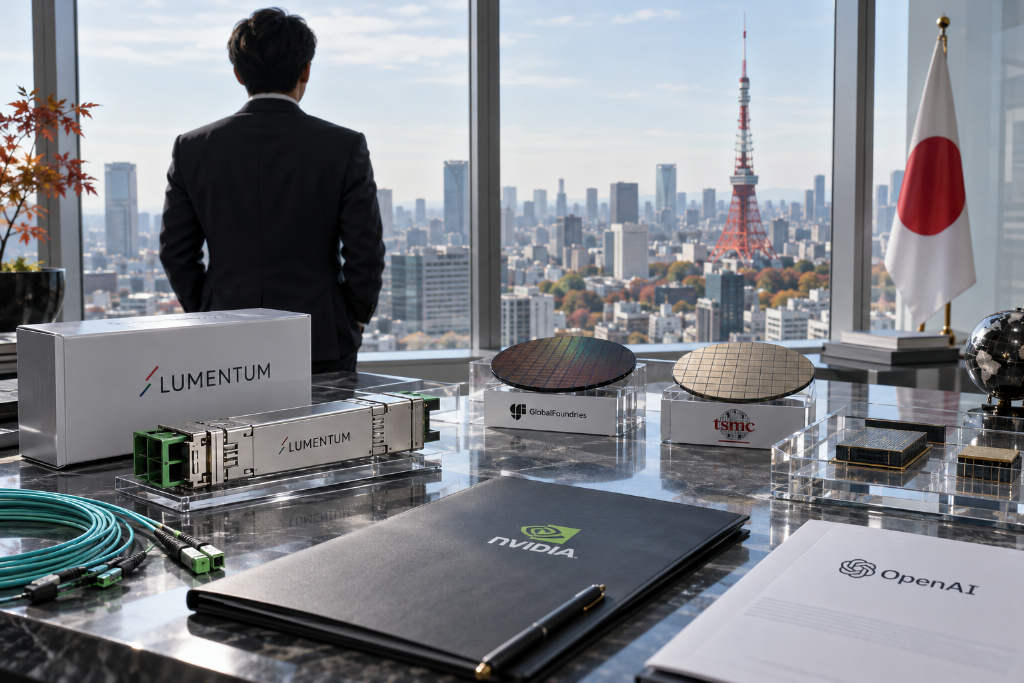
WuBlockchain’s WhiteLine Daily outlined several AI industry developments, with supply, financing and revenue expectations at the center of the latest updates.
Lumentum says optical component capacity is sold out through early 2029
According to Bloomberg, Lumentum, the U.S. company that supplies high-speed optical communication components for AI data centers, has sold out its optical component capacity through early 2029, CEO Michael Hurlston said.
Hurlston said roughly 70% of demand for some products will still go unmet in 2027, while about 30% of demand for other products will remain unmet in 2028. To expand supply, Lumentum plans to invest at least $350 million in key factories in the Tokyo metropolitan area and nearby facilities, and it has already expanded capacity at its plant in the U.K.
He also said building new capacity usually takes 3 to 5 years, and some large cloud companies have agreed to take on the capital expenditure risk tied to expansion.
WhiteLine Daily said the sellout through early 2029 improves visibility into Lumentum’s business, but the long build-out cycle limits how quickly unmet demand can be converted into revenue.
Firmus withdraws planned $5 billion IPO and turns to private funding
According to Reuters and the Financial Times, Nvidia-backed Australian AI data center operator Firmus has withdrawn its planned IPO, which had aimed to raise about $5 billion. The company is now turning to private financing and is considering listing options in other international capital markets.
Firmus currently operates two leased data centers in Melbourne and Singapore and plans to build five more across the Asia-Pacific region. Investors have been cautious about its valuation, debt burden and ability to execute on expansion.
Its partner CDC said a previous plan to jointly build a 1.6 GW AI data center with Firmus is no longer moving forward. In a letter to shareholders, Firmus said recent market volatility and current market conditions meant the proposed offering terms could not reasonably reflect the company’s long-term growth outlook.
WhiteLine Daily said the failed IPO effort leaves Firmus more dependent on private markets for expansion capital, and Nvidia’s backing has not removed investor concerns over valuation and project delivery.
Bloomberg: OpenAI annualized revenue was about $50 billion at end-September
Bloomberg, citing people familiar with the matter, reported that ChatGPT developer OpenAI had annualized revenue of about $50 billion as of the end of September and expects that figure to reach or exceed $70 billion by the end of 2026. The expected increase is mainly tied to expansion in enterprise business.
The reported figures were shared with investors in discussions tied to a new funding round. OpenAI declined to comment on the report.
WhiteLine Daily noted that annualized revenue is a projection that scales a shorter period of sales to a full-year run rate, rather than revenue already realized for a full year. It also said the $70 billion figure remains a year-end expectation. Moving from about $50 billion to at least $70 billion implies roughly 40% further growth in annualized revenue, and whether enterprise business can deliver that increase will affect valuation support in the next financing round.
GlobalFoundries signs $2 billion manufacturing agreement with TSMC
GlobalFoundries signed a $2 billion manufacturing agreement with Taiwan Semiconductor Manufacturing Co. to add capacity at its Malta, New York plant and supply silicon interposers for TSMC’s CoWoS advanced packaging.
Silicon interposers are used to connect processors, memory and other chips within the same package and are a key part of advanced packaging for AI chips. The agreement has an initial term of five years and sets a framework for later expansion. The added capacity is expected to begin production ramp in the first half of 2028.
The report said the partnership will add a U.S.-based manufacturing source to TSMC’s advanced packaging supply chain and support demand tied to AI and high-performance computing. WhiteLine Daily said the long-term agreement gives GlobalFoundries clear demand visibility, but there is still a time gap before contract value turns into actual deliveries and revenue because new supply will not begin ramping until 2028.
Main takeaway
WhiteLine Daily said long-term demand in the AI industry is still supported by orders and revenue growth expectations, but the timing of capacity build-out and financing is not moving in step. Optical component expansion takes years, while data center financing is being tested by valuation, debt and execution concerns. Whether orders can be delivered on time, whether enterprise business can keep contributing revenue, and whether funding can cover expansion spending will shape returns on this round of AI investment.