
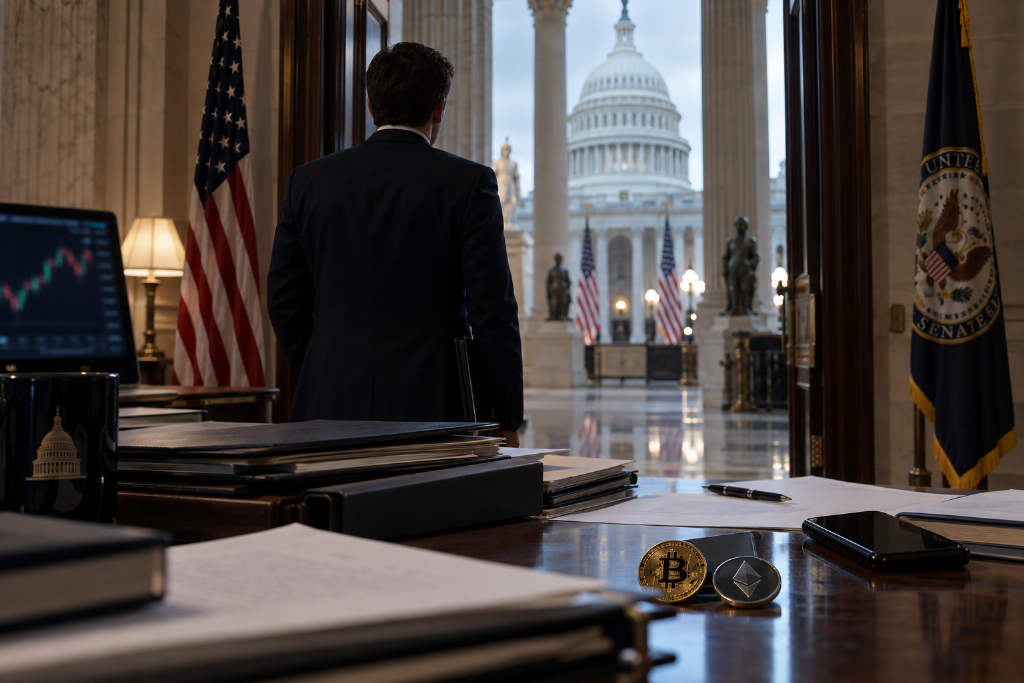
The Digital Asset Market Clarity Act did not collapse for one reason. By the time it reached a make-or-break procedural vote in the U.S. Senate earlier this month, a year of political friction, drafting choices, industry infighting and election pressure had already narrowed its path.
CoinDesk, citing interviews over the past 10 days with more than a dozen industry participants and legislative aides, reported that the bill’s chances kept eroding as several problems piled up at once. The Senate chose not to move the House of Representatives’ version of the Digital Asset Market Clarity Act, even after that version passed with broad bipartisan support. Instead, senators assembled their own text piece by piece. President Donald Trump and the White House complicated negotiations. The crypto industry approached lawmakers unevenly. Democrats rejected an ethics arrangement they believed fell short. And lawmakers were running out of room as the 2026 midterm election got closer.
The result leaves the crypto sector without the market structure overhaul it has wanted for years, even after the 2024 election delivered what industry advocates described as the most pro-crypto Congress in history and even after a major stablecoin bill passed last year.
What the bill was meant to do
The Clarity Act was supposed to spell out how the two main U.S. financial regulators for the sector, the Securities and Exchange Commission and the Commodity Futures Trading Commission, would divide oversight of a crypto market worth roughly $3 trillion and still growing.
Last year’s Guiding and Establishing National Innovation for U.S. Stablecoins Act, or GENIUS Act, addressed federal oversight for stablecoins. Clarity was broader. It aimed to tackle a problem the industry has complained about for years: crypto spot markets sit in a federal gray zone. The CFTC lacks spot market authority over them beyond outright fraud and related derivatives products. The SEC, meanwhile, had never previously produced formal rulemakings that clearly laid out how it would regulate crypto securities products. Former SEC Chair Gary Gensler’s effort to fit crypto spot trading platforms into the existing securities framework alarmed many industry leaders. There is also no explicit line in law defining where SEC authority stops and CFTC authority begins.
Without legislation, the agencies have started outlining their views through joint advisories published earlier this year. A market structure statute, however, would have settled those questions in a more durable legal form.
The ethics fight never went away
CoinDesk said it is hard to prove the Senate vote failed solely because of the controversial ethics section meant to limit personal crypto ties for senior government officials, especially Trump. Still, ethics concerns hovered over the bill from start to finish and remained one of the main themes in the debate.
Democratic unease over Trump’s crypto business ties goes back to 2025. In May last year, Sen. Ruben Gallego and eight other Democrats said they would not vote for the GENIUS Act because of the way Trump was profiting from the sector. They later voted for that bill after marginal changes, but future market structure talks were always likely to run into the Trump family’s crypto activity, including World Liberty Financial, the $TRUMP memecoin and mining firm American Bitcoin.
Trump had told Meet the Press at the time that he was “not profiting from anything … I want crypto because a lot of people, you know millions of people want it.” In his June financial disclosure, though, he acknowledged making $1.4 billion from his various crypto ventures during his first year back in office. CoinDesk noted that this was more than half of the $2.2 billion total he took in during 2025.
Democrats wanted to curb what they saw as Trump’s ability to profit openly from a sector that had also directed millions of dollars toward his 2024 campaign, inaugural balls, a ballroom replacing the demolished White House East Wing, a military parade and his political action committee.
Formally, the ethics language was described as applying to current and future presidents and senior government officials in general. In practice, multiple people told CoinDesk that Trump’s crypto ties were the issue that most alarmed Democrats. One person said Democrats broadly “actually care about this stuff.”
There had been public signs for months. Sen. Kirsten Gillibrand, one of the Senate’s longtime crypto supporters, said at CoinDesk’s Consensus 2026 event in May that the bill would not advance without an ethics provision. Sen. Angela Alsobrooks, who voted for the bill during a Senate Banking Committee hearing, also said she would not support the next step without more work.
Even industry participants expected the ethics question to be settled before a floor vote. Cody Carbone, head of the Digital Chamber, told reporters after the Banking Committee advanced the bill in May that he expected “the deal will be completed before this goes to the floor, because they’ll want to only bring it to the floor if they feel confident they’ve got 60” votes.
That never happened. The White House and Senate Republicans put forward several proposals. Senate Democrats sent counteroffers. Sens. Thom Tillis and Gallego also floated a bipartisan counterproposal earlier in the year. No final consensus emerged before this month’s vote.
Several people told CoinDesk that Trump’s June financial disclosure supercharged the argument by putting an easy headline figure in front of politicians who wanted to force him to sell his crypto holdings. As the November election approached, those concerns became even harder to sideline.
Stu Alderoty, chief legal officer at Ripple Labs, said, “I think politics was very clearly elevated over policy. It was good policy, and the industry needs to get better at politics.”
Ron Hammond, head of policy and advocacy at Wintermute, pointed to the floor votes of both Gallego and Alsobrooks against the bill as evidence of how heavily the election was hanging over the debate. Others noted that Gillibrand also opposed the procedural motion. Even Democrats who were sympathetic to the bill could not risk appearing soft on Trump’s corruption allegations that close to an election, according to the report.
Rep. Ritchie Torres made the point directly at CoinDesk’s Policy & Regulation event last week. “My personal opinion … even though the failure of Clarity had multiple causes, I am convinced that if it were not for Donald Trump, we likely could have seen both Democrats and Republicans get to yes,” he said. “Once the president issued his personal memecoin, that created a political problem for Democrats.”
Coinbase, January and the stablecoin yield fight
The industry’s own role also came under review. Last week, The Wall Street Journal reported that some insiders blamed Coinbase and Chief Executive Brian Armstrong after Armstrong publicly withdrew support in January for the Senate Banking Committee’s version of the bill before a major vote.
Armstrong said one of the central issues was how that version handled stablecoin yield and rewards. The delay opened a months-long battle between crypto and banking interests while lawmakers looked for a compromise. CoinDesk said it is not clear that many of the other unresolved issues received much attention while the yield dispute consumed the process.
After the Journal report, industry figures and Sen. Cynthia Lummis defended Coinbase. Even so, participants who spoke to CoinDesk said Armstrong’s post and the fight that followed over stablecoin yield and rewards hurt the broader effort to get Clarity passed.
One person involved in crypto lobbying said the odds of a successful vote would probably have been higher if the ethics proposal released earlier this month had surfaced in the spring instead.
Alderoty said there had been “an opportunity in January” before the midterms crowded the calendar. “The January timeframe would have given more airspace for negotiations without the midterms breathing down their necks,” he said.
Charley Cooper, president and chief operating officer at Ava Labs, made a similar point. Holding the floor vote less than two months before election day made success difficult to imagine, he said. According to Cooper, the release of an ethics proposal earlier this month had given the industry renewed optimism that the bill might pass, but the political context was already working against it. “We’re six weeks before election day in a heated midterm with a very divided electorate, very partisan fighting going on,” he said.
CoinDesk was careful not to overstate the counterfactual. Nobody guaranteed an earlier vote would have passed. Many of the people interviewed still praised Armstrong and Coinbase for their work on the bill. And despite claims that the banking industry should have negotiated stablecoin yield during the GENIUS Act process, one person noted that the Senate Banking Committee’s July 2025 market structure discussion draft explicitly invited the question, asking how legislation should address “interest or yield-bearing digital assets, including stablecoins.”
Three people said that if Senate Republicans had released their ethics proposal in early spring instead of early September, the back-and-forth might have been more productive. Others were less convinced. In their view, the political weight of the ethics fight was always going to hang over the rest of the debate, including stablecoin yield, decentralized finance risk and other disagreements.
The timing, in any case, was poor. Soon after the Senate Banking Committee postponed its initial January hearing, the U.S. entered a conflict with Iran. Fuel prices rose. Global financial conditions, already strained, became more unsettled. Public frustration over Trump’s foreign policy and the economy pushed his poll numbers lower in recent months. At the same time, progressive challengers won Democratic primaries, and multiple people told CoinDesk that the party was more worried about alienating its base than about the political cost of voting against a crypto bill.
“Neither side was going to take a leap and do something big that could be claimed as a victory for the other side,” Cooper said. “So it doesn’t surprise me at all that it failed.”
The Senate chose not to advance the House bill
Another complaint came up repeatedly: the Senate decided to build its own bill in the first place.
The House passed its version of the Digital Asset Market Clarity Act in July 2025 by a 294-134 vote, with 78 Democrats in support. The Senate largely ignored that text and pursued its own measure, originally called the Responsible Financial Innovation Act. The Clarity Act name was adopted later in the process.
CoinDesk noted that the Senate handled stablecoin legislation in much the same way. Even though the House had a stablecoin bill, the Senate wrote its own version, and that Senate text became law. House members spent the past year expressing a desire to see the Senate take up the House-passed Clarity bill instead. It never did.
“Clarity’s chances really faced an uphill battle when it came to the Senate decision not to take up the Clarity Act that passed the House as-is and [instead] just worked on their own,” Hammond said.
He added that many issues that bogged down the Senate bill in recent months simply were not major factors last year. Banking sector lobbying on stablecoin yield was not as intense through most of 2026 as it had been the previous fall. Political concerns were weaker. Many interest groups had not yet mobilized.
Two other people said the House probably never expected the Senate to adopt its bill wholesale, but the House still had to pass it. Once it cleared the chamber with more than two-thirds support, the message to the Senate was that real bipartisan energy existed.
House Financial Services Committee Chair French Hill told CoinDesk in April that the Senate bill did incorporate some work done in the House’s version of Clarity and in its predecessor, the Financial Innovation and Technology for the 21st Century Act.
Still, the Senate’s homegrown approach created another hazard. Even if senators had approved their version, the bill would have had to return to the House, and what would have happened there was unclear.
The House announced it would leave almost immediately after the Senate returned earlier this month. So even if the Senate had completed a successful string of votes on Clarity, the House would not have considered it until the lame-duck session after the election. A former House aide told CoinDesk that even then the House would not necessarily take up the Senate bill as written.
Tim Ryan, a former congressman who now advises several crypto companies, said through a spokesperson that the House would first need to assess how the Senate bill affected its own version. “A strong Senate agreement could have created real momentum for the House to act,” he said. “The deciding factors would have been the substance and whether House leaders could assemble the votes. The goal should be a workable law that gives people the confidence to build here.”
How the negotiations broke down
Several people criticized the structure of the talks themselves. In prior years, they said, legislation might have been shaped by staff from both parties in the same room. That does not appear to be how this effort worked.
Industry sources told CoinDesk that Republican staff would draft language and send it to Democratic counterparts. Democrats would provide feedback. Some of that feedback might appear in the next Republican draft, which would then be presented as a bipartisan product.
At times, though, Republicans inserted concessions on their own, hoping Democrats would accept them, according to two industry sources who pointed to changes to the Blockchain Regulatory Certainty Act as one example. A Democratic aide said negotiators would sometimes agree to provisions only to see Republican counterparts walk them back later.
Earlier this year, after Senate Republicans and the White House agreed on the first draft of an ethics provision, negotiators briefed the crypto industry on the details and aggressively promoted the language before sharing it with Senate Democrats.
One person told CoinDesk that Republican staff “f***** up the negotiation by not including Democratic staffers in the process,” adding that this gave Democrats leverage because they were not yet committed to any concession. Another person said it looked “odd” that the revised ethics proposal was announced through Sen. Lummis’s office and signed only by Republicans if it was meant to showcase a bipartisan effort. Punchbowl News also reported details of the negotiations last week.
Several people also pointed to White House adviser Patrick Witt. According to those interviewed, Witt appeared to want the bill to pass but may not have had the experience needed to coordinate legislation as complicated as Clarity. One person said Witt’s posts on X suggesting breakthroughs or successful passage were unhelpful because they may have altered industry expectations. CoinDesk said Witt declined to comment at a Georgetown event last week.
Two legislative aides and one industry participant told CoinDesk that as the procedural vote began on Sept. 15, a final attempt led by Sen. Tillis produced the idea of allowing the full Senate to vote on the Tillis-Gallego ethics proposal as an amendment to the bill. One Democratic aide said the party had reached the “one-yard line” of a successful procedural vote when the talks were cut off.
Several people said a staffer for Senate Banking Committee Chair Tim Scott ended that effort. Sens. Gallego and Chuck Schumer both said in statements that a bipartisan agreement was in the works but was “killed.” Crypto in America’s Eleanor Terrett first reported that a Scott staffer ended the negotiations.
A source familiar with the discussions told CoinDesk that the staffer had specifically instructed his own team to leave the meeting, while White House and Senate Agriculture Committee Republican staff were not present. Republicans had already rejected the prior Democratic counterproposal sent late the night before, and formal talks had already ended, the source said. In that view, the staffer did not see the ongoing conversation as an active negotiation and disputed the suggestion that he stopped progress at that point.
An industry participant said Tillis and the Republican staff still negotiating during the vote were doing so without leadership backing. A Democratic aide said Republican leadership undercut Tillis and Lummis after the two had effectively secured a deal. The industry participant added that agreement had been reached on some provisions, but the remaining details still needed to be put on paper.
The crypto industry’s own tactics also drew criticism. One person said the Clarity fight eventually brought much of the sector into alignment on the crypto-specific portions of the bill. Another said the industry could have helped itself by doing a better job of showing real-world use cases for merchants and other constituencies. In Washington, the focus remained too hypothetical. One aide said industry leaders could also have done more to encourage genuine bipartisan negotiations.
The midterm election overshadowed the bill
In 2026, every legislative move sits under the shadow of the midterms. Earlier this year, the broad expectation was that the House would likely flip from Republican to Democratic control, while Republicans would retain the Senate.
Many people told CoinDesk that this meant Democrats could not give Trump a visible win before the election, especially because progressive voters tend not to support crypto.
Sen. Bill Hagerty said at a Georgetown University event last Wednesday that he had warned colleagues the closer negotiations got to Nov. 3, the lower the odds of passage became, though he said the Senate could still revisit the measure after the election.
“It’s sad, but it’s the political reality,” he said. Hagerty also told CoinDesk there may still be room to continue negotiating some provisions. “My Democratic colleagues, this close to the election, couldn’t resist playing politics,” he said. “Is there room to do more fine-tuning? Perhaps.”
What this means for Fairshake
The failed vote also raised questions about the future of crypto political action committees. Fairshake, the largest crypto super PAC, has already announced $30 million in spending against former Sen. Sherrod Brown, who is trying to return to the Senate by challenging Ohio Sen. John Husted. Brown chaired the Senate Banking Committee during his previous time in the chamber, criticized the crypto sector and opposed bringing related legislation up for a committee hearing, though he has said little about crypto during this campaign.
Ryan Louvar, chief legal officer at WisdomTree, said neither party saw much political risk in failing to pass Clarity.
Whether Fairshake or other PACs can alter the overall trajectory of the 2026 election remains uncertain. Recent polling suggests Democrats may gain House seats, and several Senate races are competitive. If crypto PACs align exclusively with Republicans and Democrats regain at least one chamber, or win the presidency in 2028, that could reflect badly on the industry.
One person said Fairshake was not built for a wave election and has already suffered two high-profile misses. The PAC spent $10 million opposing Illinois Lieutenant Governor Juliana Stratton’s Senate bid. Stratton won anyway and is widely expected to win the general election.
The PACs also have to keep a careful balance, that person said. A total break with Democrats would be risky. Another person said it was unclear whether the threat from Fairshake failed to move Democrats on Clarity or whether Democrats simply chose to run out the clock on 2026 to avoid multimillion-dollar ad campaigns against them.
The missing crypto voter
A Democratic aide told CoinDesk that the industry cannot assume a future administration or Congress will stay broadly bipartisan and supportive of crypto bills. If the PACs follow the Republican preference and direct money against Democrats over this month’s vote, they risk alienating political allies they still need.
A former legislative staffer said PACs such as Fairshake also face a lack of supporting infrastructure in Washington. Lawmakers may hear that tens of millions of Americans own crypto, but unless constituents explain why it matters in their own lives, elected officials are unlikely to care. If members return to their districts and hear little or nothing about crypto, they may even question those ownership claims.
Alderoty, who also leads the Ripple-backed National Cryptocurrency Association, said the organization estimated that roughly 67 million Americans held crypto. Even so, he said, the group could not convince any senators to sit down with holders to talk through actual use cases.
More broadly, crypto is not a top voter issue. In a CoinDesk-commissioned survey of 1,000 registered voters nationwide, only 1% said crypto was a top concern. Respondents ranked the cost of living, jobs, the economy, Social Security and Medicare higher.
Democratic voters, whether they identified as leaning Democratic or strongly Democratic, viewed crypto more unfavorably than favorably. Independent voters also leaned more negative than positive on the sector. CoinDesk added that 62% of respondents said they did not trust the Trump administration to oversee crypto.
What comes next
The future of the Clarity Act is now uncertain. Several people told CoinDesk there is still hope of reviving the legislation before the end of the year. Even so, a new Congress will be sworn in in January regardless of the election result, and any legislative effort would have to start over.
One industry participant said Democrats are likely to produce their own version of a crypto market structure bill. Even if that text goes nowhere on its own, it would at least give the party a starting point.
Louvar said it helps that crypto products are becoming more tangible. It may help even more when tokenization and other blockchain-based products that are not strictly crypto become easier for lawmakers to understand. In his view, separating crypto from the underlying blockchain technology could show practical use even if lawmakers still hold negative views of cryptocurrencies.
In the absence of legislation, the SEC and CFTC are continuing to issue guidance and take other steps to fill what gaps they can. SEC Chair Paul Atkins has repeatedly said a market structure bill is still needed so that missing authorities can be granted by law.
As Alderoty put it, “The crypto bill transformed into an ethics bill, and that was really unfortunate. We lost a really good opportunity.”