
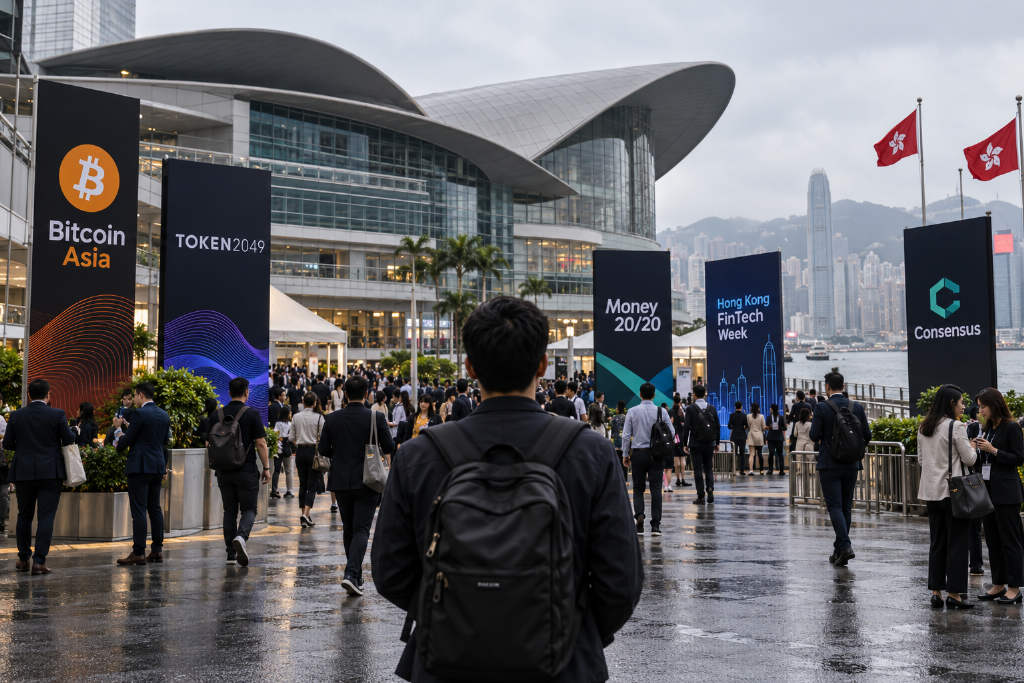
PANews has published an essay by Yuki (Liu Yuqing) on the meaning of conference-hopping in crypto and fintech. Since entering the sector last year, she wrote, she has attended Bitcoin Asia, Token2049, Money20/20, FinTech Week and Consensus, while also organizing three side events of her own. Across those trips, she kept asking people the same question: why come to these events, and what is the point of doing the conference circuit?
From internet conferences to crypto event weeks
Yuki said she had spent years attending conferences in the internet industry before moving into crypto. She mentioned 36Kr WISE, the Great Wall Club's GMIC, the World Internet Conference, as well as SaaStr and CES in the US. Back then, attending was usually part of the job: a company booth, a speaking slot, or a panel appearance. She also wrote that she had been to both the Summer Davos in China and the Winter Davos in Switzerland.
At that stage, part of the appeal was seeing more of the world, and part of it was the urge to show up and be seen. In Davos, she wrote, it was possible to meet political figures, entrepreneurs and founders who would otherwise be hard to access, and to hear young people from different countries talk about what they were building. She recalled attending the Global Shapers Annual Summit in Geneva in 2019 and coming away with a strong sense that many people were living lives completely different from her own.
Over time, though, she began to question the value of merely “knowing” impressive people. In the essay, she wrote that what really matters in the end is whether you are strong, your company is strong, or your family background is strong. Adding accomplished people on WeChat, she argued, does not mean much by itself. A photo together, a WeChat contact, or sharing a dinner table can all count as “knowing” someone in Chinese, but whether that person remembers you or replies later is a different matter.
In crypto, conference-hopping can look like a way of life
After moving into fintech and crypto, she found that attending conferences often felt less like a task and more like a lifestyle. Some people still arrive with clear goals: exhibiting, finding clients, meeting investors and discussing partnerships. But many others, she wrote, do not seem to have a mission that makes attendance strictly necessary. They come because everyone else is there.
Yuki described herself as someone who can be introverted or extroverted depending on the setting, but mostly leans introverted in large crowds. She said she is not the kind of person who can walk into a circle with a drink and exchange Telegram contacts with everyone within five minutes. At her first Token2049, she spent most of her time outside the main venue in private meetings or meals with people she already knew. One-on-one conversations and smaller private dinners suited her better.
Why people go: food, visibility and business access
Because she approaches the industry with a field-research mindset, she kept asking others why they came. One Singapore-based friend who had spent years in the sector and fit the profile of a classic business development operator gave a blunt answer: conferences are a way to find out which booth has good food and which side event is serving the best meal. In conference group chats, she wrote, people ask where to go that night, whether a side event is worth attending, and whether they should meet up in person. Technology, finance, stablecoins and next-generation global payments can all end with a very basic question: where are we eating tonight?
She also asked an OG in payments whom she had known for years but had not seen in a long time until they ran into each other at Token2049. His answer was that sometimes the point is simply to tell people where you are. Post your location, let others know you are there, and that alone can be enough. Yuki said that logic also applies to Money in Motion, the media outlet she is building. Showing up signals participation in the industry, even if nothing concrete follows.
Others framed conferences as a sales opportunity. She used Money20/20 as an example, saying many company executives attend and can be difficult to reach through email or LinkedIn under normal circumstances. During an event week, however, people may end up in the same hotel, at the same dinner, or next to each other on the exhibition floor. A half-hour conversation in person can create the opening for something later.
Main stages matter less than reunions and information gaps
Yuki wrote that many people do not spend much time in the main venue at all. In an industry where many companies operate remotely and team members live across countries and time zones, conferences can become one of the few chances to meet in person. In that sense, people come to socialize, see friends and do a bit of team building. What is being said on stage, she noted, is often not the main draw, and not many attendees are there primarily to learn.
She also argued that conferences still serve as places to look for “wealth codes” and information gaps, even if the former are less abundant than they used to be. In earlier years, when there were more projects and more money in the market, some of those so-called wealth codes circulated at dinners, in hotel lobbies and in the corners of side events. Certain things in the industry, she wrote, were never discussed openly. The easy money may have faded, but information gaps remain.
Sometimes that information is not a specific sentence. Seeing a person, watching their condition and hearing a few remarks can be enough to form a rough sense of what is going on, she wrote, while also acknowledging that such judgments are not always accurate.
A flatter competitive field, not a flatter class structure
After more than a year on the conference circuit, one of her main impressions is that the world feels flatter. What has flattened, in her view, is the field of global competition. More Chinese companies are appearing at conferences around the world and standing on the same stage as firms from the US, Europe, Southeast Asia, the Middle East, Latin America and Africa, all competing for the same clients, partners and market openings.
In fintech, she added, the focus is no longer limited to problems in developed economies. More people are paying attention to markets across Asia, Africa and Latin America: how people without bank accounts can access basic financial services, how cross-border remittances can become cheaper, and how small businesses can receive payments from around the world. Some call this financial inclusion, some call it financial equality, and some simply see business potential. Yuki wrote that she does not know how many people are genuinely pursuing financial equality and how many are chasing new opportunities, and that the two may not be easy to separate.
Still, she stressed that the world has not truly become flat. What has been leveled is the competitive arena, not social class. She used Beverly Hills as an example, writing that when people go there hoping to glimpse the estates of the wealthy, the houses are hidden behind trees. You know such people exist, but you cannot really see how they live, and it remains difficult to enter that world. Many doors are still closed. More people, she wrote, now have a chance to reach the gate.
Hosting side events during conference week
Alongside attending events, Yuki said she organized three side events during conference weeks tied to Consensus Hong Kong, Token2049 Singapore and Money20/20 USA. Her impression was that if you secure a venue and place an event into conference week, people seem to flow in naturally. She added that the topic selection and guest lineup may also have helped.
Even so, she said the atmosphere felt very different from the AI or software events she had worked on before. During fintech and crypto conference weeks, the fact that “everyone is here” can be reason enough. People spend the day meeting one group, then head to another event at night, and move again after that one ends. Some may be afraid of missing something. Others may simply have nothing to do back at the hotel.
The excitement may be fading
By the end of the essay, Yuki said she feels enthusiasm for conference-hopping has started to weaken, though she also noted that this may only be her own impression. There are still many events, and people still ask each other during conference week whether they are going. But the earlier sense that everyone had to be there or risk missing out no longer feels as strong to her.
She wrote that after seeing enough excitement, it becomes clear that many collaborations discussed enthusiastically on site never progress once people return home. Many say they should do something together next time, but that “next time” is often far away. She also said she still is not especially good at socializing and has not turned into someone who moves through crowds with ease just because she has attended many events. She still prefers one-on-one meetings or sitting down with a few people for a proper meal. If friends are there, she sees them. If there is food, she eats. If a conversation is good, she stays longer. If she does not know whom to talk to, she goes back to the hotel early.
As for the meaning of conference-hopping, she wrote that after asking many people, she still does not have a definite answer. The article ends with a note that the piece reflects personal observation and thinking only, and does not constitute investment or business advice.


