

By Man Kun
For crypto firms still operating in Europe, July 1, 2026 is more than a date on the calendar. From that point, MiCA’s longest transition period for existing crypto-asset service providers ends across the European Union. Providers that had been operating under older member-state laws but had not obtained MiCA authorization are expected to carry out orderly exit arrangements, stop offering unauthorized crypto-asset services to EU clients, and properly handle existing customer relationships and asset transfers.
That is why the EU’s CASP license is becoming more important after 2026, according to an article published by MarsBit. The piece says the authorization is no longer something only large exchanges, custodians, or established platforms need to think about. It is increasingly the formal market-entry status that firms need to assess first if they plan to offer wallets, exchange, custody, trade execution, transfers, or asset management to clients in the EU.
MiCA changes more than the name of the license. In the article’s framing, it moves Europe’s crypto business model away from separate national registrations and into a new stage built around unified authorization, common standards, and cross-border operations.
CASP is not just another national VASP registration
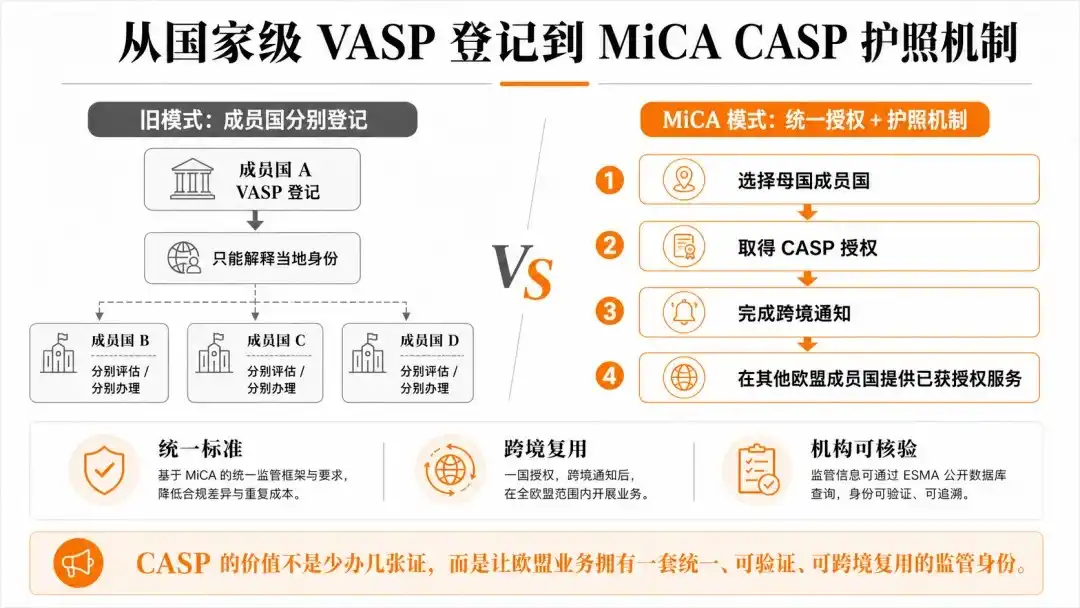
Before MiCA was fully implemented, crypto regulation in Europe was highly fragmented. A company could complete local registration in Lithuania, Poland, France, Italy, or another member state, but the requirements for business scope, capital, management, and ongoing compliance were not the same from one jurisdiction to another. Registration in one country usually did not prove that a firm had the right to keep operating across the entire EU.
MiCA changes that logic. Under the framework, a firm generally needs to apply for authorization as a Crypto-Asset Service Provider, or CASP, with the competent authority in the member state where its registered office is located. Once authorized, the firm can use the legal cross-border notification procedure to provide the crypto-asset services covered by its license in other EU member states, without filing a full new application for the same functions in every target market.
That does not mean a company with CASP authorization from one member state can run every type of business in Europe without limits. It may offer only the services covered by its authorization, and it still has to comply with consumer-protection, anti-money laundering, marketing, and other applicable rules. Even so, compared with the old system of repeated registrations in multiple countries, MiCA offers a clearer single-market access route.
For project teams, the article says the key commercial value of a CASP license is not simply having one more European certificate. It is the ability to place customers, operations, and institutional partnerships across different member states inside a regulatory framework that can be reused and independently verified.
What services a CASP license can cover
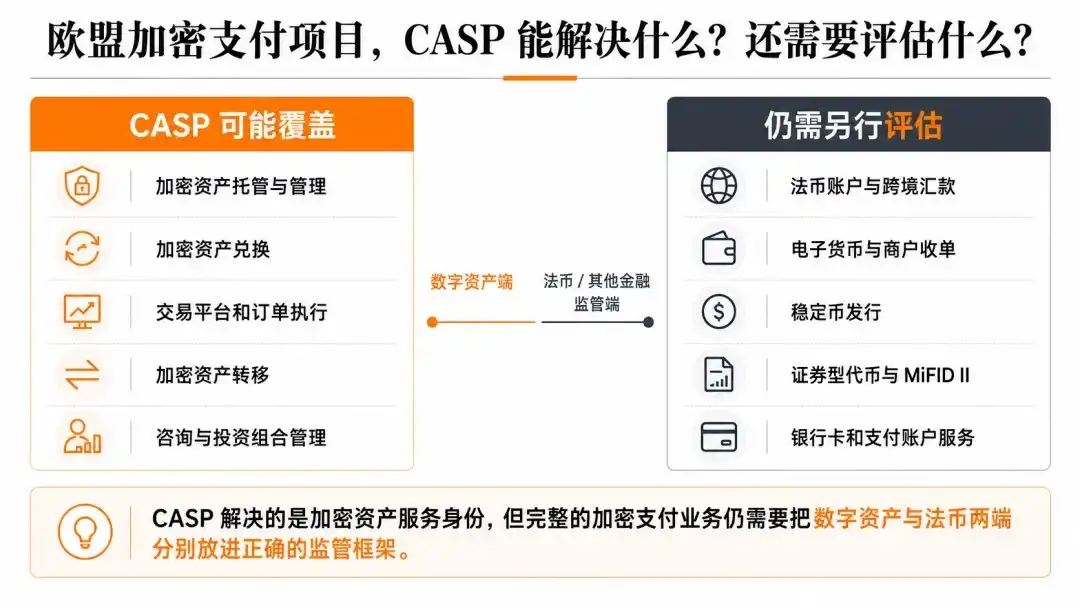
MiCA does not issue a single generic “crypto license.” It divides crypto-asset services by actual business function. The services listed in the article include custody and administration of crypto-assets on behalf of clients, operation of a trading platform for crypto-assets, exchange of crypto-assets for funds, exchange of one crypto-asset for another, execution of orders on behalf of clients, placement of crypto-assets, reception and transmission of orders, crypto-asset advice, portfolio management, and transfer services for crypto-assets on behalf of clients.
That means two products that both look like stablecoin payment tools for business users can fall into very different regulatory categories. If a platform only provides a technical interface and does not control client assets, the CASP scope may be relatively limited. If it receives customer stablecoins, controls collection wallets, converts assets, and transfers them to merchants or suppliers under client instructions, the platform may be performing custody, exchange, and transfer services at the same time.
If the platform also offers internal trading, order matching, or asset management, the required authorization scope and compliance burden can increase again. The article stresses that a company does not simply choose the service label that sounds closest to its product. Regulators determine the relevant permissions based on product functions, control over assets, transaction flows, and contractual responsibilities.
MiCA also requires CASPs to maintain prudential safeguards. The prudential resources a firm must hold are generally the higher of the minimum capital requirement for its business category or 25% of the previous year’s fixed overheads. The broader the license scope, and the closer the business is to trading platforms, custody, or more complex financial services, the higher the capital, governance, technology, and ongoing compliance responsibilities tend to be.
A broader license is not automatically better. Every added line of business means the firm has to prove it can carry those obligations over the long term.
Why banks and institutional clients are paying more attention
The article says banks, payment institutions, and institutional clients often struggle less with whether a crypto firm has registration papers and more with what a registration in a specific country actually means, whether the license matches the real business, and which entity ultimately holds client assets and regulatory responsibility.
MiCA improves the verifiability of CASP status through common authorization standards and public regulatory information. ESMA has set up MiCA-related registers and databases that can be used to check authorized CASPs and other supervisory information. That gives counterparties a way to go beyond documents presented by the project itself and verify license status, the home-state regulator, and relevant regulatory records.
The article also points out that CASP authorization is not limited to reviewing written policies. Citing ESMA authorization materials, it says regulators are expected to focus on a firm’s actual operations, governance, business plan, outsourcing arrangements, information technology, and anti-money laundering systems. Applicants with large cross-border activity, complex group structures, or heavy reliance on offshore outsourcing should face deeper scrutiny.
In practice, that means a company that obtains and keeps CASP authorization has to show regulators that it has a real EU entity and management setup, that its business plan matches the product in operation, that client assets are separated from company assets, that key technology and compliance functions are not entirely left offshore, and that workable mechanisms exist for system failures, customer complaints, or market exit.
CASP status does not guarantee a bank account, and it does not guarantee a contract with a large client. What it can provide, the article says, is a shared regulatory language for due diligence.
Non-EU projects have less room to rely on offshore structures and passive acquisition claims
For some Asian or offshore crypto projects, a common route in the past was to keep an overseas operating entity and argue that European clients came to the platform on their own, meaning no local authorization was required in the EU.
MiCA does preserve a very limited reverse solicitation exception, but ESMA has made clear that the exception should be interpreted strictly and narrowly. Only where a client acts entirely on its own initiative and requests a specific service may an offshore firm be able to provide that service within the relevant scope. If a project reaches EU clients through advertising, search engine optimization, social media, influencer promotion, traffic from an EU affiliate, or other channels, it may be treated as active solicitation and lose the ability to rely on the exception.
The article says the impact on global projects is direct. If a platform runs websites in European languages, places ads for European markets, deploys EU sales staff, or receives continuous traffic from European partners, it cannot replace the formal CASP route by adding a clause in user terms saying that the customer contacted the firm voluntarily.
In the MiCA era, whether a project is entering the EU market no longer depends only on where the company is incorporated. It also depends on who is being marketed to, who signs the contract, and which entity is actually providing the service.
CASP matters, but it is not a universal permit for EU financial business
MiCA mainly covers crypto-assets that are not already governed by other EU financial-services laws. If a token qualifies as a financial instrument based on its actual rights and economic characteristics, it may fall under securities frameworks such as MiFID II rather than MiCA, even if it uses blockchain technology.
For crypto payment projects, the interaction between e-money tokens and payment-services regulation is another issue the article highlights. If a platform transfers stablecoins on behalf of customers and those stablecoins meet the definition of e-money tokens, some of the activity may also have a payment-services character. In that case, a project may need to assess payment-institution licensing under PSD2 in addition to MiCA CASP authorization, or work with a licensed payment institution.
The article notes that the European Banking Authority, or EBA, has issued a dedicated opinion and transition arrangements on the connection between MiCA and PSD2. In its reading, that shows CASP status does not automatically cover every stablecoin payment function.
The same applies to fiat accounts, merchant acquiring, bank cards, e-money issuance, and traditional cross-border remittances. A payment platform that connects stablecoins and fiat often needs a CASP entity for the crypto-asset side, while the fiat side is handled by a PI, EMI, bank, or another payment institution.
CASP solves the question of authorization for crypto-asset services. A full crypto-payments business still has to place the digital-asset side and the fiat side into the right regulatory frameworks separately.
Which projects should prioritize MiCA CASP
The article identifies three types of projects that should consider CASP first.
- The first group includes trading, wallet, custody, exchange, and payment platforms that have already chosen the EU as a core market and plan to serve clients across multiple member states over the long term. If these firms continue relying on offshore entities or old national registrations, they may struggle to support cross-border marketing and institutional partnerships, and after the longest transition period ends they may face direct market-access problems.
- The second group includes projects preparing to work with EU banks, EMIs, PIs, large merchants, or institutional clients. These counterparties will typically ask about the scope of the CASP license, how customer assets are controlled, which authority supervises the home state, and how cross-border notifications have been handled. They may also verify the real division of work between EU entities and offshore group companies.
- The third group includes groups that have already built a certain trading scale and want to consolidate operations in multiple European countries under one regulated entity. MiCA’s passporting mechanism can reduce repeat applications, but the project must choose a home member state with a real operating base and align management, technology, compliance, and core decision-making with that entity.
By contrast, the article says that if a project is still in the product-validation stage, has no clear EU client base or market plan, and is not ready to market to or continuously serve users in the EU, launching a CASP application immediately may be too heavy a step. A more practical route is to define market boundaries first, limit EU-facing business, and design the future entity and product structure in line with MiCA requirements in advance.
After the transition period, the gray area is shrinking
The article closes by saying that when MiCA first passed, the market focused on the fact that Europe finally had a unified crypto regulatory framework. By 2026, the more important shift is no longer the rulebook alone. The longest transition period has ended, unauthorized projects have to leave, and banks and institutional clients are screening counterparties against MiCA standards.
For crypto firms that want to enter Europe, CASP is not a license to leave in marketing materials for later use. The article describes it as the basic structure connecting customer access, cross-border operations, banking relationships, and group responsibility. It does not solve every issue involving fiat payments, stablecoin issuance, or securities regulation, and it does not replace a real team or sustained compliance capacity. But for projects that plan to provide crypto-asset services in the EU over the long term, CASP is moving from something worth considering to something that must be clearly explained.
That growing importance, the article argues, comes not from Europe adding one more license, but from the bloc recognizing only one crypto-asset service identity that can be supervised under a unified framework.