
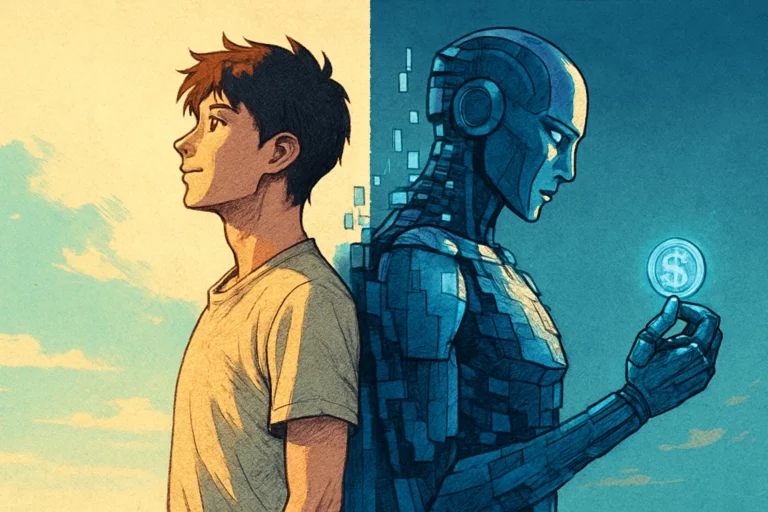
A commentary by Lao Bai, organized and adapted by Foresight News, argues that World of Warcraft and Roblox survived gold-farming ecosystems because money never became the highest layer of value inside those games. The piece draws a sharp contrast with Web3 games, where repeatable in-game actions are often tied to assets that can be freely traded and exited, creating conditions that favor capital, automation, and studio-style scaling over ordinary players.
Why gold farming did not break World of Warcraft
The article says WoW worked because gold was never the end-state value. Status, achievements, reputation, top-tier gear, and raid contribution could not simply be bought with gold. High-end items were commonly distributed through raid rules such as rolls or DKP, and loot was often bound to the character once obtained, cutting off resale. Gold could save time. It could not turn someone into a core player by itself.
That distinction kept industrialized farming at the edge of the game instead of the center. The article also points to Blizzard’s response after gold-farming operations appeared: allowing controlled channels for real-money-to-gold conversion, adding time gates through daily and weekly systems, and expanding categories of value that gold could not buy, including guild standing, coordinated raid performance, and social reputation. Farming remained part of the ecosystem, but it never dictated the core experience.
Roblox rewards creation more than repetitive labor
Roblox, in the article’s view, operates on a different but related logic. The most profitable activity is not repetitive resource grinding. It is making maps, designing gameplay, and managing communities. Those outputs are much harder to mass-produce through workshop-style operations. A team can scale resource collection. It cannot easily mass-manufacture a game mode that users genuinely want to spend time in.
The article also highlights Roblox’s more closed economic loop. Buying Robux with a credit card is easy, but converting value back into cash is less fluid, with thresholds, delays, and loss in the process. That limits arbitrage and “brick-moving” strategies. Revenue circulates through platform fees, top creators, and in-game spending, with far less open leakage than the asset models common in crypto games.
The critique of Web3 games starts at the design layer
The article’s main claim is that most blockchain games combine repeatable behavior with freely exit-able assets. In an environment where Web2 game systems are already mature, that structure invites whoever can optimize scale the fastest. Scripts, farming studios, and capital efficiency take over space that might otherwise belong to players. The author treats Play-to-Earn, Move-to-Earn, and Play & Earn as variations of the same formula rather than materially different models.
The piece frames this as a kind of impossibility triangle. A game may be fun. Speculators may be able to make money. Workshops may be able to scale. The article argues that all three do not hold at once for long. From that perspective, the failure of Web3 games is not only about execution quality or funding. It is rooted in a design choice that places financial exit at the heart of gameplay.
Putting WoW on-chain would not preserve what made WoW work
The article also revisits an old idea from the height of blockchain gaming: what if World of Warcraft itself were put on-chain? Its answer is blunt. If gold, items, and mounts became freely tradable, withdrawable, and financialized on-chain assets, the structure that made WoW durable would be weakened rather than extended. The game’s most meaningful elements were largely the ones that could not be freely traded: top gear, titles, achievements, guild first-kill history. They reflected what a player had done, not what a wallet had purchased.
The article suggests that if blockchain has a place in games like this, it may be better suited to recording proofs and traces rather than turning every object into a market asset—first-kill certificates, guild history, achievement timestamps, and records of world events. Its conclusion is narrow but clear: not everything benefits from being financialized, and in successful games, the most important things are often the ones that cannot be sold.