

A MarsBit analysis argues that DeFi primitives on HyperEVM are running into a structural clash with HyperCore’s market design. In the author’s view, lending markets, tokenized vaults and liquid staking tokens, or LSTs, cannot be copied onto Hyperliquid in the same way they were built elsewhere.
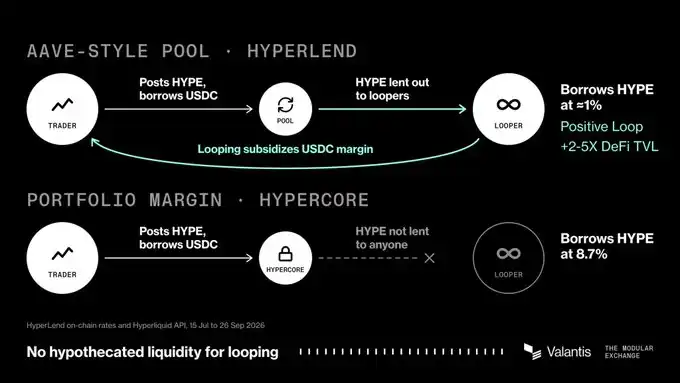
The central claim is that portfolio margin is making recursive borrowing around native Hyperliquid assets unworkable, while most DeFi primitives still rely on recursive borrowing. That leaves DeFi on Hyperliquid competing with HyperCore’s growth instead of reinforcing it.
The article lays out two possible paths. One is to build DeFi markets rooted in token utility rather than the older recursive-yield model. The other is that the DeFi layer must become complementary to HyperCore’s growth, or it will be absorbed or pushed out.
An economy built on leveraged yield runs into a break on Hyperliquid
The piece says traditional DeFi has been built around native on-chain yield sources: native yield first, then same-asset borrowing against yield-bearing receipts, then a downstream flywheel that supports a large share of DeFi activity.
On Hyperliquid, the market structure changes in two basic ways. The most important one is portfolio margin. The article describes it as Hyperliquid’s native margin engine and says liquidity that would otherwise support leveraged yield gets pulled into leveraged trading instead.
That mechanism was not designed for same-asset borrowing, the author says, so the conditions that keep the usual DeFi flywheel running have changed and there is no direct replacement.
- There is no reusable rehypothecated liquidity for recursive loops. The article gives an example: on AAVE, if HYPE is posted as collateral to borrow USDC, that HYPE collateral can still be used by recursive stHYPE and kHYPE users, lowering the cost of looping. On HyperCore, if HYPE is posted to borrow USDC, that HYPE liquidity is not made available for recursive reuse.
- It also does not support the lower-capital liquidation paths common in EVM lending markets. Hyperliquid is designed to liquidate against an order book. If a yield-bearing derivative is used as collateral, a separate deep order book would need to be built on HyperCore. On AAVE and Morpho, by contrast, yield-bearing derivatives can be supported through mechanisms such as withdrawal-queue liquidation.
Why the AAVE flywheel looks different
The article compares AAVE’s growth strategy with Hyperliquid’s portfolio margin model. It says AAVE subsidizes ETH borrowing by bringing in large whale ETH-USDC borrowing activity, and uses E-Mode to give yield-bearing derivatives a special liquidation path, making stETH more usable as collateral.
According to the article, 80.6% of supplied WETH on AAVE belongs to accounts that use it as collateral to borrow stablecoins. The author argues that AAVE’s pool engine creates a flywheel between USDC margin and ETH yield leverage, with each side subsidizing the other.
Portfolio margin works differently. The article says it pulls USDC margin out of the pool system, does not re-lend collateral and does not allow same-asset borrowing. Recursive trading is therefore killed off, with nothing replacing it.
If USDC borrowing moves from pool-based lending to portfolio margin, the author says, recursive Hyperliquid-native yield, including vault tokens, LP positions and LSTs, gets removed from the DeFi economy. The problem is that the current DeFi economy depends on that trade and on the symbiosis between margin and recursion.
Staking emissions may have limited structural value on Hyperliquid
The article argues that Hyperliquid is unusual because the chain is already useful enough that it does not need network-level inflation to drive consensus participation. In that setting, staking emissions have limited marginal value. On many other chains, those emissions are the native yield source that supports a large share of DeFi activity.
The author says staking emissions do little to align token holders. Net new demand for HYPE, according to the piece, comes from HIP-3, HIP-4, AQA and staking-tier discounts, not from the 2.2% yield.
The validator set, the article says, is effectively made up of custodians, DATs, data providers and organizations that run validators for operational reasons and latency, rather than for yield. It points to the number of 0% commission validators as evidence that entry into the active set is a privilege many are willing to pay for.
From there, the author argues that if staking emissions do not provide a meaningful benefit to Hyperliquid, they should be reassessed. Hyperliquid DeFi, in the same view, needs to quickly redefine its purpose.
Liquidity is being pulled out of HyperEVM DeFi
The article says HyperEVM DeFi is fundamentally driven by LST leverage, and the current picture is weak.
One key date in the piece is Sept. 18, when Hyperliquid announced manual borrowing: users could post HYPE or BTC on HyperCore and borrow USDC.
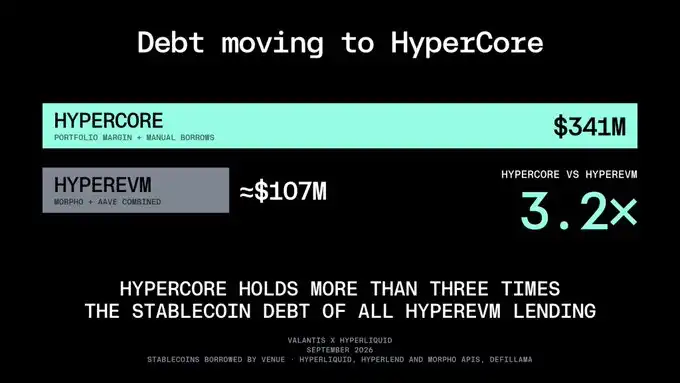
Two days later, according to the article, one HyperLend account withdrew 743,058 HYPE, bridged it to HyperCore, borrowed $25.65 million in USDC against it and repaid $25.60 million in HyperLend debt. The entire HyperEVM borrowing position moved to HyperCore in 33 minutes.
A second account followed. The article says utilization in HyperLend’s HYPE pool rose from 78% to 98%, while the HYPE borrow rate jumped from 1% to 90%. At that point, recursive looping stopped making economic sense.
Structurally, the author says, portfolio margin is moving HYPE liquidity from HyperEVM to HyperCore. Without intervention, that process could continue until liquidity is exhausted.
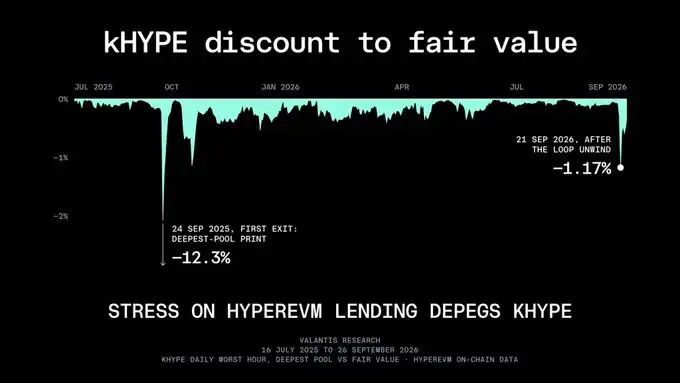
The result is that LSTs on Hyperliquid struggle to support their own economics and can remain depegged for long periods. The article points to kHYPE as an example, saying its depegs have been more frequent and more severe than comparable LSTs in the Ethereum and Solana ecosystems.
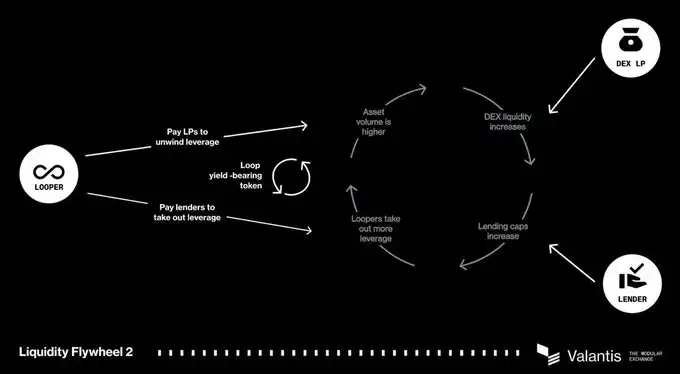
Liquid staking is capital-intensive by design, the piece says. It needs HYPE lenders to support low-rate, stable recursive loops. It also needs DEX liquidity and arbitrageurs to maintain the peg and lower exit costs. Once the native margin engine pulls out a core part of the system, the flywheel becomes hard to sustain.
Valantis and Kinetiq face the same structural pressure
The article says Valantis has focused on optimizing DeFi economics under capital constraints. It describes stHYPE’s native dynamic instant-redemption buffer as a way to reduce the need for deep DEX liquidity and help users exit within seven days. It also says STEX reuses liquidity across HYPE lenders, serving recursive loops while also providing swap liquidity when needed.
According to the piece, stHYPE is only one-fifth the size of kHYPE, yet its peg has been more stable. Even so, market pressure is still visible. The author argues that the staking-yield trade has become too fragile to assume the flywheel can survive portfolio margin. Under the current structure, HyperCore absorbing all liquidity is the natural direction.
The article also mentions Kinetiq, which has described itself as building the fastest-growing LST in the category’s history and has framed its role as becoming Hyperliquid’s Lido and Jito. The author pushes back on that comparison, saying Ethereum and Solana do not have a native margin engine competing with lending markets. Structurally, Hyperliquid is one of the least suitable environments in crypto for a standard LST model.
If that trade no longer exists, ordinary LSTs have little left to do, the article says. The disappearance of usable liquidity for yield-bearing derivatives should be read in a broader context: much of today’s DeFi is made up of yield-bearing derivatives, including tokenized yield vaults, LP positions and LSTs. Once recursive liquidity disappears, many of the DeFi primitives that have been validated so far stop working. New primitives are needed.
HYPE staking is not mainly about yield
The article says most Ethereum DeFi sits downstream from LST leverage loops, which is why recursion is treated as a first-class feature there. Hyperliquid locks HYPE in a different way. Instead of paying holders to stake, it requires businesses that want to use exchange resources to buy and stake HYPE.
- To deploy a perpetual market under HIP-3 or an event market under HIP-4, users must stake 500,000 HYPE for six months, with slashing risk.
- To make a stablecoin the aligned unit of account, users must stake 1 million HYPE.
- To trade at lower fees, users can stake 10 HYPE for a 5% discount, with the top tier reaching 40% at 500,000 HYPE. The article lists intermediate tiers at 100, 1,000, 10,000 and 100,000 HYPE. It says top traders and market makers can save more than $40 million a year by locking HYPE for lower fee tiers.
- To peer directly with foundation nodes for low-latency data, users must stake 10,000 HYPE.
Each of those cases, the author says, reflects a partner or trader consuming network resources and paying with locked HYPE. If someone wants access to those resources, staking HYPE is the entry key. Liquid staking should build markets around that key.
The article cites Valantis’ framing of liquid staking in three acts: first, yield from high economic security costs, represented by stETH; second, yield from privileged access to liquidity flows, represented by JitoSOL; third, yield from direct access to liquidity, represented by staked HYPE.

In this model, the point is not to tokenize HYPE’s native yield. It is to build an economy around gated access to network resources and liquidity.
DeFi primitives that survive will need to extend HYPE utility beyond HyperCore
The article argues that the primitives most likely to survive on Hyperliquid are the ones that can carry HYPE utility into areas HyperCore cannot cover on its own.
Native staking cannot be used as portfolio-margin collateral
Traders who want to use their HYPE as margin are giving up yield and lower Hyperliquid fees, the article says, because portfolio margin cannot accept staked HYPE as collateral.
The reason, according to the author, is that a margin engine needs liquidators, either through an order book or through a risk-curated lending market willing to take redemption risk. Natively staked HYPE has neither. Portfolio margin therefore will not support native staking by design. LSTs are needed to bring staking benefits into the margin system.
The article suggests that an LST capable of carrying trading-fee discounts could address that gap. Its logic is that stHYPE tokenizes the discount, something that cannot be replicated without a liquid receipt, and that can create downstream DeFi activity. The author describes this as a Hyperliquid-native DeFi flywheel.
HyperCore handles USDC margin, HyperEVM handles derivative risk
The article says HyperCore portfolio margin does not support derivative assets in a capital-efficient way. Bootstrapping separate order books for stETH-USDC and stHYPE-USDC would be capital-intensive and would compete with ETH-USDC and HYPE-USDC books on HyperCore.
One path, the author says, is for HyperEVM margin to take derivative risk while HyperCore takes price risk. The article sketches the route as follows:
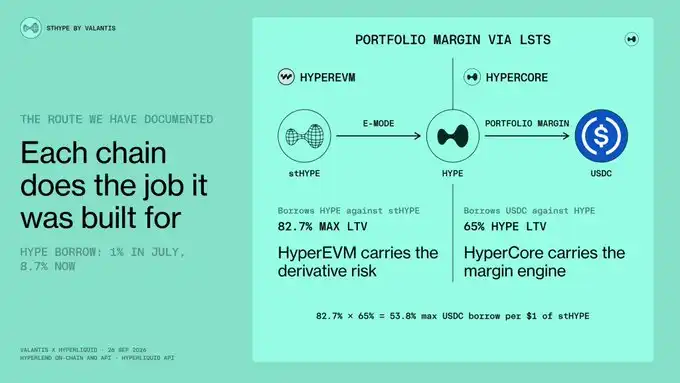
- AAVE: stHYPE to HYPE
- HyperCore: HYPE to USDC
That model competes the least with HyperCore because it only fills the missing piece while still using HyperCore’s USDC liquidity. HyperCore does not carry derivative risk; the EVM side does.
The main question is how to keep HYPE borrowing rates low when most HYPE-USDC borrowing has already moved to HyperCore. If that can be solved, the author says, recursive activity could return around a new set of DeFi assets enabled by Hyperliquid’s specific structure.
Markets for HYPE utility and exclusive yield
The article says tokenization is fundamentally about splitting assets to create new markets. It points to the Valantis integration with Pendle as an example, describing it as the tokenization of Hyperliquid fee discounts.
In the model described by the author, traders pay a premium to buy fee discounts from HYPE holders. stHYPE holders monetize their staking-tier discounts by selling them to YT holders and collecting a premium, which shows up in PT yields.
That, the article says, is DeFi creating a new yield source and a market around HYPE’s asset utility. Similar structures could appear around HIP-3, HIP-4 and future HYPE utility use cases.
Exclusive yield created by DeFi
The article stresses that staking is not homogeneous. The same 500,000 staked HYPE can be worth 2.2% to a passive holder, a 40% taker-fee discount to a market-making desk, a license to operate a perpetual exchange to a deployer, the right to list an event market to another participant, or a distribution channel into what the author calls the fastest-growing exchange in crypto for a stablecoin issuer.
Behind the same stake sit different businesses, and nearly all of them are obtained through private deals with their own yields, lockups and slashing terms. That is what the author calls exclusive yield on Hyperliquid. It does not come from on-chain emissions. It comes from what staking unlocks for a specific counterparty.

Once staking becomes non-fungible, primitives such as restaking and tranching may become useful tools for delivering value that HyperCore itself cannot replicate. The article says the dynamic utility of staking on Hyperliquid opens a new design space for DeFi.
It also gives one example. From December to August, stHYPE delegated HYPE to Ethena HyENA exchange, generating more than $1 million in HYPE rewards for stHYPE holders. The article says that turned a private, illiquid yield source into something publicly accessible, with more than $100 million in HYPE able to move in and out without delay.
That new yield created new economics for stHYPE and spread into lending markets, AMMs and ordinary user wallets, the author says. The next phase for stHYPE, in the same view, will try to rebuild that state through scale and network effects. The article adds that this DeFi structure could help HyperCore grow rather than fight it, and that DeFi liquidity may bring more market activity to HyperCore than private counterparties do.
The issue is market structure, not speed
The article closes by saying any Hyperliquid project built on the assumption of a general-purpose DeFi layer is more exposed than it may realize.
What is holding HyperEVM back is not speed or composability, the author argues, but market structure. A new sidecar or Layer 2 will not fix that on its own.
The conclusion is that HyperEVM’s current difficulty comes from an outdated mental model. The inherited DeFi playbook on Hyperliquid is over, and the next version of its DeFi layer is now taking shape.