

NeoCloud has become one of the strongest pockets of the latest rebound in U.S. tech stocks. MarsBit’s analysis points to CoreWeave, Nebius and a group of AI infrastructure companies with access to power and data center resources as the main standouts.
The article’s core argument is that investors are assigning value to a layered AI infrastructure equity story: compute capacity that is already locked in by contract and can be delivered fast. If AI demand expectations move higher, revenue forecasts, financing capacity and equity value for NeoCloud companies can all rise at the same time. That helps explain why the group has shown sharper upside during the rebound.
Investors are paying for powered-on compute factories
MarsBit says the bottleneck in AI has shifted. Early on, the scarcest item was the GPU. Then the pressure moved to HBM and high-speed networking. Now, customers are short of something broader: a full package that includes secured GPUs, enough power, completed data center construction, network interconnection and the ability to deliver large clusters within a matter of months.
That gap is where NeoCloud sits. These companies typically package GPU clusters, networking, liquid cooling, data centers, power access and operations. Customers are not just buying chips. They are buying large-scale compute capacity that can run AI training and inference right away.
That distinction matters. GPUs can be purchased. Power capacity, land, substations, data center permits and network access cannot be reproduced quickly. Large cloud platforms have capital and customers, but they still face build timelines. Some AI companies also want more flexibility and do not want to place all of their demand with a single hyperscaler.
In that setup, NeoCloud providers with existing power and rapid deployment capability become accelerators for AI infrastructure spending.
MarsBit says the market is willing to assign higher valuations because these assets share two characteristics:
- They are scarce, since available power and deliverable data center capacity are limited.
- They can be contracted, since customers are willing to sign multi-year capacity agreements with minimum commitments.
Once scarce resources are tied up in long-term contracts, investors stop treating the business as plain IT services revenue and start viewing it more like infrastructure cash flow.
Earnings shifted the market’s view of the model
The biggest question hanging over NeoCloud had been straightforward: buying GPUs and building data centers requires heavy capital expenditure, so would these companies be trapped in a cycle of constant fundraising and constant cash burn?
MarsBit says recent earnings leaned in a more constructive direction. CoreWeave posted Q2 revenue of $2.575 billion and disclosed backlog of about $104 billion, defined in the article as signed but not yet recognized expected revenue. Nebius said AI Cloud ARR reached $3 billion and also disclosed several large long-term contracts.
The market is looking past quarterly revenue alone and focusing on whether a full business loop is now visible:
- AI customers sign long-term capacity contracts.
- Some customers provide prepayments or minimum payment commitments.
- The company gains easier access to debt and equipment financing.
- New GPUs, data halls and power capacity come online.
- Revenue and EBITDA grow.
- Financing capacity and expansion capacity improve again.
Under that framework, the story is moving away from a high-capex GPU lessor and toward an AI infrastructure operator whose expansion is backed by orders. If orders, financing and delivery keep connecting, MarsBit argues, the business starts to resemble a flywheel.
Why storage and the big three clouds did not get the same move first
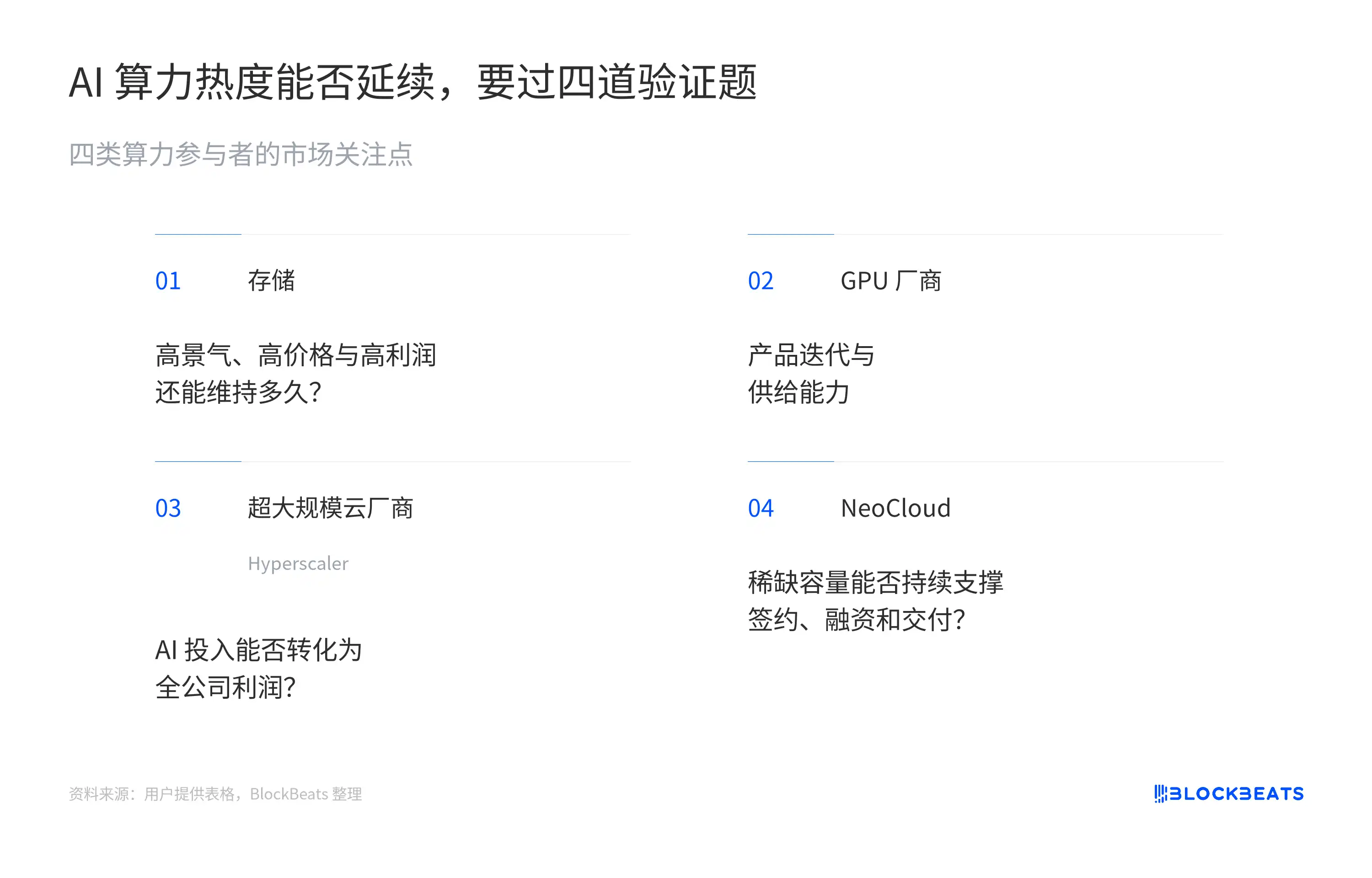
The article says capital is reacting to differences in expectation and sensitivity across the value chain.
Storage leaders still benefit from AI demand, and the cycle in HBM and DRAM remains strong. But investors have started worrying about supply ramping up, prices staying elevated, margins reaching a peak and whether earlier optimism is already reflected in stock prices. In that case, even strong earnings can leave shares under pressure if forward guidance is not revised higher.
Storage companies also face a cycle problem. Investors are trading the path of pricing, shipments and gross margins over the next few quarters. If supply may catch up with demand and average selling prices may ease, strong current earnings do not necessarily keep expanding valuations. MarsBit also notes that HBM/DRAM, NAND/SSD and HDD belong to different sub-cycles, so share price moves across storage names should not be reduced to a single explanation.
The three major cloud platforms — Microsoft Azure, Amazon Web Services and Google Cloud — have steadier cash flow, customer reach and technical depth, and they remain core beneficiaries of AI spending. But their AI businesses are diluted by much larger revenue bases across advertising, enterprise software, e-commerce and consumer operations. New AI capital spending also takes longer to show up as margin improvement at the full group level.
For investors chasing elasticity, one large NeoCloud contract often has a greater marginal effect on revenue and valuation than an order of the same size would have for the overall valuation of the big three clouds. MarsBit places NeoCloud between the two groups: smaller revenue bases, purer AI exposure, faster order growth and long-term contracts that can directly support the next round of financing and expansion.
The three layers of NeoCloud leverage
MarsBit sums up the market’s logic with a simple idea: NeoCloud is, in essence, a form of leveraged AI infrastructure exposure.
Owning these stocks means holding an equity asset that is highly sensitive to AI compute demand, the pricing of deliverable capacity and financing conditions. The article breaks that leverage into three parts.
The first is operating leverage. Upfront spending on GPUs, data centers, power access, networking and operations is high, and many of those costs become relatively fixed once capacity is live. As utilization rises and per-unit capacity pricing improves, incremental revenue can convert into profit at a faster rate, producing noticeable margin improvement at the margin.
The second is financing leverage. Long-term contracts, take-or-pay style commitments and customer prepayments make projects more attractive to lenders and equipment finance providers. That allows a company to use a portion of equity capital to unlock much larger GPU, facility and power investments. Once new capacity starts billing, revenue can support the next construction cycle.
The third is equity leverage. MarsBit says NeoCloud companies usually have smaller revenue bases and market capitalizations than the big three clouds, while fixed assets and debt occupy a larger share of their balance sheets. If a major contract lifts revenue expectations, utilization and financing availability at the same time, the market’s repricing of equity value can be steep. Sharp post-earnings rallies often come from a combination of higher profit expectations and higher valuation multiples.
Those three layers create a positive feedback loop on the way up:
- Larger long-term contracts.
- Easier financing and greater capacity expansion.
- Higher utilization and operating profit.
- Higher equity value and stronger financing ability.
- More contracts and another round of expansion opportunities.
The same mechanism also amplifies downside risk. If customers delay, utilization drops, GPU or power delivery slips, or debt costs rise, fixed costs and financing obligations can compress equity returns. The market’s willingness to price NeoCloud for high upside also reflects the execution burden attached to that view.
Order visibility is at the center of the re-rating
MarsBit says the most attractive part of the NeoCloud story is revenue visibility.
When customers sign take-or-pay style contracts, they still carry minimum payment obligations even if short-term usage fluctuates. That makes revenue easier for operators to forecast, and it also improves the feasibility of asset-backed financing from a creditor’s perspective.
Because of that, the market is tracking several metrics closely:
- The duration, enforceability and customer credit quality of signed contracts.
- The gap between energized MW and contracted MW.
- Revenue per MW and capex per MW.
- The share of customer prepayments and the payment schedule.
- Utilization, renewal rates and customer concentration.
- Debt rates, debt tenor and follow-on financing capacity.
Among them, energized capacity stands out. Contracted MW represents demand, but only MW that is powered on, installed and billing will enter revenue and cash flow.
The market is also revaluing power assets
One of the most important observations in the article is a shift in focus from GPU counts to power capacity.
GPU supply can expand as NVIDIA, AMD and cloud providers keep buying. High-quality power capacity takes longer to build. It depends on the grid, substations, land, permits, data center construction and regional network conditions.
Whoever secures enough power earlier can convert GPUs into sellable compute earlier.
That is also why some companies transitioning from Bitcoin mining sites have been able to enter this theme. They already hold parts of the necessary power resources, land and infrastructure, and can move assets from mining load to AI load. MarsBit adds an important caution, though: having the resource base is not the same as commercial success. Customers, financing and delivery still decide the outcome.
A reshuffling inside the AI infrastructure value chain
MarsBit’s conclusion is that NeoCloud’s leadership in the tech rebound reflects a repricing across the AI infrastructure value chain.
The assets drawing the most attention are those that can combine GPUs, power, data centers and long-term customer contracts into deliverable compute capacity at speed. They capture AI capex, but they also carry stronger contract characteristics than chips or components alone. That gives them both growth sensitivity and a scarcity premium tied to infrastructure.
The next question is a simple one. Can those large orders turn into powered-on clusters, recognized revenue and cash flow that covers the cost of capital on time? That, the article argues, will determine whether NeoCloud can keep outperforming.