
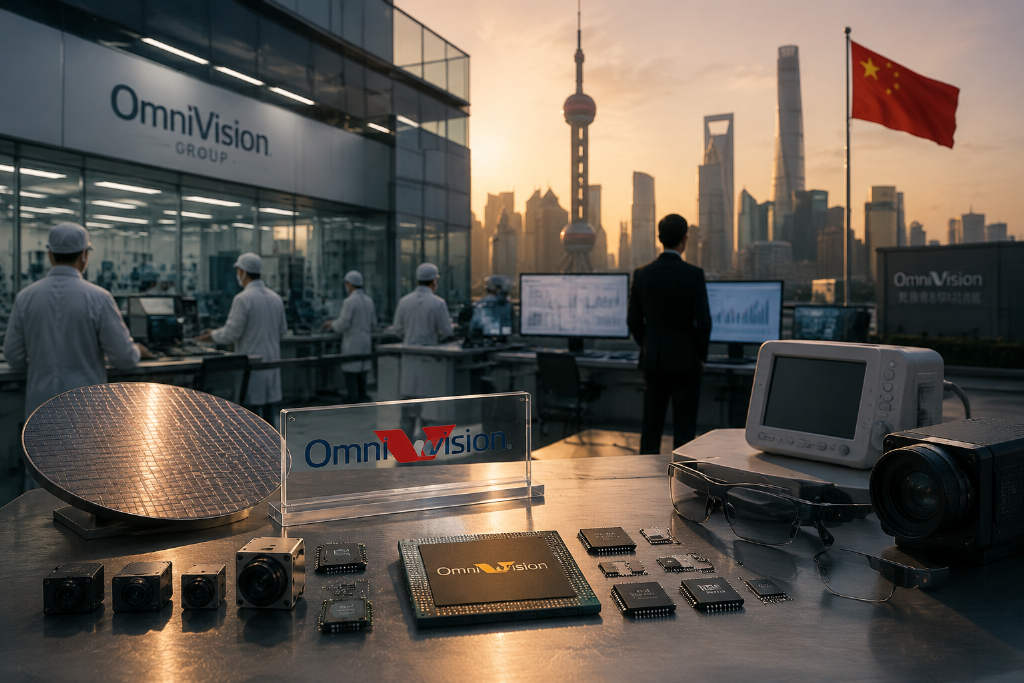
Will Semiconductor released a first-half 2026 report that showed flat top-line growth but a much weaker profit picture. Revenue for the period reached 14.02 billion yuan, up 0.49% from a year earlier, while net profit attributable to shareholders fell 39.85% to 1.22 billion yuan. Net cash generated from operating activities came in at 408 million yuan, down 78.40% year over year.

Only months earlier, the company’s 2025 annual report had shown full-year revenue growth of 12.14% and a 21.73% rise in attributable net profit. The first half of 2026 marked a clear reversal on earnings.
The company is chaired by Yu Renrong. The report said his fortune reached 68 billion yuan in 2025, and media outlets described him as China’s richest chip entrepreneur. Will Semiconductor’s main businesses are semiconductor design and sales, and semiconductor distribution. It is also described as the world’s third-largest smartphone CIS supplier and the largest supplier of automotive image sensors.
Core businesses weighed on earnings
By segment, the company operates two main businesses: semiconductor design and sales, and semiconductor distribution. Revenue from semiconductor design and sales totaled 10.67 billion yuan in the first half, down by 900 million yuan from a year earlier. The report attributed the decline mainly to temporary supply-demand disruptions in memory chips and pressure on downstream demand in consumer electronics and automotive electronics.
Revenue from image sensor solutions, which accounted for 66.05% of main business revenue, fell 10.55% to 9.254 billion yuan. Within that business, revenue from the automotive market was about 3.159 billion yuan, down 16.64%, while revenue from consumer electronics was 2.836 billion yuan, down 30.98%.
By contrast, semiconductor distribution made up 23.29% of main business revenue. Because that business carries a lower gross margin, it pulled the company’s overall gross margin down by 1.70 percentage points.
Costs added more pressure. R&D expenses and finance costs combined increased by 216 million yuan from a year earlier in the first half, further narrowing profit room.
Cash flow weakened and inventory climbed
Beyond earnings, investors also focused on cash flow and inventory. Net cash from operating activities dropped to 408 million yuan in the first half of 2026, a decline of 78.40%. The company said the main reason was higher cash paid for goods purchased and services received.
Using operating cash flow divided by net profit, the earnings cash conversion ratio was 33.43% in the first half of this year, versus 93.09% in the same period last year. That change points to weaker cash backing behind reported earnings.
As of the end of the first half of 2026, inventory had risen to 9.187 billion yuan, up 15.51% year over year. The company warned about the risks tied to its relatively large inventory balance, saying that if it fails to respond in time to downstream industry changes or if other hard-to-predict factors emerge, inventory may not be sold smoothly, which could hurt operating results and operating cash flow.
Third-quarter guidance leaves little room for acceleration
Alongside the interim report, Will Semiconductor also released an operating outlook for the third quarter. It expects revenue of 7.578 billion yuan to 8.130 billion yuan, representing a year-over-year change of -3.18% to 3.87% and a quarter-over-quarter change of -0.43% to 6.83%.
For comparison, revenue in the third quarter of 2025 increased 14.81% from a year earlier and 4.58% from the prior quarter. Based on the company’s own guidance range, this year’s third-quarter year-over-year growth rate could come in below last year’s level.
The first-half report, taken as a whole, showed three clear signals: revenue was largely defended, profit contracted sharply, and cash flow indicators turned weaker.

Medical imaging, AI glasses and machine vision are the main new bets
With its traditional smartphone and automotive CIS businesses under pressure, Will Semiconductor is stepping up work in newer areas including medical imaging, AI glasses, sports cameras, machine vision and automotive analog chips.
In a company research briefing cited in the report, Will Semiconductor said it places high importance on medical, AI glasses, sports cameras and machine vision, and sees them as the focus of its second growth curve.
In professional imaging devices, the main product forms include sports cameras, panoramic cameras and wearable imaging devices. The report cited an institutional forecast that the global sports camera market will expand to $8.18 billion in 2026. Will Semiconductor said its image sensors are core image capture components that support image quality and stability in panoramic and sports cameras.
In machine vision and robotics, the company has set up a new machine vision division focused on solutions for industrial automation, robotics, logistics barcode scanners and intelligent transportation systems. It is also continuing technical engagement with customers in embodied intelligence and humanoid robotics, while pushing related product planning.
On-device AI hardware is another target. The report said product form factors are moving from function-oriented glasses centered on audio and photography toward AR devices with display and interaction capabilities. In that area, the company’s CMOS image sensors, CameraCubeChip® and LCOS products can all be used in smart glasses.
In medical applications, the company said it has worked in medical imaging for more than a decade, with medical CIS products widely used in minimally invasive surgery, surgical robots and precision diagnosis and treatment.
Growth is real, but scale is still limited
Operating data disclosed by the company show that revenue from emerging markets within the image sensor business reached about 1.726 billion yuan in the first half, up 47.12% year over year. Revenue from the medical market within the image sensor business was about 509 million yuan, up 14.73%.
Will Semiconductor also said its analog solutions business is built around two core categories, analog ICs and discrete devices, covering power management, signal conditioning and power drive. As automotive intelligence and electrification advance, automotive analog chips have become the company’s core second growth line within analog products.
In the first half of 2026, the company launched several automotive-grade analog products designed for high-speed signal transmission and power control needs in intelligent driving and cockpit applications. Those products have passed early-stage testing and validation by multiple automakers and Tier 1 customers. According to the company, automotive analog IC revenue reached 200 million yuan, up 66.51%, making it the main driver of growth in the analog segment.
Even so, the report was clear about the current limit of that momentum. The combined revenue from the new growth lines remained below 2.5 billion yuan in the first half, accounting for less than 18% of total revenue. More than 82% of the company’s revenue still came from traditional image sensor businesses tied to consumer electronics and automotive demand.
That leaves Will Semiconductor in the middle of a structural transition. Its image sensor solutions business is facing pressure, while newer businesses and automotive analog chips are growing quickly. Whether the company can return to a stronger growth path will depend on two points raised in the report: whether consumer electronics and automotive CIS can stabilize, and whether newer businesses can keep scaling fast enough to carry the second growth curve.
This article was sourced from the WeChat account Delinshe (ID: delinshe), written by Chidu Business.