
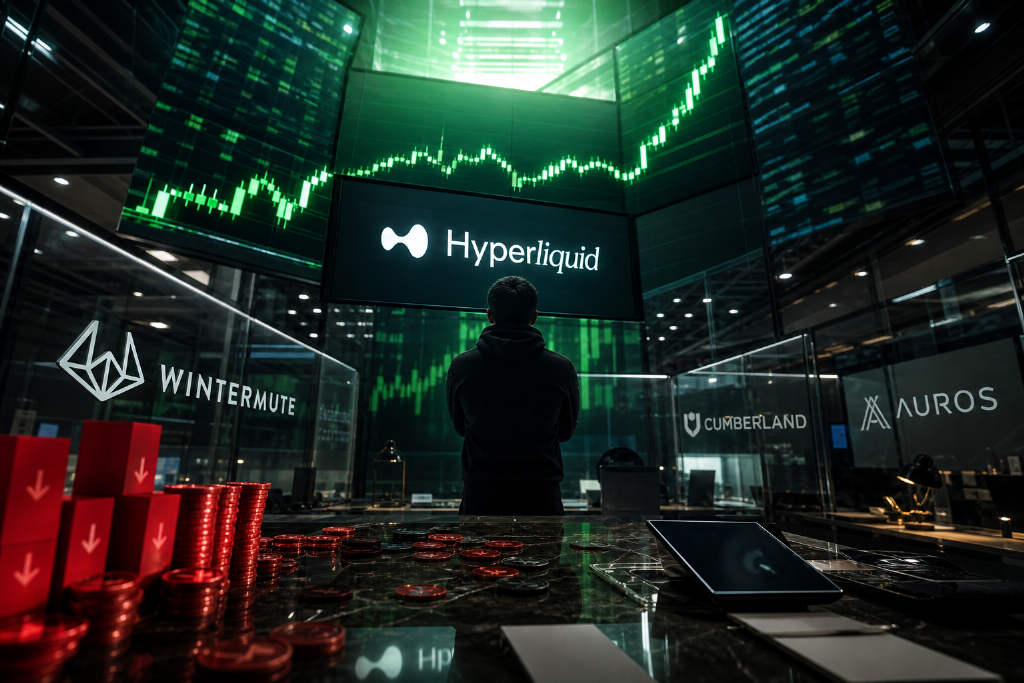
Crypto prices broadly moved higher, but several market-making addresses ended up carrying large short exposure in the process.
According to TradingBeats data cited by BlockBeats on Aug. 24, 66 of the 76 main perpetual contracts on Hyperliquid with more than $1 million in trading volume over the past 24 hours posted gains. That works out to roughly 86.8%, while the median increase was about 4.6%. BTC rose around 1.8%, ETH added about 2.7%, and some altcoins were up more than 10%.
During that move, three addresses labeled as Wintermute, Cumberland, and Auros were forced to take the other side of large sell orders, leaving them with a combined crypto short book of about $230 million. Their long positions totaled only about $9.93 million, putting net short exposure at roughly $220 million. At the time of publication, the three addresses were showing a combined floating loss of about $6.92 million.
Wintermute accounted for the biggest share. A single address linked to the firm held 61 short positions worth about $163 million. Shorts in ETH, BTC, SOL, and HYPE alone were nearing $100 million. Cumberland and Auros were carrying short exposure of about $20.63 million and $46.87 million, respectively.
Order book data also pointed to standard market-making behavior rather than a simple directional bet. Wintermute had 1,718 crypto orders live, including 854 sell orders and 864 buy orders, across 77 contracts. Of those, 74 had two-sided quotes in place. Auros was also posting both bids and offers across most instruments, maintaining what BlockBeats described as a typical market-making structure.
BlockBeats said that when prices keep rising and aggressive buyers continue lifting offers, market makers acting as counterparties passively sell more contracts. That process pushes perpetual inventory toward the short side. In that framing, Wintermute’s roughly $160 million short position was the result of a one-way rally transferring risk inventory onto liquidity providers.
By press time, Wintermute had already started to cover those shorts on an ongoing basis and reduce its net short exposure, a move the report said fit the pattern of market-making inventory rebalancing.