
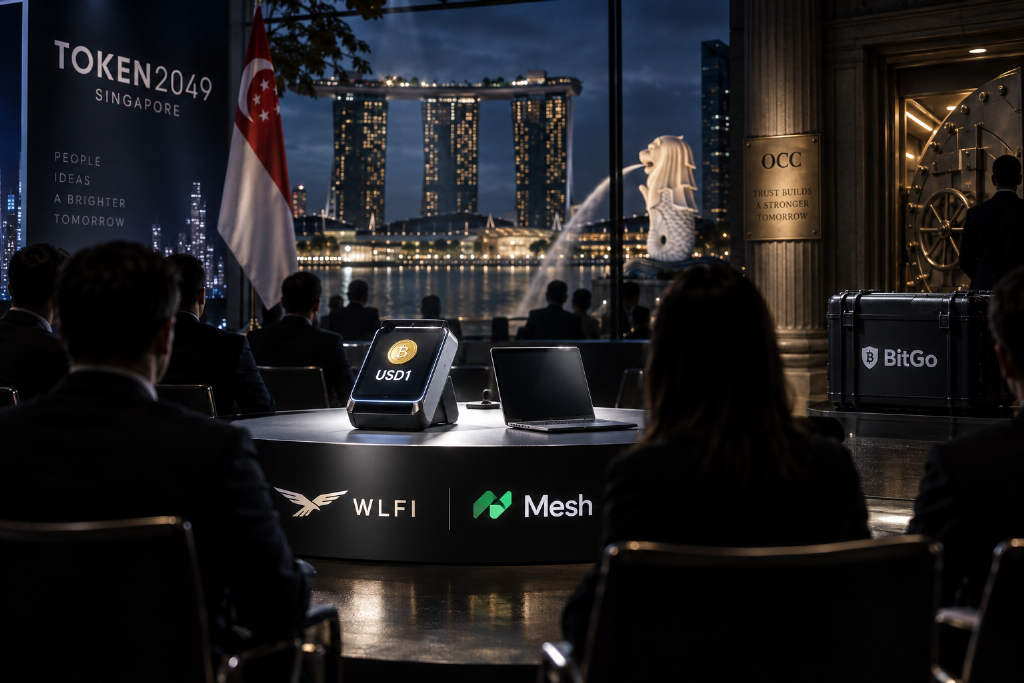
World Liberty Financial (WLFI), the Trump family-backed crypto project, used the Token2049 stage in Singapore on Wednesday to roll out two updates: a partnership with payments infrastructure company Mesh aimed at bringing the USD1 stablecoin to e-commerce and online merchants, and conditional approval from the Office of the Comptroller of the Currency (OCC) for a trust bank charter that could, in time, let WLFI handle USD1 issuance itself instead of leaning on BitGo.
USD1 is being prepared for e-commerce use
WLFI CEO Zach Witkoff, co-founder Zak Folkman, and Mesh co-founder and CEO Bam Azizi appeared together in a roundtable centered on stablecoins. Azizi said Mesh will work with WLFI so USD1 holders can spend the stablecoin directly for payments across Mesh’s merchant network.
Folkman said, "Beyond the World Liberty app itself, we are already planning to bring this technology to some of the biggest Web2 companies in the market." Put simply, the company plans to push the payment tech past the World Liberty app and into some of the largest Web2 businesses. That would move USD1 out of crypto-native use cases and into regular online commerce.
According to CoinGecko data cited in the report, USD1 has a market capitalization of $4.45 billion and is currently the most active asset in the WLFI ecosystem. If Mesh pulls off the integration across its merchant network, USD1 would move closer to actual consumer spending instead of staying boxed into transfers and trading inside crypto markets.
WLFI says trust bank approval could shift issuance away from BitGo
Right now, USD1 is issued through BitGo, which manages reserve custody and compliance. The report says those reserves consist of cash, U.S. government money market funds, and other cash-equivalent assets.
In August, the OCC gave conditional approval to WLFI’s application to establish a national trust bank. Witkoff said, "At the moment we issue through BitGo; with a trust charter, we will be able to take on that responsibility ourselves." In plain terms, WLFI says the charter would let it take direct responsibility for issuing USD1.
If that happens, WLFI would be one of the few crypto companies holding both stablecoin issuance authority and a trust bank charter.
Political criticism follows the OCC decision
But the OCC decision has done nothing to kill the controversy around the project. Senator Elizabeth Warren criticized the agency’s move, saying the Trump family’s relationship with WLFI creates a conflict of interest. She also introduced the Ending Presidential Corruption in Banking Act in an attempt to stop the arrangement.
The OCC replied that its leadership team and staff fully complied with their statutory duties and ethical obligations. Witkoff described the approval as something the company achieved "despite all kinds of attacks, we still got it done," referring to criticism from mainstream media and political figures.
Adoption remains the next test for USD1
For now, the report says WLFI is working with three advantages: political backing, a coming trust bank charter, and a stablecoin with a $4.45 billion market cap. The Mesh deal gives USD1 its first shot at mainstream e-commerce spending instead of keeping it stuck inside crypto-only transfer and trading activity.
Still, the next stretch comes down to a few hard questions: whether merchants actually want to accept USD1, whether U.S. regulators put WLFI under tighter scrutiny, and whether the company can build market trust while the political fight keeps going.