

The World Cup is a practical setting for observing how crypto wallets are changing. Daily conversations among fans about whether a team will qualify, how championship odds move, and which match is worth watching become tradable and priceable actions on prediction markets such as Polymarket. In that context, World Cup prediction campaigns integrated by mainstream Web3 wallets can be read as a lightweight starting point for users to enter on-chain interaction. The source article places this path alongside its earlier discussion, “世界杯狂欢,预测市场上桌:Polymarket 们如何撕开大众化口子?”, which focused on how prediction markets create a more accessible opening for broader users.
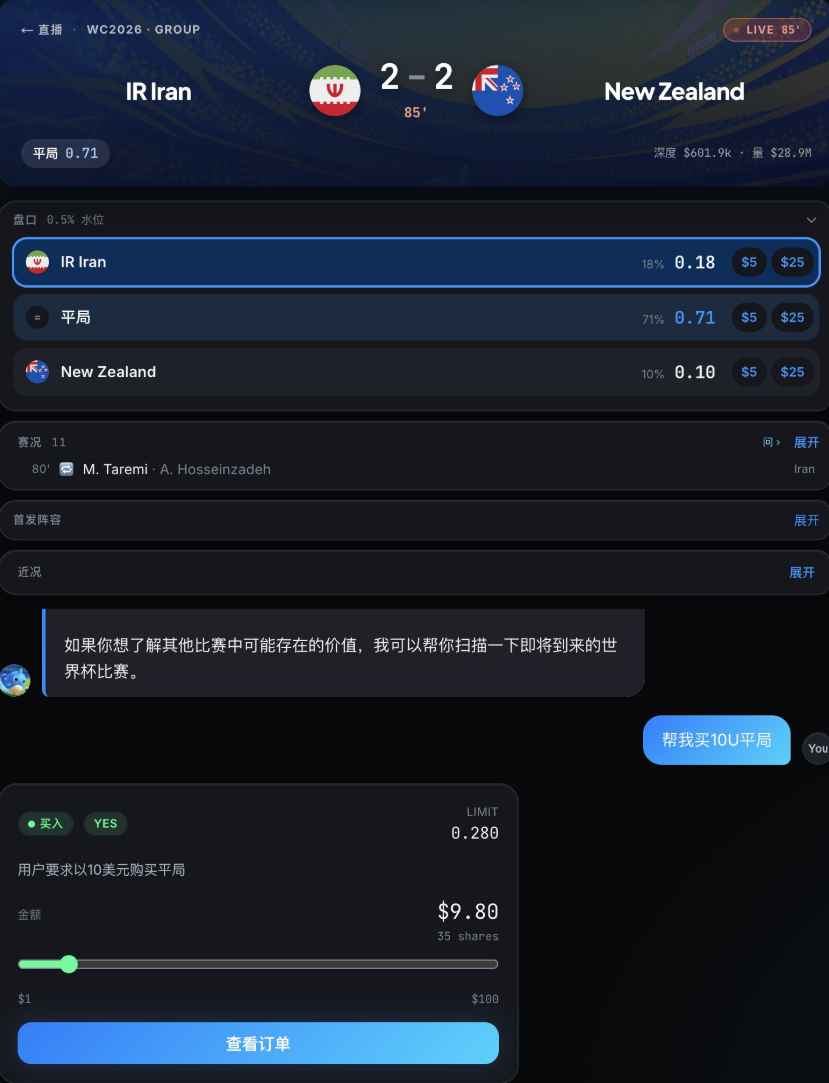
imToken’s latest World Cup-related exploration is one example. The wallet has started placing AI Agents inside actual usage scenarios. Its web-based agent and Discord agent are designed around concrete prediction needs, helping users complete betting transactions in a more natural flow. Users do not have to operate only inside the wallet app. They can participate in prediction markets through Discord or web pages, while the agent guides them back to on-chain actions with less friction.
World Cup Prediction as a Wallet Testing Ground
This is presented as an early form of the Agentic Wallet. In this framing, the future Web3 wallet is not limited to a single wallet application. It is closer to an AI-native wallet form that can appear wherever the user’s intent emerges. Over the past decade, the wallet’s core questions were clear: where assets are stored, who controls the private key, and who signs transactions. When users opened imToken, their main goals were to check balances, send transfers, interact with protocols, or manage multi-chain assets. At that stage, the wallet was mostly an asset entrance and a signing entrance. The user knew what they wanted to do, and the wallet completed the last step.
The Agentic era changes that starting point. A user may not begin with a precise action. In a World Cup scenario, an ordinary user may not first think, “I need to open Polymarket, find a specific market, evaluate the odds, and place a trade.” The user is more likely to ask, “What is interesting about tonight’s match?” “I think Portugal will qualify; is there a related market?” “Are these odds already too low?” or “If I only want to participate with a small amount, what is the process?” These are intent-level questions rather than menu-level commands.
From Function Menu to Intent Interpreter
In the past, such questions were scattered across WeChat groups, social platforms, and search engines. Each user had to assemble the information and then execute the steps manually. Once an Agent enters the process, the interaction changes. The user only needs to express a rough intent. The Agent breaks down the path, and the wallet turns that path into a series of on-chain actions. This is therefore not the same as simply adding a chat box to a wallet. The deeper shift is that the wallet moves from being a function menu to becoming an intent interpreter.
Earlier wallet interfaces asked the user to decide whether to transfer, Swap, stake, or connect to a DApp. The newer interaction begins from natural language: the user says what they want to accomplish, and the system helps map that intent into a usable flow. That is why a mass event like the World Cup is a useful entry point for an Agentic Wallet. It already has a shared context. Users naturally want to express opinions and make judgments. An Agent does not need to start by managing a complex portfolio, especially because complex asset management carries higher risk. It can first help users find an interaction path in one specific scenario, then return the final control to the wallet and the user.
The web and Discord agents mentioned in the imToken example illustrate this lighter entry model. They bring wallet capabilities into places that are less rigid than a wallet app. A user does not necessarily open the app first, and does not necessarily enter a traditional DApp browser first. Instead, the user can arrive through an activity page or a World Cup-themed environment, then rely on the Agent to discover the interaction path.

This also means the boundary of the wallet is expanding outward. In the old model, the wallet entrance was relatively clear: open the app, enter the asset page, click a function, then connect a DApp. In the next model, wallet entrances can be distributed across web pages, Discord, Telegram, AI chat boxes, activity pages, developer tools, or even a lightweight wallet interface generated by a user. From this angle, the World Cup prediction campaign is not the main point. The main point is that it places the wallet more naturally in front of user intent.
Mastercard, WeChat Pay, and the Same Payment Question
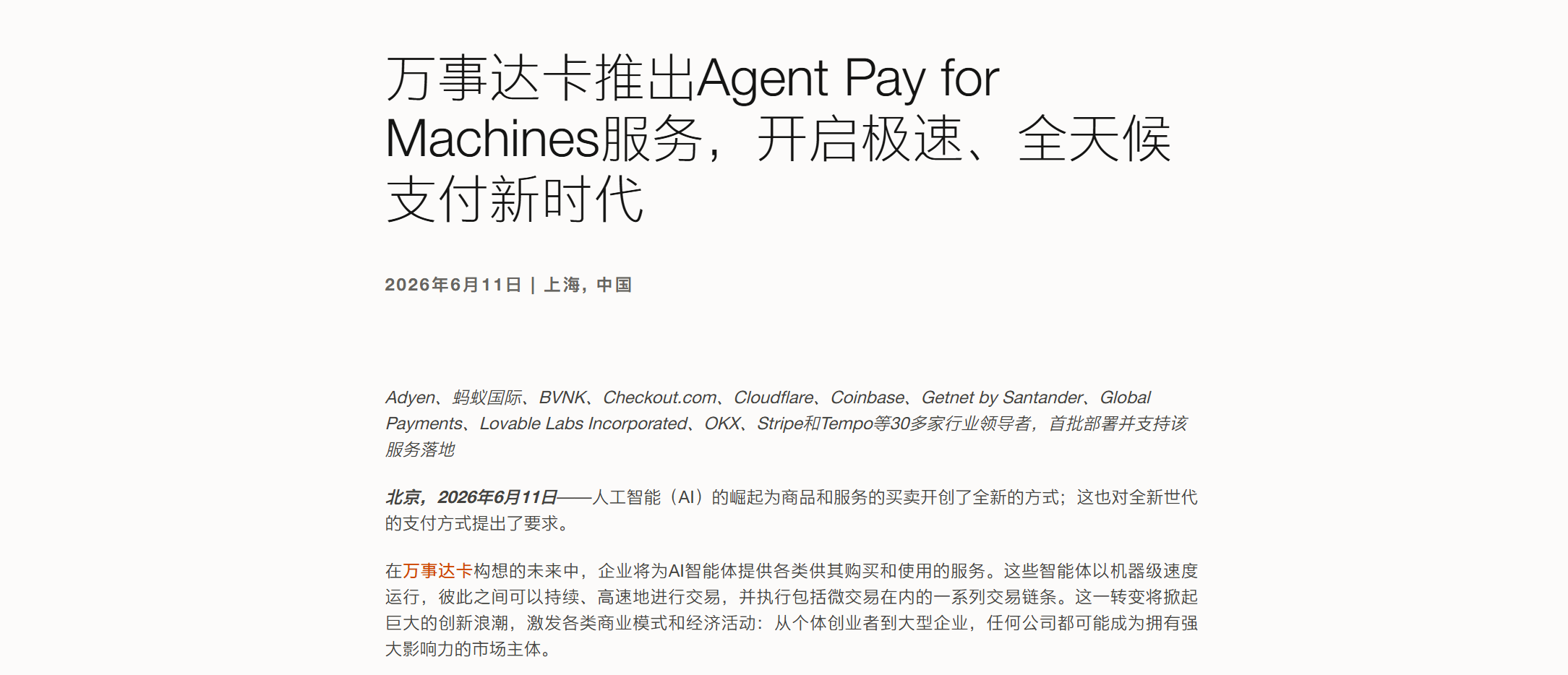
If viewed only from inside Crypto, the Agentic Wallet can sound like another narrative about AI watching markets, finding opportunities, and trading for users. Mastercard’s launch of Agent Pay for Machines on June 10 moves the topic beyond Web3. Mastercard defines Agent Pay around trusted AI Agents participating in payments under user authorization. The framework deals with how an Agent is identified, how it is authorized, how it is verified inside the payment network, and how merchants, issuers, and users know that a transaction was completed with assistance from an Agent.
This overlaps strongly with the problems Web3 wallets face. When AI only helps write copy, the cost of an error is usually limited. When AI begins to participate in asset interaction, the questions change: does it have permission, has it understood the user’s intent correctly, is the service it calls trustworthy, does the transaction exceed the permitted boundary, and who handles the result if it does not match the user’s expectation? Mastercard’s answer is to redesign the identity, token, authorization, risk control, and dispute-handling mechanisms for a trusted Agent within a payment network.

Domestic payment giants are also moving in this direction. WeChat Pay is working with Tencent’s agent product WorkBuddy to test AI payment functions. One disclosed example is the “AI 专属卡” inside WeChat Wallet. Based on the disclosed information, the core of such products is not to let AI spend money freely. It is to set boundaries for agent payments through recharge limits, payment authorization scope, and password verification. This follows the same line as Mastercard Agent Pay: AI can participate in payments, but it must be identified, authorized, restricted, and audited.
Security Boundaries Define the Agentic Wallet
Web3 wallets are facing the on-chain version of the same question. Traditional payment systems emphasize payment networks, merchants, issuers, and compliance responsibilities. On-chain wallets emphasize private keys, signatures, authorizations, contract calls, and user self-custody. The distinction matters because traditional payment users can rely on banks, card networks, merchants, dispute processes, and risk-control systems. In the on-chain world, once a transaction is recorded, there is often no button to reverse it.
The more efficiency an AI Agent brings, the more important the wallet becomes as the final security boundary. A future wallet cannot only make it easier for an Agent to act. It must also ensure that the Agent acts only within the range permitted by the user. Many discussions of AI Agents drift toward extreme automation: AI automatically trading, managing money, finding airdrops, or performing arbitrage. For a wallet, however, the hardest issue is not automation itself. It is the sense of boundary.
A wallet is not an ordinary application. If AI recommends the wrong song, writes the wrong paragraph, or clicks the wrong page inside a common app, the damage is usually a user-experience problem. Inside a wallet, if AI misunderstands an instruction, calls the wrong contract, or grants an authorization that is too broad, the result can become a real asset risk. The source article connects this issue with another discussion, “Sign 不只签名:当 AI Agent 替你签名,谁还握着控制权?”, which focuses on control when AI Agents participate in signing.

This is why the first-principles question for an Agentic Wallet is not how many things AI can do for the user, but how the user knows what AI is doing. It also explains why imToken has continued to emphasize control over the past several years. From self-custody wallets to multi-chain asset management, and now to AI co-creation and Agent exploration, the continuous line is not simply more functions. It is that users must still be able to understand, confirm, and control their digital world.
In the Agentic era, that line becomes more specific. A wallet needs to let the user understand who the Agent is, which capabilities it can call, how long the authorization lasts, whether it can operate across DApps, when the user must confirm again, and whether the user can pause or revoke it with one click. These questions may sound detailed, but they are the foundation for whether an Agentic Wallet can work. The strength of an AI Agent is that it can turn complex processes into simple requests. A single sentence from the user can become more than ten execution steps. That is good for experience, but it also creates a security challenge. The longer the path and the more intermediate steps there are, the more the wallet needs to bring key checkpoints back in front of the user. The World Cup prediction activity is an event entrance, while imToken’s web agent and Discord agent are community entrances. Together, they show that the Agentic Wallet begins with small scenes where intent, execution, and control can be connected.