

The World Cup is a useful setting for watching how Web3 wallets are changing. Topics that fans discuss every day, such as whether a team will qualify or how championship odds are shifting, become priceable and tradable actions in prediction markets such as Polymarket. When mainstream Web3 wallets integrate World Cup prediction activities, the result is not merely another campaign. Over a longer timeline, it functions as a lightweight entry point for users to begin interacting on-chain.
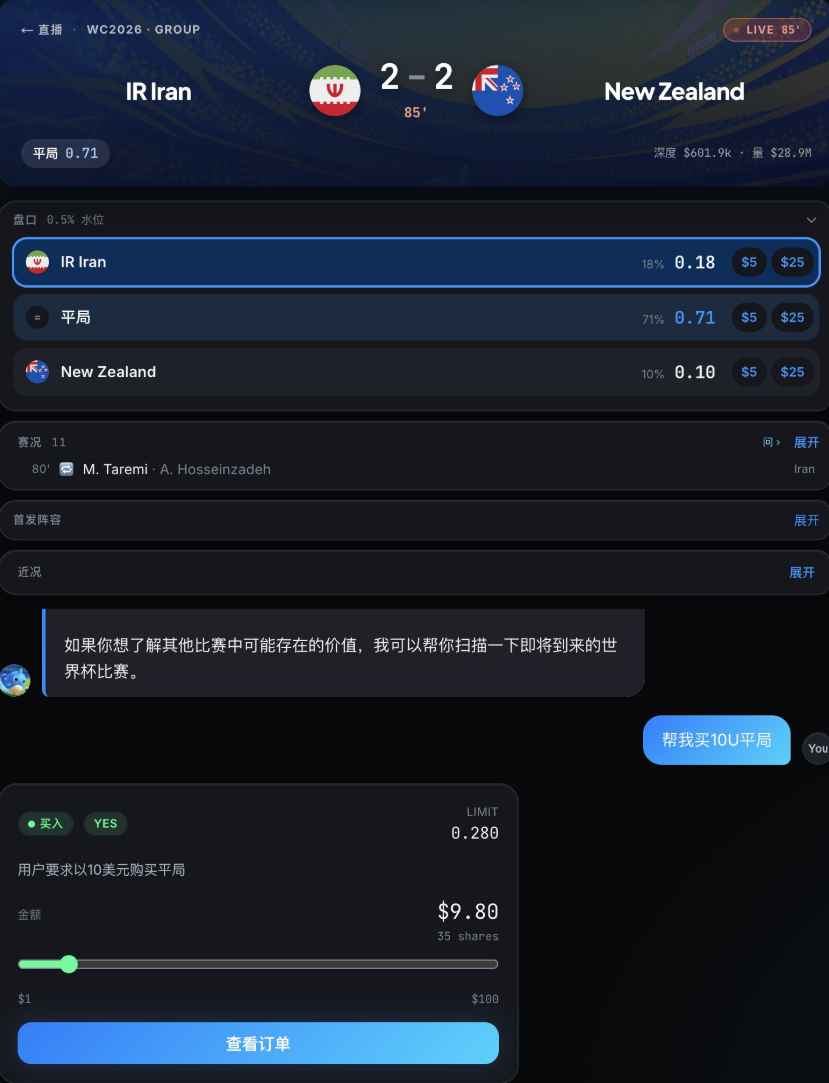
imToken brings agents into World Cup prediction flows
In this World Cup-related exploration, imToken has begun placing AI Agents into practical user scenarios. Its agents on the web and in Discord are designed around specific prediction needs, helping users complete betting-related transactions in a more natural way. Instead of operating only inside a wallet app, users can participate in prediction markets from Discord, web pages, and other lighter environments, while being guided back to on-chain interaction by the agent.
This can be read as an early form of the Agentic Wallet. The future Web3 wallet may not be limited to a standalone wallet application. It may instead take the form of a more ubiquitous AI-enabled wallet layer. Over the past decade, the core questions that wallets addressed were clear: where assets are stored, who controls the private keys, and who signs transactions. When users open imToken, they mainly check balances, transfer assets, interact with protocols, and manage multi-chain holdings. In that stage, the wallet is primarily an asset entry point and a signature entry point.
The Agentic era changes the starting point of interaction. Users do not necessarily know what they need to click at the beginning. In a World Cup scenario, an ordinary user may not start with the thought, “I need to open Polymarket, find a specific market, judge the odds, and complete the trade.” They are more likely to ask, “What is interesting about tonight’s match,” “I am optimistic about Portugal qualifying, is there a related market,” “Are these odds already too low,” or “If I only want to participate with a small amount, how should I proceed.”
Previously, such questions were scattered across WeChat groups, social platforms, or search engines. Each user had to piece the information together and then execute the steps manually. With an agent involved, the interaction changes. The user only needs to express a broad intention. The agent then breaks down the route, while the wallet turns that route into a series of on-chain actions.
From function menu to intent interpreter
This is not simply a matter of adding a chat box to a wallet. The deeper change is that the wallet begins to move from being a function menu to being an interpreter of intent. In the previous wallet model, users first decided whether they wanted to transfer, swap, stake, or connect to a DApp. In the next model, the user may only need to describe what they want to accomplish in natural language, and the agent will organize the steps.
This is also why a mass event such as the World Cup is suitable as an entry point for the Agentic Wallet. The event already has context, users already have a desire to express opinions, and judgment is part of the experience. An agent does not need to start by managing a complex asset portfolio, especially since complex asset management carries higher risk. It can first help users find an interaction path in a specific scenario, while the final control remains with the wallet and the user.
The imToken agents mentioned above, available on the web and in Discord with on-chain interaction capability, are a typical example. They bring wallet capabilities into lighter entry points. Users do not necessarily have to open an app first, nor do they need to begin inside a traditional DApp browser. Instead, they can enter through an activity page or a World Cup-themed scenario and use an agent to find the interaction path.
This means that the boundary of the wallet is spilling outward. In the past, the wallet entry point was relatively clear: open the app, enter the asset page, click a function, and connect to a DApp. In the future, wallet entry points can be distributed across web pages, Discord, Telegram, AI chat boxes, campaign pages, developer tools, and even lightweight wallet interfaces generated by users themselves. From this angle, the main point of World Cup prediction is not the prediction activity itself, but the way it allows the wallet to stand in front of user intent more naturally.

Mastercard and WeChat Pay show the payment-side reference
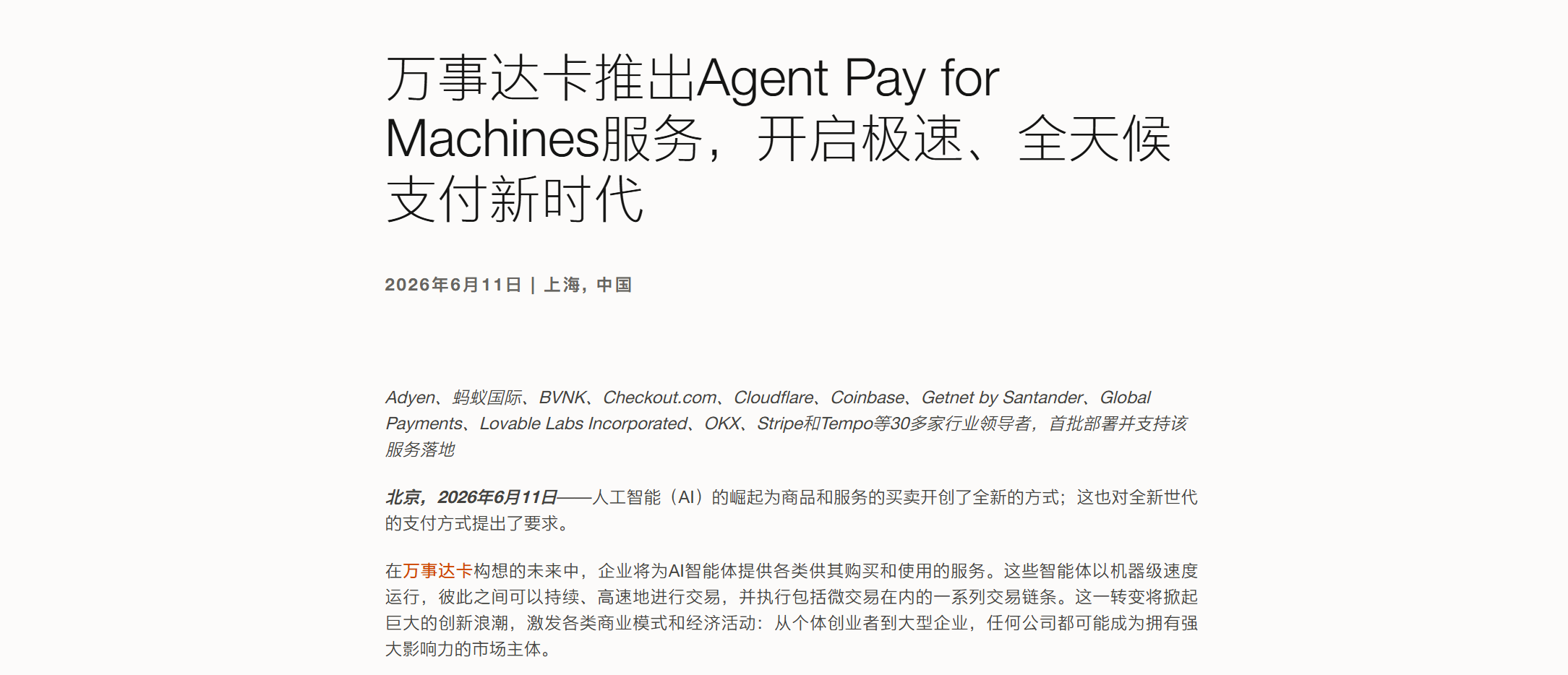
If viewed only from inside Crypto, the Agentic Wallet can be misunderstood as another narrative around AI helping users read markets, find opportunities, and execute trades. Mastercard’s launch of Agent Pay for Machines on June 10 makes the topic no longer exclusive to Web3. Mastercard defines Agent Pay as enabling trusted AI Agents to participate in payments under user authorization. This includes how agents are identified, how they are authorized, how they are verified inside the payment network, and how merchants, issuers, and users know that a transaction was assisted by an agent.
This is highly similar to the issues faced by Web3 wallets. When AI only helps write copy, the cost of an error is usually manageable. Once AI begins to participate in asset interactions, the questions change: does it have permission, has it understood the user’s intent accurately, is the service it calls trustworthy, has the transaction it initiates exceeded its boundary, and who takes responsibility if the result differs from the user’s expectation.
Mastercard’s answer is to redesign the identity, token, authorization, risk control, and dispute handling of trusted agents inside the payment network. The signal is important because, while Agentic ideas inside Web3 can still carry a geek-oriented imagination, a traditional financial giant designing payment infrastructure for Agentic Commerce places the issue in a more practical commercial context.

Domestic payment giants are also moving in the same direction. WeChat Pay is working with Tencent’s agent product WorkBuddy to test AI payment functions, including the launch of an “AI dedicated card” inside WeChat Wallet. Based on disclosed information, the core of these products is not to let AI spend freely, but to set boundaries for agent payments through stored balances, payment authorization scopes, and password verification confirmations.
This follows the same logic as Mastercard Agent Pay: AI can participate in payment, but it must be identified, authorized, restricted, and audited. Web3 wallets face the on-chain version of the same question. The difference is that traditional payment systems emphasize networks, merchants, issuers, and compliance responsibility, while on-chain wallets emphasize private keys, signatures, authorizations, contract calls, and user self-custody.
For on-chain wallets, the core issue is control
Because of this difference, the Agentic Wallet cannot simply copy the path of traditional payments. In traditional payments, users can rely on banks, card networks, merchants, dispute handling, and risk control systems. In the on-chain world, once a transaction is recorded on-chain, there is often no undo button. The more efficiency AI Agents bring, the more important the wallet becomes as the final security boundary. Future wallets should not only allow agents to “do things,” but ensure that agents can only act within the range permitted by the user.

This is why Web3 may be a particularly suitable environment for discussing Agentic Wallets. When people talk about AI Agents, they often move toward an extreme vision: AI will automatically trade, manage wealth, find airdrops, and execute arbitrage. That direction has appeal, but for wallets, the most difficult problem is not automation. It is the sense of boundary.
A wallet is not an ordinary application. In an ordinary app, if AI recommends the wrong song, writes an incorrect paragraph, or clicks the wrong page, the result is mainly a user experience problem. In a wallet, if AI misunderstands an instruction, calls the wrong contract, or grants excessive authorization, the result can become a real asset risk. The original discussion also connects this issue to the question raised in “Sign Is Not Just Signing: When an AI Agent Signs for You, Who Still Holds Control?”
Therefore, the first-principles question for the Agentic Wallet is not how many tasks AI can complete for users. It is how users know what AI is doing. This is also why imToken has continued to emphasize control over the past several years. From self-custodial wallets to multi-chain asset management, and now to AI co-creation and agent exploration, the continuous thread is not simply a growing list of functions. It is that users must remain able to understand, confirm, and control their digital world.

In the Agentic era, that thread becomes more specific. A wallet needs to help users understand who the agent is, what capabilities it can call, how long the authorization lasts, whether it can operate across DApps, when the user must confirm again, and whether the user can pause or revoke it with one action. These questions may sound cumbersome, but they are the foundation for whether an Agentic Wallet can truly stand.
The strength of an AI Agent comes from its ability to simplify complex processes. A single sentence from the user can be broken into more than ten execution steps. That improves experience, but it also creates a security challenge. The longer the route and the more intermediate links involved, the more the wallet must bring key checkpoints back in front of the user. A better wallet interaction may not show users more technical details, but translate complex transactions into language they can understand. World Cup prediction activity is an event-based entry point, while imToken’s web agent and Discord agent are community-based entry points. Together, they show how the Agentic Wallet is beginning with small, concrete scenarios.