
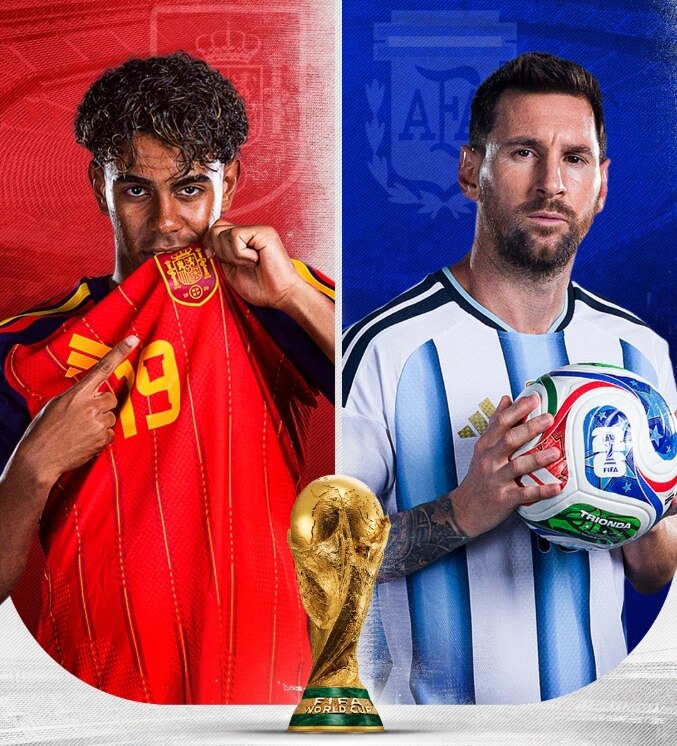
Argentina and Spain will meet in the 2026 World Cup final at 3:00 a.m. Beijing time on July 20, with Argentina chasing back-to-back titles and Spain arriving on the back of a defensive run that has defined the tournament.
Spain’s route to the final has been marked by control. In the knockout rounds, they beat Austria, Portugal, Belgium and France. The semifinal against France ended 2-0, and across seven matches Spain have conceded only one goal while recording six clean sheets. That record, paired with their command in midfield, has become the core argument behind the calls backing them to win the title.
Argentina’s run has looked very different. Their knockout games have been tight and often chaotic. They beat Cape Verde and Egypt by identical 3-2 scorelines, did not pull away from Switzerland until late in extra time in the quarterfinal, and then came from behind against England in the semifinal. Argentina were still trailing in the 85th minute before Lionel Messi produced consecutive assists, with Enzo Fernandez and Lautaro Martinez completing a 2-1 turnaround.
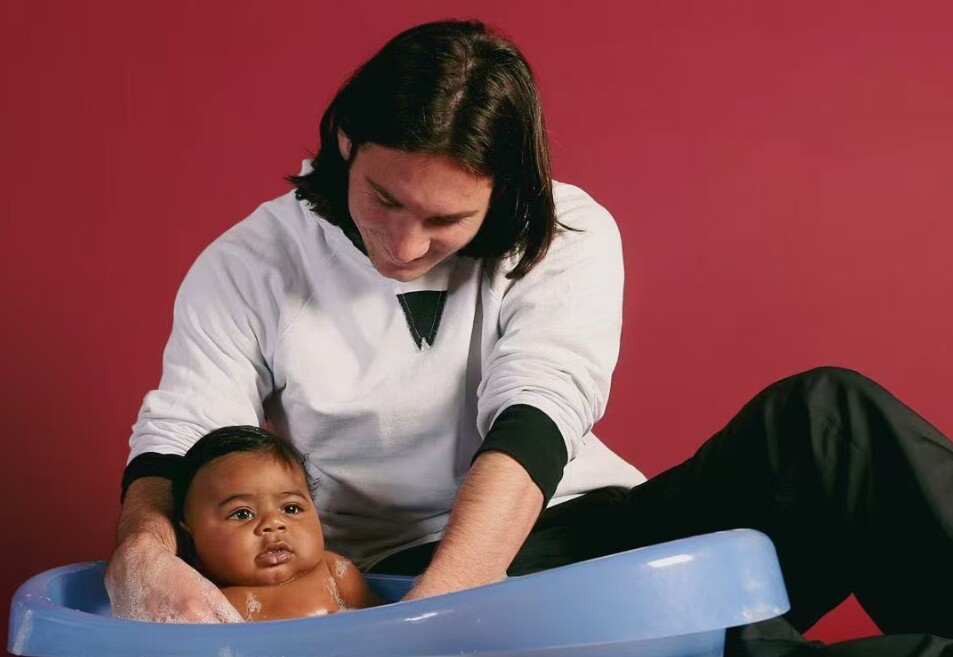
The match also carries an unusual personal storyline. During a 2007 charity photo shoot, a young Messi was photographed holding and bathing an infant Lamine Yamal. Nearly 20 years later, the two are set to face each other in a World Cup final for the first time in their careers. Messi is now 39, Yamal 19, and the old image has added a generational layer to the occasion.
Semifinal calls went off track for most models
In the quarterfinal round, all six AI models correctly picked France, Spain, England and Argentina to advance. That changed in the semifinals.
For France against Spain, ChatGPT, Claude, Grok, DeepSeek and Qwen all backed France to go through, and all five projected a 2-1 French win. Their case was similar: France, they argued, could exploit the space left behind by Spain’s advancing full-backs and hurt them on the break. The game went the other way. France never found that transition threat, Spain controlled the tempo, and the semifinal finished 2-0 to Spain. Gemini was the only model to choose Spain to advance, though it expected the match to go to penalties and did not get the script right.
The England-Argentina semifinal split the six models evenly. Grok, DeepSeek and Qwen backed England. ChatGPT, Gemini and Claude picked Argentina. Argentina won 2-1 after coming from behind, meaning the three models that favored Argentina all got the advancing side right. Gemini was the only one that also hit the exact score.
After those two matches, Gemini stood alone as the only model to correctly identify both finalists, making it the strongest performer of the round. For the final itself, though, the field has moved into full agreement.
Prediction market odds still show a close final
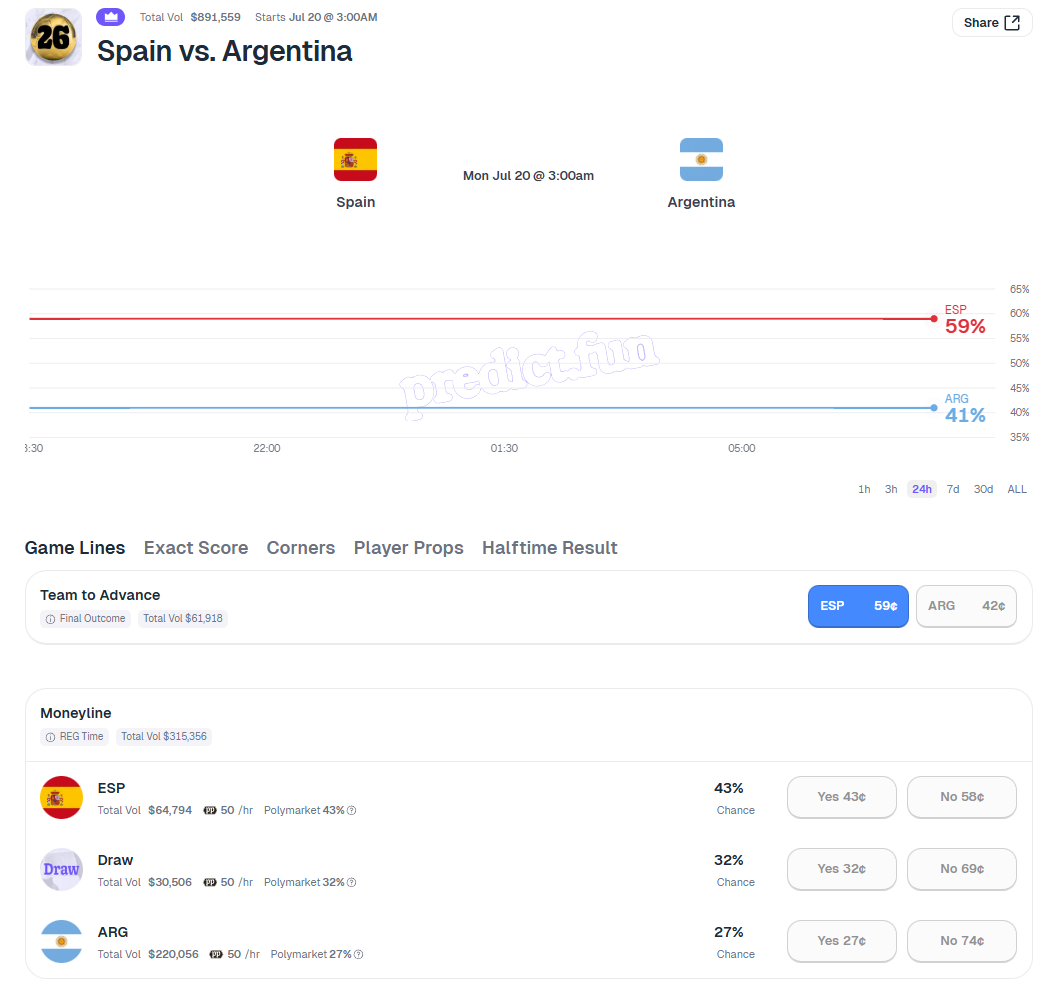
According to PPP’s tracking of prediction market tools, the predict.fun event for the World Cup final between Argentina and Spain showed Argentina at 27% to win in regulation, a draw at 32%, and Spain at 43%. When extra time and penalties are included, Spain’s probability of winning the title rises to 59%, while Argentina stands at 41%.
The market numbers suggest a relatively narrow gap. The AI models are less divided on direction. ChatGPT, Claude, Gemini, Grok, DeepSeek and Qwen all picked Spain to become champion.
Why the models are lining up behind Spain
The reasoning was largely the same across the six systems: defense, midfield control and energy levels.
Spain’s defense has been the most persuasive point in their favor. One goal conceded in seven matches tells part of the story. The knockout phase added more weight, with Spain limiting Portugal, Belgium and France. Argentina may carry greater attacking punch, but against Spain’s compact shape the report argues they may not see the same open counterattacking lanes they found earlier in the tournament.
Midfield control is the second pillar. Rodri is tasked with setting the attack, Dani Olmo keeps moving into the half-spaces, and Yamal stretches defenses from the wing. Argentina are at their best when they compress the middle and then break quickly through Messi, Julian Alvarez and Lautaro Martinez. Spain, in contrast, are seen as capable of reducing the number of transition moments through longer spells of possession, forcing Argentina away from the tempo they prefer.
Fitness is the third variable repeatedly raised by the models. Spain finished their semifinal a day earlier than Argentina and had the smoother path. Argentina played 120 minutes against Switzerland and then had to battle England deep into stoppage time. If the final reaches extra time, Spain’s younger squad and deeper rotation were cited as possible edges.
Most of the models do not expect Spain to win inside 90 minutes
Agreement on the champion does not mean agreement on the match script.
Gemini, the best-performing model of the semifinal round, forecasts a 1-1 draw in regulation, another deadlock in extra time, and Spain winning on penalties.
ChatGPT, Grok and Qwen are broadly aligned with each other. All three lean toward a 1-1 score after 90 minutes. In their view, Argentina can stay in the game through Messi’s playmaking and the finishing efficiency up front, but Spain’s stronger energy base and squad depth would become clearer in extra time, allowing them to score the decisive goal in the additional 30 minutes.
Claude did not offer a precise scoreline. Instead, it framed the final as a low-scoring match, listing outcomes such as 1-1, 1-0 and 0-0. Its emphasis was on the caution that often defines finals, with the balance potentially broken by a set piece, a counterattack or individual quality.
DeepSeek was the only model more inclined to see Spain settle the match in regulation. It backed Spain to carry over their defensive level, contain Argentina’s attack and win directly by either 2-0 or 2-1.
Before the semifinals, five of the six AI models had lined up behind France, only to watch Spain win 2-0 and prove that consensus wrong. Now all six are on the same side again. Whether Spain’s overall structure will hold, or Argentina will drag the final into another late escape, will be decided on the pitch.