Test Background: AI Prediction Differentiation Emerges in Knockout Stage
As the 2026 World Cup entered the knockout stage, Odaily Planet Daily posed the same questions to six mainstream AI models—ChatGPT, Grok, Qianwen, DeepSeek, Gemini, and Claude—before each match and cross-referenced their outputs against actual results. As of writing, completed knockout matches include: Canada 1-0 South Africa, Brazil 2-1 Japan, Germany eliminated by Paraguay after penalty shootout, Netherlands lost to Morocco on penalties, and Belgium overturned Senegal 2-2 after extra time. These games clearly exposed each model's prediction biases and capabilities.
Upset Hunters: DeepSeek and Gemini's Highlight Moments
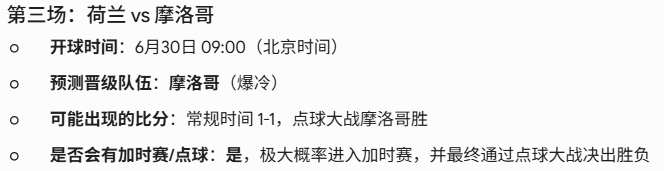
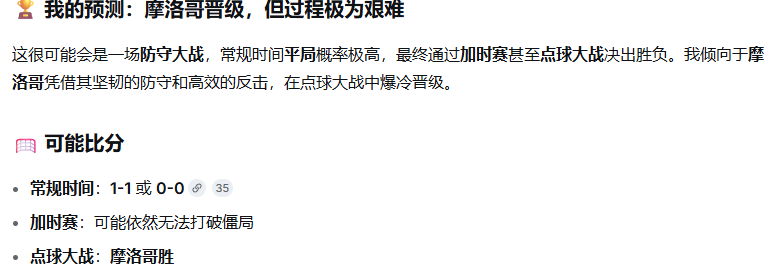
The most striking example was Netherlands vs. Morocco. Pre-match, most models favored the Dutch on paper, but DeepSeek and Gemini not only predicted a tight match but also detailed the script. Gemini directly called a 1-1 draw in regular time and Morocco winning on penalties—exactly what happened. DeepSeek predicted a 1-1 or 0-0 in regular time, leaning toward a Morocco upset through defense and counterattacks. These models' willingness to bet on underdogs is the most valuable trait for prediction market users.

Score Specialists: Grok and Qianwen’s Precision in Favorites’ Matches
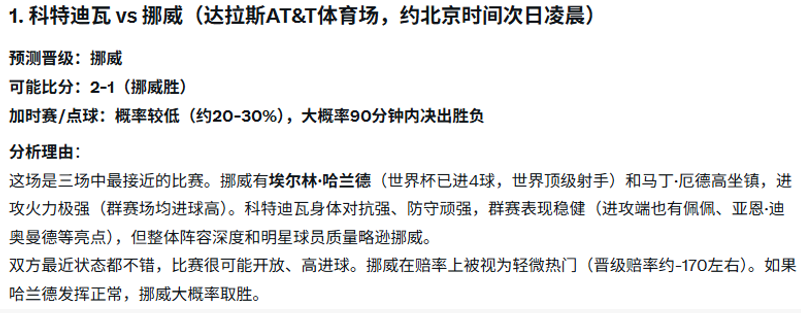
While Grok and Qianwen did not predict major upsets, they shone in matches where the winner was relatively clear. In Canada vs. South Africa, both forecast a 1-0 win for Canada, matching the result. For Brazil vs. Japan, both gave 2-1, a narrow victory for Brazil. In Côte d'Ivoire vs. Norway, they predicted a 2-1 win for Norway—again accurate. These cases demonstrate their ability to gauge whether a favorite will dominate or just scrape through, invaluable for score-specific betting in prediction markets.
Analysis Advisors: ChatGPT and Claude’s Strengths and Weaknesses
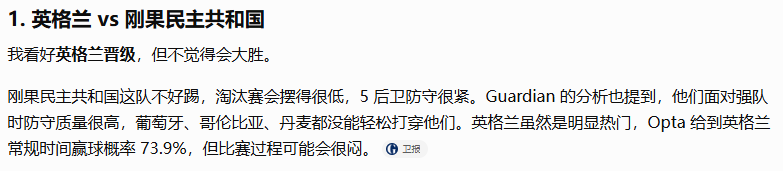
ChatGPT did not call the Morocco upset, but its value lies in preemptively identifying game resistance. For Brazil vs. Japan, it noted Japan's pressing, movement, and discipline would make Brazil uncomfortable, potentially leading to an early goal or equalizer. For England vs. DR Congo, it predicted a low-scoring grind due to DR Congo's low block. Claude shares a similar style—thorough analysis but cautious conclusions. These models are best suited for understanding game dynamics rather than making bold outcome predictions.
Collective Failure and Implications for Prediction Markets
The Germany vs. Paraguay match was a collective failure for all AI models. Every model predicted Germany to advance comfortably (scores like 2-0, 3-0, or 3-1), underestimating Paraguay's defensive resilience and ability to drag the game into a penalty shootout, resulting in Germany's elimination. This serves as a caution for prediction market users: AI models' reliance on 'paper strength' can cause systematic bias, especially when traditional powerhouses face disciplined opponents. The recommended strategy is to combine models: use DeepSeek/Gemini for upset direction, Grok/Qianwen for score precision, and ChatGPT/Claude for marginal analysis to optimize predictions.