
Stablecoins may help reduce friction in trade finance, but fragmented regulation is still limiting their role in international trade, according to the World Trade Organization.
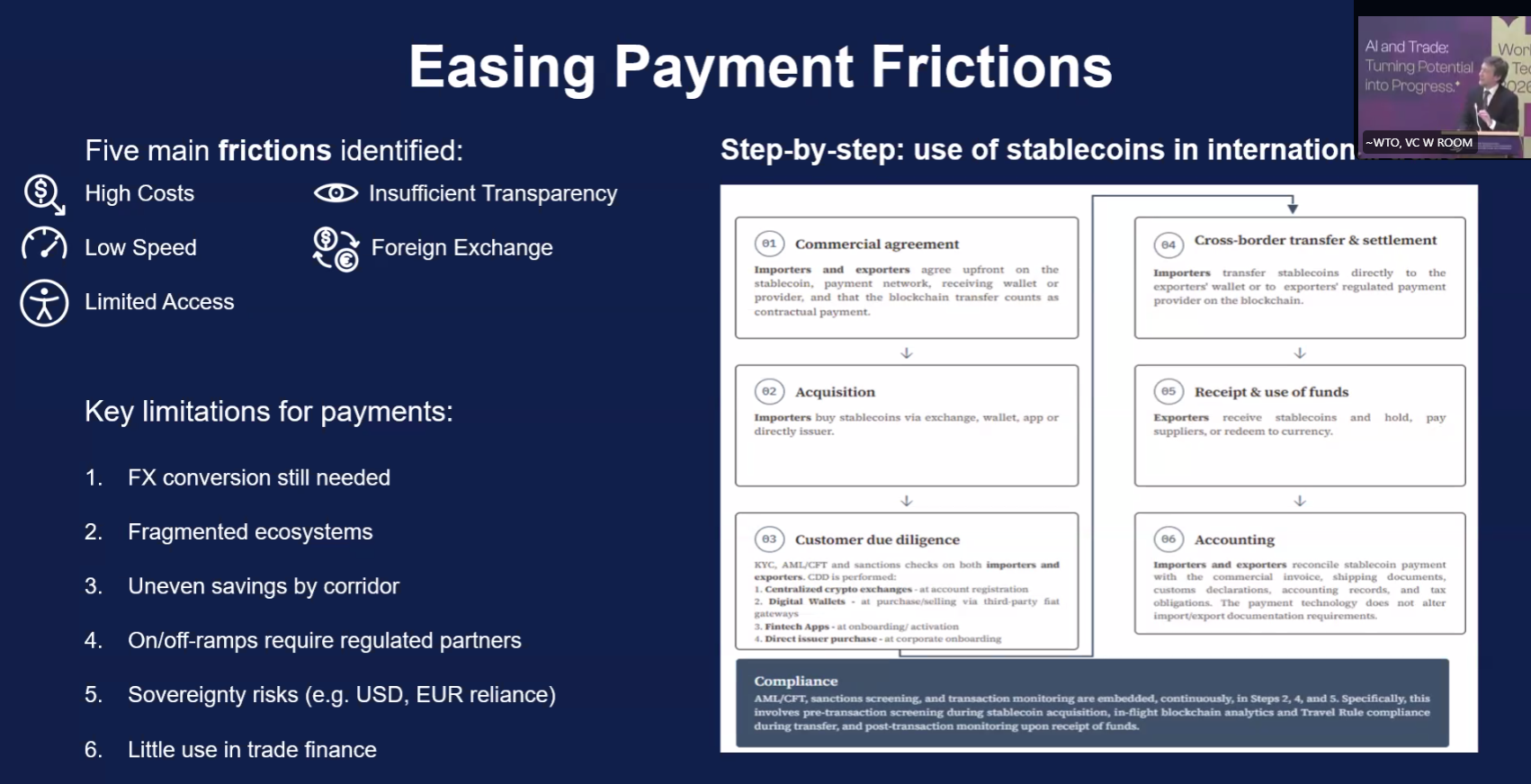
Juan Marchetti, director of the WTO’s trade in services and investment division, made the point during a Monday speech in Geneva at the launch of the organization’s study on stablecoins in world trade. He said the main constraint is not technical.
“The constraint is not technology. It is actually regulation and the lack of development of regulatory frameworks,” Marchetti said.
Stablecoins still represent only 3% of international payments
Marchetti cited an October 2025 report from the Financial Stability Board, which found that only 39% of the 28 surveyed jurisdictions had finalized their stablecoin regulatory frameworks. That equals 11 jurisdictions.
He said stablecoins may improve several of the main friction points in trade finance, yet they currently account for only 3% of total international payments because regulatory regimes remain fragmented.
The WTO report identified five areas where stablecoin adoption could reduce frictions in trade finance:
- high costs
- low speed
- limited access
- insufficient transparency
- foreign exchange limitations
The report also said stablecoin use in cross-border payments grew 35-fold between 2020 and mid-2024.
Developing economies could benefit more, but many are less prepared
According to the WTO, developing economies stand to gain the most from stablecoin adoption, in part because the technology could lower remittance fees.
At the same time, Marchetti said those countries often have the least developed regulatory regimes needed to support adoption.
“Stablecoins’ contribution to trade will depend far less on the technology than on regulatory convergence, interoperability and the surrounding financial infrastructure, especially in developing economies that stand to gain,” he said.
Payment firms are already testing stablecoin settlement models
Large payment providers are also exploring how stablecoins might improve cross-border transfers.
In August, Mastercard partnered with stablecoin orchestration network Borderless to pilot ways to bring more trust to cross-border stablecoin transfers through Mastercard’s Crypto Credential framework.
In June, Mastercard also said it planned to expand its settlement capabilities to include intraday, weekend and holiday card settlement, including settlement through stablecoins.
Also in August, Western Union partnered with stablecoin infrastructure provider Rain to launch a digital wallet and a Visa-branded card. The product allows users to hold and spend a US dollar-backed stablecoin in 37 markets, with plans to expand to more than 60 markets by the end of the year.