
Capex keeps rising as miners redirect into AI and HPC
According to TheEnergyMag, listed Bitcoin miners and their AI data center peers spent $30.7 billion in capital expenditures in the first half of 2026, already above the full-year 2025 total of $21.53 billion, a 42.6% increase. Within that figure, 12 listed miners accounted for $6.87 billion in first-half capex, higher than their full-year 2025 total of $6.5 billion. AI-native cloud companies CoreWeave, at $14.12 billion, and Nebius, at $8.13 billion, made up nearly three-quarters of the total spending among the 15 companies tracked.
Among mining companies, TeraWulf led with $1.61 billion, followed by Applied Digital at $1.58 billion, Core Scientific at $1.18 billion, and Cipher at $911.5 million. At the same time, revenue from HPC and AI operations among nine major miners rose 52% quarter over quarter to $205.8 million in the second quarter, with first-half revenue reaching $341.2 million. Even so, capex during the same period was still nearly 15 times that revenue base.
TheEnergyMag also said that as listed Bitcoin miners accelerated the shift of power and infrastructure toward AI and HPC, the realized hashrate across the miners it tracks fell from 368.3 EH/s in the fourth quarter of 2025 to 319 EH/s in the second quarter of 2026, down 13.4% in six months. Over the same stretch, Bitcoin’s network-wide quarterly average hashrate declined 10.6%. Excluding Bitdeer, which expanded against the broader trend, realized hashrate across the rest of the sample dropped 21.2%. The publication linked the contraction to weaker mining economics and rising competition between AI and Bitcoin mining for capital and power resources.
Difficulty, fees, miner balances and shutdown prices
CoinDesk, citing Hashrate Index data, reported that Bitcoin mining difficulty most recently fell 0.74% to 126.23 T. That leaves it about 14% below the January 2026 peak, around 19.1% below the all-time high, and below the level from a year earlier. It is the second time in Bitcoin’s history that difficulty has declined on a year-over-year basis. The report said weaker BTC prices, lower mining revenue, and the diversion of capital and electricity toward AI and high-performance computing have weighed on hashrate growth. Forward hashrate markets expect only a modest improvement in revenue per unit of hashrate for the rest of the year.
Glassnode data showed that Bitcoin transaction fees currently account for just 0.69% of miner revenue, still close to the 10-year low of 0.52% reached in April. Fee share has stayed below 1% for nearly a year, leaving miners more dependent on the 3.125 BTC block subsidy. Checkonchain data, cited by Cointelegraph, showed total network hashrate falling from a peak of 1.3 ZH/s in October 2025 to 861 EH/s, a decline of about 33%. As of Tuesday, the average cost to produce one BTC was estimated at $78,254, around 23% above the spot price at the time.
Digital Asset reported that as of Aug. 15, Bitcoin miner balances had fallen to about 1.1919 million BTC, down 885 BTC from a week earlier and the lowest level since May 31. A decline in miner balances usually means some miners have used BTC for sales, loans, or collateral. Over the same period, Blockchain com data showed Bitcoin’s 7-day moving average hashrate at roughly 895 million TH/s, down about 25.48 million TH/s from a week earlier. The Puell Multiple stood at 0.75, unchanged from a week earlier and still in a range that is neither historically overheated nor deeply undervalued.
According to WuShuo Data Center, as of Aug. 6, about 22.7% of 22 mainstream BTC miner models were already generating negative daily net profit. The most efficient machine had a shutdown price of about $46,787, meaning that if BTC falls below that level, even the most energy-efficient model would enter a break-even shutdown zone under the assumed power-cost conditions.
At an electricity price of $0.05/kWh, the base shutdown price for Bitcoin mining was about $31,992 as of Aug. 14, while BTC was trading near $63,492, or 1.98 times that level. Differences between models remain large. The shutdown price for the S19 Pro+ Hyd. was about $66,487, already above the current BTC price. The S19 XP Hyd., S19 XP+ Hyd., and S21 Hyd. stood at about $50,292, $45,937, and $38,683, respectively. If depreciation is included, the breakeven price for some older models rises above $80,000.
New AI infrastructure agreements and halted mining sites
Bloomberg reported that Anthropic and Riot Platforms reached a long-term cloud computing agreement valued at about $9.1 billion to secure compute capacity for Claude. Riot will provide 191 MW of data center capacity from its Rockdale campus in Texas under a contract lasting 20 years. The deal points to Riot’s deeper move away from Bitcoin mining and into AI data center operations.
Reuters reported that two Tether-backed Bitcoin mining sites in Uruguay have stopped operating after a dispute with state power company UTE over the scale of electricity supply. A former Tether contractor estimated that the company had invested about $120 million across the two sites, though Tether did not respond.
Documents reviewed by Reuters showed that the two sides disagreed on whether the contracted power allocation represented a minimum guarantee or a maximum cap, leaving the sites without enough electricity at one stage. Microfin, Tether’s local entity, stopped paying part of its power bills in 2025 and moved in June to terminate the contract. UTE then cut electricity to the sites on July 25, 2025. Tether had previously treated Uruguay as the first step in expanding Bitcoin mining in South America, but mining margins and higher energy costs have pushed more miners toward AI and HPC businesses.
Bitdeer, Soluna and a broad set of miner earnings updates
Bitdeer reported that it produced 1,190 BTC in July 2026, up 322% year over year. At the end of July, it held 257 BTC. On the AI side, the company had deployed 4,248 GPUs with a 95% utilization rate and annualized recurring revenue of about $76 million. Its 9.5 MW A102 facility in Malaysia has been fully covered by long-term offtake agreements, with expected total contract revenue above $800 million. Bitdeer had previously disclosed a 16-year AI/HPC data center leasing agreement for its Tydal campus in Norway worth about $4.7 billion in contract revenue.
Bitdeer (NASDAQ: BTDR) also posted second-quarter 2026 results with total revenue of $228.8 million, a net loss of $92.3 million, and adjusted EBITDA of $31.1 million. Self-mining revenue was $168.4 million and AI Cloud revenue was $14 million. The company mined 2,694 BTC in the quarter and held 150 BTC as of June 30.
TheEnergyMag reported that Bitdeer will deploy about 28 MW of Bitcoin mining equipment at Soluna’s Project Kati 1 in South Texas, adding an estimated 1.93 EH/s of hashrate starting in September 2026. Bitdeer will supply and own the Sealminer A2 Pro Air machines, while Soluna will handle the site, power, and operations. Mining proceeds will be shared under a revenue-split model. Project Kati 1 is an 83 MW data center powered by the Las Majadas wind project.
Soluna Holdings said second-quarter 2026 revenue rose to $15.06 million from $6.16 million a year earlier. Data hosting revenue increased to $12.65 million, while cryptocurrency mining revenue fell to $1.72 million. The company posted a quarterly net loss attributable to the company of $20.71 million and a first-half net loss of $38.18 million. As of June 30, total assets were $294 million and total liabilities were $81.82 million. Soluna also amended its credit agreement with Generate Lending, securing waivers on certain reporting and operating compliance matters and agreeing to early repayments of about $5.69 million and $13.43 million.
CleanSpark reported fiscal third-quarter 2026 revenue of $138 million, down 30.5% year over year. It posted a net loss of $239.8 million, compared with net income of $257.4 million a year earlier, and adjusted EBITDA of negative $113 million, versus positive $377.7 million a year earlier. As of June 30, the company held $202.6 million in cash, Bitcoin worth $814.9 million, net long-term debt of $1.78 billion, and working capital of $761 million. For the Sandersville project, it signed a 20-year triple-net lease with an investment-grade tenant worth $6.6 billion, said required equity funding had been fully arranged, and said all long-lead equipment needed for the planned service date had been ordered and prepaid. It now controls more than 1.8 GW of power, land, and data center resources in the US.
In a separate July operating update, CleanSpark said it produced 586 BTC, sold 229 spot BTC and another 350 BTC through exercised call options, and ended July with 13,931 BTC. Operating hashrate reached 50 EH/s, average hashrate was 38.6 EH/s, deployed miners totaled 230,507 units, and contracted power capacity stood at 1.8 GW. The company also said it signed a 20-year triple-net lease at its Sandersville campus in Georgia with a global technology company carrying a high investment-grade profile. Initial-term contract value is expected to reach $6.6 billion.
IREN, which is repositioning itself as an AI infrastructure provider, said it had delivered the first Horizon AI Cloud deployment to Microsoft. The project is one of four stages under a five-year agreement valued at $9.7 billion. Horizon 1 is located at the Childress campus in Texas, runs at 50 MW, and uses Nvidia GB300 GPUs. All four stages together are expected to reach 200 MW, with the remaining projects scheduled for completion this year. IREN is targeting 1.2 GW of AI cloud capacity by 2027.
IREN also reported fiscal fourth-quarter 2026 revenue of $137.2 million, broadly in line with expectations, while adjusted EBITDA came in at $19.2 million, about 53% below expectations. AI cloud revenue rose from $33.6 million to $70.5 million quarter over quarter, while Bitcoin mining revenue fell from $111.2 million to $66.7 million. The company said current operating ARR is about $1 billion, 2026 capacity is largely sold out with contracted ARR of about $4 billion, and it signed a new multi-year agreement with a frontier AI lab. Recent three-year contracts have exceeded $20 million per IT MW, with some negotiations around $25 million. IREN plans to raise cumulative IT capacity from about 0.3 GW in 2026 to around 0.8 GW in 2027. Existing cash, committed GPU financing, and customer prepayments together total about $14 billion.
The Energy Mag reported that MARA completed two loans on Aug. 4 with Coinbase Credit and Two Prime Lending, using 18,750 BTC as collateral. The pledged BTC was worth about $1.2 billion at the time and supported about $600 million in fresh funding. Total principal across the two loans is $750 million. Of that, Coinbase’s $450 million facility includes a refinancing of an existing $150 million credit line, leaving $300 million in net new capital, while Two Prime provided another $300 million. The Coinbase loan currently carries an interest rate of about 7.5%, while the Two Prime loan has a fixed rate of 7.65%. Both mature in 2028. MARA said the funds will be used for general corporate purposes, including energy asset acquisitions and expansion across Bitcoin mining, AI, and HPC infrastructure.
TeraWulf reported second-quarter 2026 revenue of $44.767 million, including $12.835 million from digital assets, down about 73% year over year, and $31.932 million from HPC leasing, which accounted for about 71% of total revenue. The company posted a net loss of $940.8 million, mainly due to a $755.67 million loss from changes in the fair value of warrants. As of June 30, it held $133,000 in digital assets. Lake Mariner had 102 MW of revenue-generating critical IT capacity online, and part of the company’s former Bitcoin mining infrastructure is being repurposed for HPC development.
TheEnergyMag reported that Nasdaq-listed Ionic Digital posted second-quarter revenue of $48.6 million, up 31% year over year. AI data center and other digital infrastructure leasing revenue reached $43.8 million, or about 90% of total revenue, while Bitcoin mining revenue dropped from $37.2 million a year earlier to $4.8 million. The company is converting its Ward County site in Texas into an AI infrastructure campus and has signed a long-term lease with Nscale worth about $1.95 billion in contract revenue. Ionic was originally built from Bitcoin mining assets involved in Celsius’s bankruptcy restructuring.
Cipher Digital said that as of June 30, 2026, it held BTC worth about $37.802 million. Second-quarter revenue was $25 million and adjusted EBITDA was negative $30 million. The company delivered the first capacity at its Black Pearl data center two months ahead of schedule and began collecting rent. It also secured a development option on land near San Antonio, Texas, for the Apollo data center project with capacity of up to 900 MW, and completed a bond offering to fully fund construction of the Stingray data center project.
TheEnergyMag reported that a tax dispute in Sweden over input VAT deductions for crypto mining is pushing some miners to reallocate local hashrate assets. HIVE said in its latest earnings release that it had recorded a non-cash reserve of $84.7 million tied to the Swedish VAT dispute, adding that tax enforcement and uncertainty had reduced the economic viability of traditional hashrate operations there. The company is gradually scaling back ASIC mining and repurposing its Boden facility toward AI and HPC. Northern Data’s Swedish subsidiary is also facing VAT disputes worth several hundred million Swedish kronor, though the relevant tax decisions remain disputed or under appeal.
Bitcoin miner and energy infrastructure company Hut 8 said in its SEC 10-Q filing that second-quarter 2026 revenue rose to $74.93 million from $41.3 million a year earlier. Compute revenue increased to $72.5 million, mainly as Bitcoin production climbed from 308 BTC to 935 BTC. The company posted a quarterly net loss of $177 million, compared with net income of $137 million a year earlier, mainly because of a $138.6 million digital asset fair value loss. As of June 30, Hut 8 held 17,316 BTC on a consolidated basis worth about $1.04 billion at period-end prices. Of that, Hut 8 held about 9,314 BTC and majority-owned subsidiary American Bitcoin held about 8,002 BTC. Another 3,090 BTC had been pledged to mining machine manufacturer Bitmain.
TheEnergyMag reported that Cango (NYSE: CANG) posted unaudited second-quarter 2026 revenue of $50.8 million, down about 50% from the previous quarter. Net loss from continuing operations was $81.6 million, narrower than the $261.1 million loss in the first quarter, mainly due to a $42.9 million mining machine impairment charge and an $8.5 million equipment disposal loss. Adjusted EBITDA loss narrowed to $10.7 million. At quarter-end, operating hashrate was 27.58 EH/s, including 19.84 EH/s in self-mining and 7.74 EH/s in leased hashrate. Quarterly BTC production was 656 coins, average cash cost per BTC fell to $73,313, and the company held 1,056 BTC at the end of June.
On the AI infrastructure side, its 3 MW site in Georgia was converted in early July and is planned to provide bare-metal GPU hosting and colocation services, with first revenue expected in the third quarter. It has also deployed testing nodes in Texas and on the US West Coast.
BitFuFu reported second-quarter 2026 revenue of $42.8 million, down 62.9% year over year. Net loss was $20.5 million, compared with net income of $47.1 million a year earlier, and adjusted EBITDA was negative $18.4 million. Weaker cloud mining demand, lower year-over-year Bitcoin prices, and hashrate optimization pushed total managed hashrate down to 15.3 EH/s, though self-mining output rose to 192 BTC. At the end of June, BitFuFu held 1,671 BTC, while cash and digital assets totaled about $119.5 million. The company said total managed hashrate had recovered to around 20 EH/s by mid-August.
The Wall Street Journal reported that BitFuFu produced 112 BTC in July, including 72 BTC from self-mining and 40 BTC from cloud mining, and ended the month with 1,314 BTC, down from 1,671 BTC at the end of June. The company said the decrease in BTC holdings was mainly because some BTC was used as a prepayment to lock in future hashrate scheduled to come online in August for a 330-day term. At the end of July, total managed hashrate was 14.2 EH/s, with owned hashrate at 3.6 EH/s, up 2.9% from the previous month. Total managed power capacity stood at 255 MW. BitFuFu expects total managed hashrate to recover to around 20 EH/s by mid-August as capacity locked in during June and July is brought online.
SEC filings show that Bitcoin mining infrastructure and hosting provider Bitari Inc. has filed an S-1 to offer about 4.286 million shares at $7 each, aiming to raise about $30 million and list on the Nasdaq Global Market under the ticker BIAI, subject to approval. After expenses, estimated net proceeds are about $26.95 million, with roughly 40% allocated to strategic acquisitions and investments and 15% earmarked for new mining sites and infrastructure construction.
ZEC mining economics and related corporate moves
According to analysis from TheEnergyMag, a roughly 70% jump in ZEC over the past week, with the token briefly reaching around $890, has widened the gap between Zcash mining and both Bitcoin mining and AI/HPC in terms of revenue generated per unit of power. Based on its Aug. 24 calculations, an Antminer Z15 Pro mining ZEC could generate about $727 in gross revenue per MWh of electricity, about 3.3 times the average AI/HPC industry return and 4.5 times the level of an Antminer S23 Pro Bitcoin miner. Since late June, revenue per unit of electricity for the Z15 Pro has risen about 95%, compared with about 22% for the S23 Pro.
Nasdaq-listed Zcash treasury company Cypherpunk Technologies (CYPH) said it has launched ZEC mining. Its subsidiary, Cypherpunk Mining, has deployed about 4.2 GSol/s of Equihash hashrate in the US, equal to around 18% of the Zcash network total. The company said the fleet is now the largest active mining fleet on the Zcash network. The mining machines were funded through a $33.33 million equity transaction between Cypherpunk and Winklevoss Capital. The company also appointed mining industry figure Kevin Zhang as head of mining. Cypherpunk holds 323,394 ZEC, about 1.92% of circulating supply, and plans to keep building toward a goal of holding 5% of total ZEC supply through mining and additional purchases, according to The Block.
DCG-backed Zcash miner Fortitude disclosed second-quarter 2026 revenue of $20.9 million, adjusted EBITDA of $8.5 million, and a net loss of $9.5 million, alongside a $10.3 million mining machine impairment charge. It mined about 33,646 ZEC during the period, averaged 4.0 GSol/s of operating hashrate, and controlled more than 60 MW of power capacity across seven sites. Fortitude is seeking a public listing through a proposed business combination with Nasdaq-listed medical technology company HeartSciences (HSCS), with the transaction expected to close in the second half of 2026.
Pools, BIP-54 and the fading support for BIP-110
Bitcoin mining pool OCEAN and co-founder Luke Dashjr said in a joint statement that they had agreed to separate. Dashjr resigned as chairman, CTO, and director, and OCEAN repurchased all of his equity. The two sides said the split came from different visions for the future direction of Bitcoin mining after recent protocol changes. Dashjr will launch a new project called CONVOY to continue work on decentralizing Bitcoin mining, while OCEAN will continue operating its non-custodial pool business.
Bitcoin News reported that Bitcoin developers have finalized the BIP-54 “Consensus Cleanup” specification. The proposal would use a soft fork to address four edge-case consensus risks: timewarp attacks, maliciously high validation-cost blocks, the 64-byte transaction Merkle proof issue, and duplicate Coinbase transactions. It does not add new functionality.
F2Pool co-founder Wang Chun said he does not support BIP-54, but if the proposal is activated strictly under the BIP-9 process and reaches the required absolute majority threshold for miner signaling, he will update his mining nodes. Until then, he will not participate in signaling. BIP-54 is a Bitcoin soft fork proposal designed to fix long-standing consensus-layer issues including timewarp attacks, unusually long validation times in extreme cases, Merkle tree weaknesses, and duplicate transaction validation. BIP-9 is the version-bits mechanism used to coordinate soft-fork lock-in and activation through miner signaling.
Strategy founder Michael Saylor wrote that at block 960,561, BIP-110 had received just 24 signals out of 946 blocks, or 2.54%, and that all of those signals came from DATUM miners sharing rewards through OCEAN. Signals from outside OCEAN were zero. He said the 55% voluntary activation threshold had already become mathematically unreachable in the current period, which in his view does not represent miner consensus. Saylor also said OCEAN had made BIP-110 signaling the default setting on its existing endpoints, while the BIP-110 guide steers node operators toward Bitcoin Knots and miners toward DATUM. He said the effort was, in substance, closer to a vertically integrated marketing campaign for Knots and OCEAN/DATUM.
BIP-110 supporter Roughnecks said it will stop mining under that group name and advised miners currently using the existing PoW algorithm to mine the BIP-110 chain to pause participation. Roughnecks had previously mined the only two blocks currently on the BIP-110 fork chain and said halting mining should not be read as conceding defeat, but as preparation for the “next phase,” according to Bitcoin News.
Saylor later wrote on X that with only 2.6% miner signaling support, BIP-110 had failed to secure broad backing from miners. At block 961,632, nodes supporting BIP-110 will begin rejecting blocks that do not carry the relevant signal. After that point, he said, BIP-110 will stall or split into irrelevance, while the Bitcoin network continues operating normally.
Japan’s SBI Crypto, a mining company under financial group SBI Holdings, stopped pool services on July 31 and shut down the Stratum servers miners used to connect. Data showed its 7-day average hashrate dropped from 16.222 EH/s on June 30 to 5.817 EH/s on July 30, a decline of about 64% in one month. On the same day, Foundry USA, AntPool, and F2Pool at one point accounted for about 60% of recent Bitcoin blocks, though those three pools had already exceeded 60% combined share before SBI Crypto shut down. Existing data does not confirm where SBI’s lost hashrate moved, according to CryptoSlate.
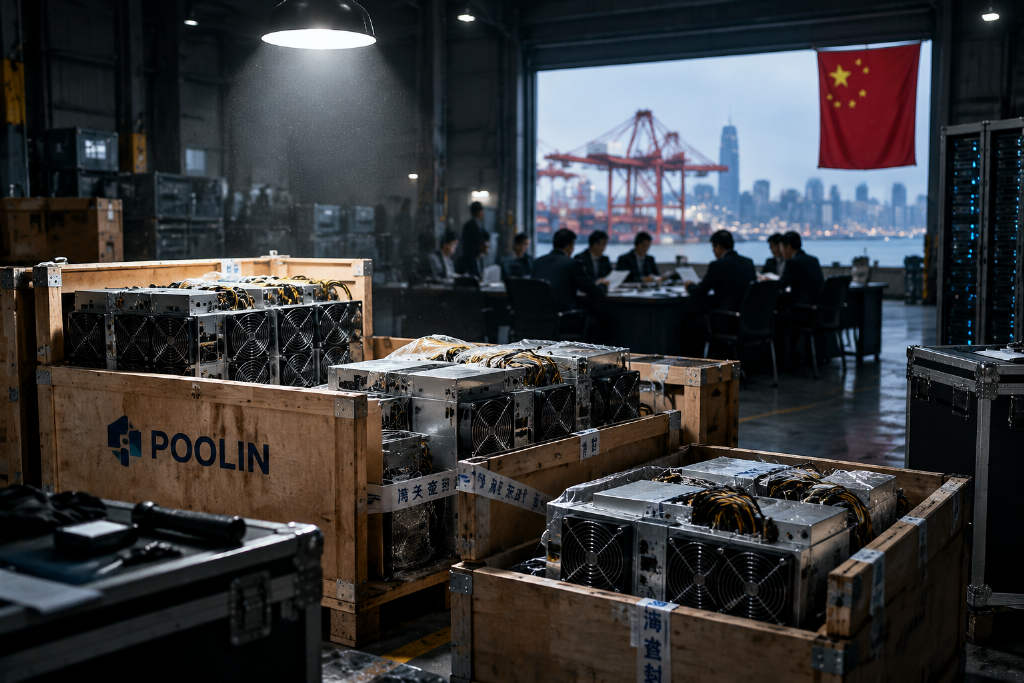
Poolin’s creditor committee was formed on Aug. 12 and has retained a law firm on behalf of all creditors to participate in and supervise the bankruptcy process. The case is currently an asset sale and liquidation proceeding, and creditors do not need to hire counsel on their own. Claims can be filed through the official Verita Global page. According to information on that page, Poolin Technology PTE. LTD. and two other debtors filed for Chapter 11 bankruptcy protection on July 22, 2026, and the cases are being jointly heard in the US Bankruptcy Court for the District of New Jersey.
Policy, tax, enforcement and regional mining updates
Bits media reported that Amanbay Orynbayev, chairman of the parliament of the Republic of Karakalpakstan in Uzbekistan, said the region is building three cryptocurrency mining centers and three data centers with total investment of $5.11 billion. In April, the whole territory of Karakalpakstan was designated as the special mining zone Besqala Mining Valley. Under Uzbekistan’s rules, cryptocurrency mining may be conducted only by legal entities and should primarily use renewable energy. Use of power from the national unified grid is charged at double tariff rates. Mining licenses are issued by the National Agency for Perspective Projects.
Bits media also reported that Kazakhstan’s Ministry of AI and Digital Development said licensed miners and mining pools in the country mined about 7,200 BTC from the start of 2023 through May 2026. Output peaked in 2024 at about 3,400 BTC, followed by 2,300 BTC in 2025 and 519.5 BTC in the first five months of 2026. Kazakhstan currently has 78 licensed mining companies and more than 465,000 registered mining machines. Mining-related taxes from 2023 through 2025 amounted to about 35 billion tenge, or roughly $75 million.
Bits media reported that Russia will ban cryptocurrency mining from Aug. 15, 2026, in Moscow, Moscow Region, and parts of Kursk Region, with the ban lasting until Dec. 31, 2032. The affected area includes eight municipal districts in Kursk Region and the city of Lgov, and it also applies to local residents participating in mining pools. The government order was signed by Prime Minister Mikhail Mishustin.
Livecoins reported that police in Brazil found a suspected electricity-theft Bitcoin mining site at a scrapyard. Officers seized 15 ASIC miners and three servers with an estimated value of more than $39,400. Local utility Cemig determined that the operation had been using illegal power connections, causing estimated monthly losses of about $11,800. A 37-year-old employee was arrested at the scene on suspicion of theft and receiving stolen goods. He could not explain the origin of the equipment or provide purchase records. Police are investigating where the mined cryptocurrency went, where the equipment came from, and whether a criminal organization was involved.
According to an article by lawyer Shao Shiwei, a virtual-currency mining machine smuggling case in Ningbo in July 2026 involved Liao and others allegedly smuggling Antminer L9, IceRiver KS3, and other machines into China through false declarations and concealed disassembly. The amount involved exceeded 17 million yuan. Core participants were sentenced to fixed prison terms of three to seven years for smuggling goods and items prohibited from import and export by the state. The article said the case may be the first publicly reported one in China to treat miner smuggling under that charge, whereas previous judicial practice had more often handled similar conduct under the offense of smuggling ordinary goods. It added that the legal characterization remains disputed.
MARA’s second-quarter results
MARA reported second-quarter 2026 revenue of $175 million, down 27% year over year. Net loss was $611 million and adjusted EBITDA was negative $361 million. Period-end hashrate rose 22% to 70.3 EH/s, Bitcoin production increased 3% to 2,422 BTC, and daily cost per unit of hashrate fell 4% to $27.7. Bitcoin holdings declined 29% year over year to 35,577 BTC, while the combined value of cash and Bitcoin was about $2.5 billion. The company currently has 1.4 GW of operating capacity and 1.9 GW of existing total capacity. It plans to expand potential total capacity to about 4.8 GW through the acquisition of Long Ridge and development of the Matagorda project in Texas, though completion of those transactions, regulatory approvals, grid interconnection, and construction progress remain uncertain.



