
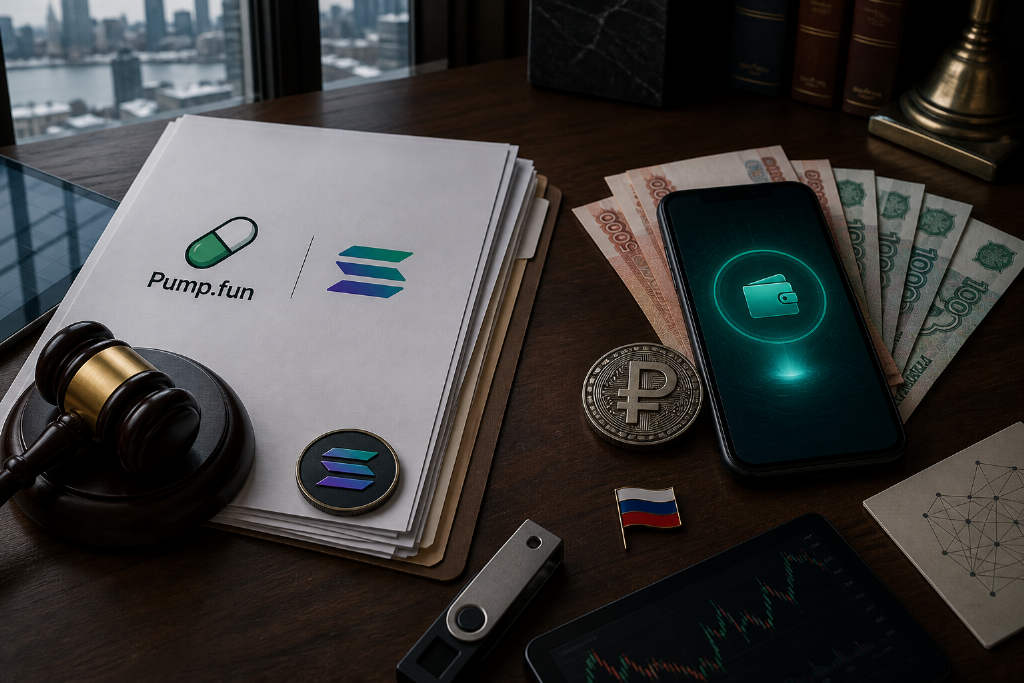
New York court dismisses securities claims in Pump.fun case
A federal court in the Southern District of New York dismissed securities claims tied to meme tokens in the Pump.fun class action and also dismissed all claims against Solana Labs, the Solana Foundation, and related executives. The court said the tokens at issue did not satisfy the "common enterprise" requirement under the Howey Test.
Pump.fun has not cleared the case entirely. Claims against its operating company and three founders, including RICO fraud and alleged unlicensed money transmission, were allowed to continue. The case will now move into discovery.
Russia begins broader digital ruble rollout on Sept. 1
Russia will enter a large-scale rollout phase for the digital ruble starting Sept. 1. Under the central bank’s plan, systemically important banks and large merchants with more than 120 million rubles in revenue in the previous year must support digital ruble payments first.
The rollout will expand in 2027 and 2028 to cover other banks and small and mid-sized merchants.
Use by individuals remains voluntary. Consumers can open digital ruble accounts through banking apps connected to the central bank platform. Individuals may transfer up to 300,000 rubles per month from bank accounts into digital ruble accounts, and personal payments and transfers will carry no fees. Russia is also launching a unified payment QR code that supports digital ruble spending.
Arkham researcher says Lazarus-linked funds moved through Hyperliquid
Arkham researcher Emmett Gallic said addresses linked to the North Korean hacking group Lazarus Group, which has been sanctioned by the Office of Foreign Assets Control, recently moved more than $30 million through Hyperliquid, with activity still continuing as of yesterday.
According to Gallic, the funds first entered Hyperliquid as BTC, were then swapped into ETH and SOL, and later bridged to Tron, Solana, and Ethereum. The money ultimately moved to KuCoin, LBank, Kraken, and several untagged Tron services.
Roughly $30 million of the inflows can be traced to addresses previously labeled as Lazarus. Another roughly $5 million in Hyperliquid-related volume came from a separate cluster of addresses. Gallic said those addresses showed similarities to known Lazarus wallets in dormancy periods, address type, and counterparty behavior, but there is no confirmed Lazarus link at this stage.
Strategy urges MSCI to withdraw index proposal
Strategy said in a public response to MSCI that it opposes a proposed index eligibility test that would exclude so-called non-operating companies, including Strategy, from the MSCI Global Investable Market Indexes, or GIMI. The company asked MSCI to withdraw the proposal.
Strategy said funds tracking MSCI GIMI hold only about 3.1% of its basic free float, so the direct effect of exclusion would be limited. Even so, the company argued that the proposal effectively revives an earlier MSCI approach from 2025 that was later withdrawn, under which companies with more than 50% of holdings in digital assets would not qualify for index inclusion.
It also said the distinction between operating and non-operating companies is not clearly defined under U.S. GAAP, IFRS, or other widely recognized legal frameworks. Strategy added that it has disclosed its Bitcoin business as an operating segment under U.S. GAAP and said that treatment is consistent with its communications with SEC staff.
MSCI’s consultation period runs through Sept. 30, with results expected on Oct. 16. If adopted, potential constituent changes would be announced on Nov. 11 and take effect on Dec. 1.
Kalshi issues its first lifetime trading ban
Prediction market platform Kalshi imposed its first lifetime trading ban on former U.S. Representative George Santos and fined him more than $70,000.
Kalshi accused Santos of placing large trades in a contract tied to whether he would attend Donald Trump’s State of the Union address, then influencing the contract price through public statements that were false or misleading about his attendance. Kalshi said Santos made about $18,000 by betting that he would not attend.
The platform said Santos was permanently banned for failing to cooperate with its investigation. During the same period, Kalshi handled four other enforcement cases, and those users received temporary trading suspensions after cooperating with investigators.