
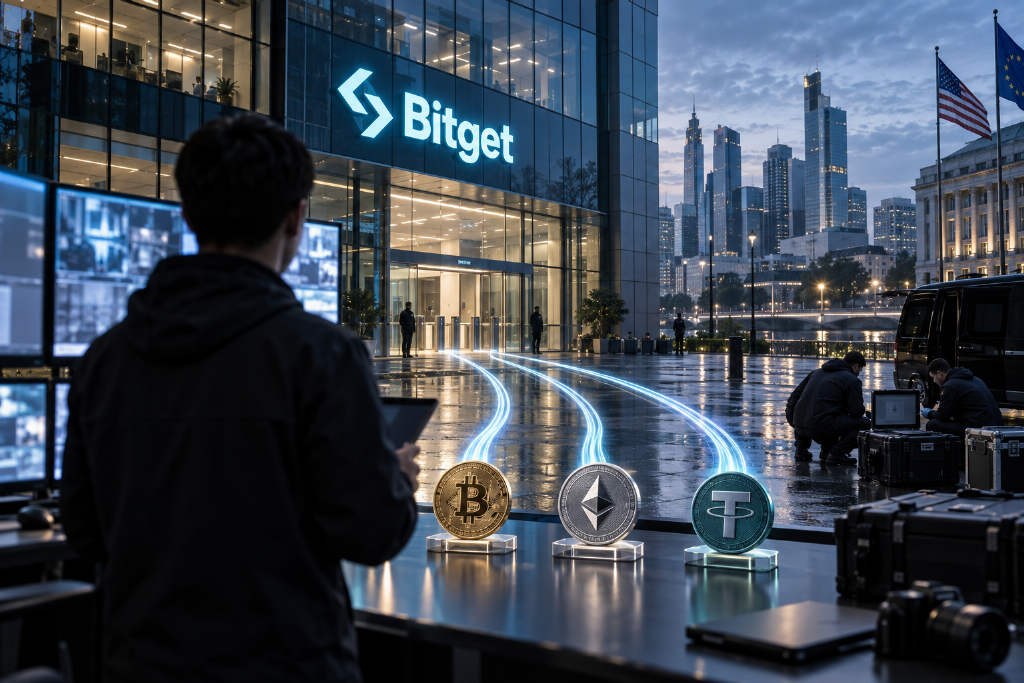
Bitget lays out a phased withdrawal restart
Bitget said the vulnerability involved in the Sept. 24 security incident has been identified and fixed, and the exchange plans to resume withdrawals in stages after completing security checks. In Beijing time, BTC withdrawals are scheduled to reopen at 16:00 on Sept. 28, ETH at 16:00 on Sept. 29, USDT at 16:00 on Sept. 30, and other tokens, fiat services, and P2P services at 16:00 on Oct. 2.
The exchange said user account balances were not affected, its protection fund will cover the financial losses caused by the incident, and trading and deposits are operating normally. Mandiant and SlowMist are still assisting with the investigation.
Vitalik Buterin says Ethereum node sync has improved
Ethereum co-founder Vitalik Buterin said an Ethereum node can now complete synchronization in half a day, and disk usage can fall below 0.5 TB under more aggressive settings. He said EIP-4444 and client-team work on snapshot sync have already improved the sync experience, and the Glamsterdam upgrade is expected to improve it further.
Buterin also said some browser-based dApps do not support local nodes well, while others hardcode RPC connections to their own servers, leaving him increasingly inclined to use the command line. He said he has already used a local Python script and a local node to update ENS records successfully, and his next step is to push for better privacy-protocol integration in kohaku-cli, where some early development work has already been completed.
Kazakhstan pushes miners to use associated gas from oil fields
Kazakhstan is moving to encourage crypto mining companies to generate electricity from surplus associated petroleum gas at oil fields and use that power for mining sites. The plan is aimed at reducing gas flaring, easing pressure on the power grid, and attracting miners back to the country.
Under the proposal, mining firms would bear the infrastructure costs, while oil fields could earn revenue by selling gas that would otherwise be burned off and also ease the constraints that associated-gas disposal places on higher crude output. Kazakhstan’s Energy Ministry said about 40 to 60 oil fields are currently flaring associated gas, and that it is working with the Ministry of AI and Digital Development on the legal framework.
Vietnamese man charged in crypto pig-butchering money laundering case
Federal prosecutors in the Western District of Missouri charged 37-year-old Vietnamese national Trung Nguyen Van with participating in a crypto pig-butchering scheme and brought two money laundering counts against him.
Prosecutors said that from June to August 2024, one victim believed they were investing through a crypto investment platform called Triangle and transferred about $16 million in crypto assets, with part of those funds directly traceable to Van’s wallet. From February 2018 to December 2024, Van’s crypto wallet allegedly received about $53.28 million in crypto assets tied to telecom fraud targeting U.S. citizens and sent about $53.19 million of that amount to other accounts.
Prosecutors also said multiple U.S. victims in separate pig-butchering schemes lost millions of dollars in total, with the funds flowing through multiple suspicious wallets into Van’s crypto wallet.
Autopsy rules former Hack VC partner Hsin-Ju Chuang died by suicide
An autopsy ruled that Hsin-Ju Chuang, a former partner at crypto venture firm Hack VC, died by suicide on Aug. 24 at age 37. The California Highway Patrol said its investigation into the circumstances surrounding the death is still ongoing.
Before her death, Chuang had publicly accused Hack VC of mistreatment during her time at the firm and said she rejected a settlement proposal that included confidentiality requirements, adding that she planned to release related evidence. Hack VC had previously said its account of the matter differed significantly from Chuang’s.
WuBlockchain weekly picks: Top 10 stories of the week
1. Bitget confirms the scale of the security incident and continues the probe
Bitget CEO Gracy Chen said the exchange’s security system detected unauthorized transfers from some hot wallets at 02:31 on Sept. 25 (UTC+8), with initially estimated affected funds of about $351.6 million. Bitget said cold wallets remained safe, the incident involved only some hot wallets and the warm-wallet layer, and user funds were covered by a user protection fund worth more than $464 million. The platform said it had identified and tagged abnormal transfer addresses, notified law enforcement and on-chain security organizations, and temporarily suspended withdrawals while deposits and trading continued as normal.
Chen said the security team’s preliminary finding was that hackers breached a critical backend system serving the wallet service, forged transfer information, and triggered the authorized signing process to move funds. She said a private-key leak had been ruled out. Multiple technical teams were working in parallel on system repair, security hardening, and preparations for restoring withdrawals, though no exact restart time had been given at that stage.
According to Specter, the stolen XRP from Bitget, after moving across chains, could be directly linked to $24 million stolen in the July attack on AFX. That earlier AFX attack had been attributed to TraderTraitor, so Specter said it believed Lazarus Group was behind the Bitget attack.
In a livestream, Chen said Bitget could not yet fully confirm the attacker’s identity, but some IP signals closely matched VPN characteristics used by a North Korea-linked group. She said the attackers were highly professional and may have watched Bitget for a long time. Most of the damaged assets came from hot wallets, and one wallet that looked like a cold wallet was in fact a warm wallet. Cold wallets were not affected. She added that Bitget’s protection fund of more than $464 million could cover the loss, the platform also had more than $1 billion in its own capital, and the withdrawal pause might last from several hours to one or two days.
Chen said Bitget was “absolutely not another FTX” and could handle concentrated withdrawals once the service resumed. She also said Bitget’s retail business was close in scale to Bybit’s, and that if Bybit could absorb a $1.5 billion loss, Bitget could absorb a loss of more than $300 million.
Bitget said it was working with independent third-party experts Mandiant and SlowMist on a full investigation. Chen repeated that protecting users was the exchange’s top priority, that user balances remained intact, and that the Bitget user protection fund would cover the impact of this platform-level incident. She added that Bitget Wallet, which uses self-custody infrastructure separate from Bitget Exchange, was not affected. Deposits, trading, rewards, and other exchange functions remained normal, while withdrawals stayed paused during additional security checks.
In a later update, Bitget said the security team had identified the attack path and the method used to bypass existing controls, and that the underlying vulnerability had been fixed and the incident was under control. The latest on-chain tracking showed about $387.5 million in assets had been moved to attacker-controlled addresses, above the earlier estimate of $351.6 million because previously uncounted Zcash and TRON assets were added, not because of a new theft.
Bitget also launched a bounty program for asset recovery, offering a 5% reward to participants who directly help freeze or recover stolen funds, and said it planned to publish a withdrawal recovery plan by 12:00 Beijing time on Sept. 26 at the latest.
CZ said Bitget had gone through a difficult day and that Binance, the BNB Chain ecosystem, and the community would try to help, while reminding users to stay safe. On the same day, Bybit CEO Ben Zhou, Binance co-CEO Richard Teng, MEXC CEO Vugar Usi, and CoinDCX co-founder Sumit Gupta also publicly offered assistance.
2. Trump discloses purchases of Coinbase and Strategy shares
A periodic transaction report disclosed by the U.S. Office of Government Ethics showed that Trump reported buying between $1,001 and $15,000 of Coinbase Class A shares on July 24. The filing also showed purchases of Strategy Class A shares worth between $1,001 and $15,000 on July 24 and between $50,000 and $100,000 on July 27. Earlier, he reported selling between $1,001 and $15,000 of Strategy Class A shares on July 8.
The report also showed that on July 29 he sold between $15,000 and $50,000 each of bitcoin mining stocks CleanSpark and MARA. The White House has previously said multiple times that Trump’s stock and bond portfolio is independently managed by a third-party financial institution, and that Trump and his family cannot direct, influence, or advise on specific investments or trade timing.
3. SEC Commissioner Hester Peirce criticizes the KYC/AML model
In a recent speech, SEC Commissioner Hester Peirce said the SEC’s “Innovation Exemption,” introduced last week, creates an interim path for trading tokenized securities through AMMs. She said the exemption is meant to keep overseas markets from dominating tokenized exposure to U.S. equities and to serve as a bridge before long-term written rules are adopted.
Peirce also sharply criticized the current KYC/AML approach, saying the costly model of expanding a “haystack of data” to find a criminal “needle” has delivered limited results while turning the financial system into a privacy-invasive “panopticon prison.” She called on regulators to adopt cryptographic tools such as zero-knowledge proofs and attribute credentials so compliance attributes can be verified without collecting or repeatedly storing users’ sensitive raw data, while protecting personal privacy as much as possible.
4. ECB launches Pontes for blockchain settlement in central bank money
The European Central Bank launched its blockchain settlement service Pontes on Sept. 21, linking existing payment systems with blockchain-based financial markets and allowing banks and investors to settle blockchain transactions in euro central bank money rather than relying on private money such as stablecoins.
Deutsche Bank, Santander, and securities settlement institution Clearstream are among the first participants to complete integration. In its initial phase, the service runs on weekdays from 08:00 to 16:00 Central European Time. The ECB also plans to allocate a very small portion of its own funds to invest in highly rated euro-denominated tokenized debt securities issued by public institutions.
5. ESMA makes AI and tokenization core priorities from 2027
The European Securities and Markets Authority said in a report that from 2027 it will treat artificial intelligence, tokenization, and other emerging financial technologies as core supervisory priorities across Europe.
Under a plan titled “Innovation with investor safeguards,” ESMA will work with regulators in EU member states to examine how licensed financial institutions are applying AI and tokenized financial products in core customer-facing business processes, not just middle- and back-office operations, and assess risks tied to data governance compliance and governance frameworks. EU regulators will also conduct a broad review next year of how such tools are being used in customer-interaction products and begin a first round of targeted inspections at the most affected firms.
6. Major U.K. banks complete first cross-bank transfers using tokenized deposits
Lloyds, NatWest, Barclays, HSBC, and other major U.K. banks have completed what was described as the first cross-bank fund transfers using tokenized deposits. Test scenarios included two mortgage transactions and one simulated online-shopping P2P payment.
Programmable deposits can release funds automatically once conditions such as delivery of goods or completion of a property transaction are met. The Bank of England has previously said it prefers banks to develop tokenized deposits with the same legal status as traditional bank deposits rather than rely on privately issued stablecoins.
7. U.S. weighs promoting overseas use of dollar stablecoins
The U.S. government is considering ways to promote the overseas use of dollar-denominated stablecoins to reinforce the dollar’s role as the world’s reserve currency and increase demand for U.S. Treasuries. People familiar with the matter said the government is considering support for stablecoin-related business through structures such as joint ventures with private companies, with possible involvement from the Treasury Department, the State Department, and the U.S. International Development Finance Corporation.
8. Binance takes a $100 million stake in Circle and signs a five-year USDC deal
A Form 8-K filed by Circle on Sept. 22 showed that one of its subsidiaries entered into a new five-year agreement with Binance on Sept. 17 to expand cooperation on USDC promotion, replacing earlier agreements signed in November 2024 and August 2025.
Circle will pay Binance monthly incentive fees based on the amount of USDC held through its modular smart-contract wallet infrastructure service. On the same day, Binance subscribed for 1,237,011 shares of Circle Class A common stock at a discounted price of $80.84 per share, for a total of $100 million, and the transaction has been completed. The shares are generally subject to a two-year transfer restriction, with early termination and other exceptions possible.
9. Coinbase opens IPO stock access to U.S. retail users
Coinbase said it is opening IPO stock subscriptions to U.S. retail users, with the first supported deal being Oura’s IPO this week. Eligible users can apply in the Coinbase app to receive shares at the offering price before public trading begins, though final allocations may be full, partial, or none.
Coinbase said users who sell within 30 days after an IPO stock begins trading may be suspended from future IPO subscriptions for 60 days. The service is provided by FINRA-registered broker-dealer Coinbase Capital Markets, with clearing and custody handled by Apex Clearing.
10. First tokenized stock platforms under SEC exemption may reveal plans next quarter
Taylor Lindman, chief legal counsel of the SEC Crypto Task Force, said the first tokenized stock trading platforms operating under the new Innovation Exemption could begin disclosing operating plans as early as next quarter, and that the SEC has already heard from multiple companies interested in participating.
The five-year exemption allows eligible platforms to trade tokenized U.S.-listed stocks on public, permissionless blockchains through permissioned AMMs and liquidity pools. The tokens must preserve traditional shareholder rights such as dividends and voting. SEC Commissioner Hester Peirce said the current transaction-size limits are enough to support commercial operations rather than only small-scale experiments, and she described the exemption as a transitional arrangement before long-term rules are written.
Key funding deals
- HIFI completed a $37 million Series A round led by Left Lane Capital.
- DeFi project infiniFi raised more than $3 million in seed funding and plans a TGE in the fourth quarter.
- Stablecoin payments network Atum raised $13.5 million in a round led by Variant.
- Stablecoin payments platform Infini raised $6 million in seed funding.
- XStable completed a new funding round with participation from YZi Labs, Sui Foundation, and others.
More industry fundraising deals are available at crypto-fundraising.info.