
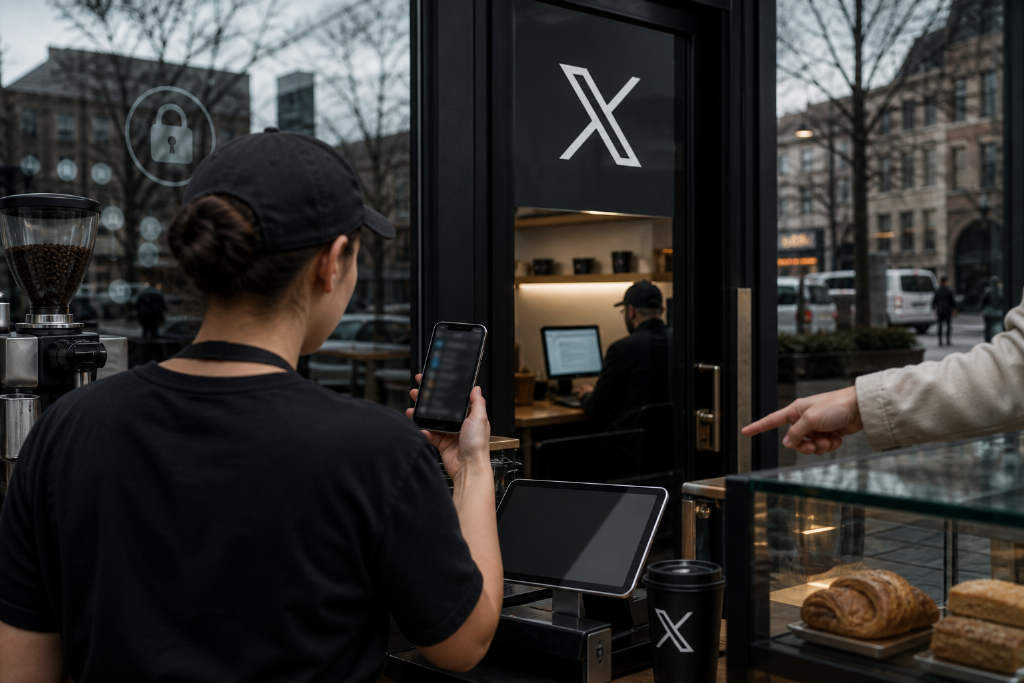
X has launched X Chat Agents, a feature that puts AI agents directly inside end-to-end encrypted direct messages on the platform, including group chats where business accounts can take orders and reply without moving users into a separate bot window.
On Aug. 27, Chris Park, who leads X’s developer platform, announced the rollout on X. The XDevelopers account posted a 40-second demo video at the same time. In the video, a coffee shop called The Barista Bar is summoned inside a group chat, then handles an order, confirms the items, and responds with an estimated preparation time, all within the same conversation.
Park wrote: 「Ladies & Gentlemen, We are launching 𝕏 Chat Agents to bring more utility & agentic experiences in Chat. Powered by 𝕏 Everything API.」
Agents are now part of the chat thread
X Chat Agents is built on the X Chat API and Chat XDK, which X made public on July 30. According to the official announcement cited in the source material, developers can use the API set to build direct message bots that send and receive end-to-end encrypted messages with cryptographic signatures on X.
The supported scope includes one-to-one chats, group conversations, encrypted text and media, typing indicators, and read receipts. Chat XDK, which handles encryption, decryption, and signing on the user device side, supports six languages: Python, TypeScript, Rust, Go, C#, and Java.
After connecting a business account, developers can make the agent appear directly in an existing chat under that account’s name. Users do not need to open a separate bot interface.
The official example repository shows three prototypes: a basic echo bot, a bot connected to Grok, and a bot that reacts only through read receipts. In each case, the flow is built around subscribing to event updates, decrypting incoming messages locally, and replying with an authorization token.
The report says this toolchain extends a broader push from X’s developer platform earlier this year. X first packaged more than 200 API endpoints into tools that agents could call, then released the command-line tool xurl with a focus on agent optimization. Chat Agents is presented as the first time that infrastructure has been connected to a consumer-facing private messaging surface.
Encryption remains, but merchants take on the decryption step
The core logic of end-to-end encryption is simple: keys stay on the devices of the users and their chat counterparts, so the platform cannot see plaintext. That works cleanly in person-to-person messaging. The tension appears when a business agent is inserted into the exchange.
If an agent is expected to answer questions such as whether there is a table for four at 8 p.m. or when an order will ship, it has to decrypt the message on the merchant’s own server, interpret it, and generate a reply. As the source article puts it, encryption has not disappeared; the question of who can read what you say has shifted from the X platform to the merchant’s backend.
The official documentation, as quoted in the source, states this plainly: X itself cannot read message plaintext, but the merchant side must decrypt messages for the agent to work. The article frames that not as a minor engineering detail, but as a trade-off built into the business model of agent-based encrypted chat.
Rate limits and future pricing are still unresolved
The report also highlights practical limits. Chat API message throughput is capped at 25 messages per 15 minutes and 500 messages per 24 hours. For a business account handling delivery orders or customer service inquiries, that ceiling is not especially wide.
X’s documentation currently says only that the feature is available for free for a limited time. It does not say how pricing will work after that period ends. The source article notes that a coffee shop may be able to test the feature, but any merchant planning to place a full customer service workflow on top of it still has to consider when the bill will arrive.
The launch came before the documentation was finished
Another point raised in the report is that the product announcement arrived before the documentation was complete. Under docs.x.com/xchat, there is not yet a standalone Chat Agents page, and entering the direct URL returns a 404, according to the source material.
That means the feature was announced first and specified later, which the article describes as uncommon for a technical platform that usually pays close attention to developer experience.
The same report cites a practical note from Vercel’s contemporaneous update: XChat does not support Markdown. Middleware has to turn tables into ASCII layouts and convert links into interactive components. There is also no token-by-token streaming output, so live updates depend on editing messages that have already been sent.
Even if developers connect stronger models, the experience inside X direct messages will not look like the kind of character-by-character output users associate with ChatGPT.
The latest piece in X’s 2026 developer push
Viewed over a longer timeline, the article positions X Chat Agents as the latest step in a series of moves by X’s developer platform this year: usage-based billing in February, an API toolbox for agents in June, the release of Chat API in July, and now agents that can live directly inside private messaging.
The report contrasts that with xAI’s Grok Bot, which was introduced in mid-August and follows a different approach. Each task gets a dedicated cloud computer and a separate set of login credentials, with the focus on completing a full task from start to finish. The article also notes that bot ecosystems on Vercel, Slack, and Discord are more mature than X’s.
X is taking a different route by placing agents into group chats people already use in daily life. The source argues that this targets a different layer of trust. X may not be first, but the platform does have something others do not: a native end-to-end encrypted messaging network built on more than a decade of accumulated social relationships.
The article closes on that trust question. The original promise of encrypted messaging was that even the platform would not know what users were saying. Now part of that trust is being handed to the merchant-side agent. X is betting that users will treat protection from platform-level visibility and readability by a merchant’s AI as compatible ideas. Whether that holds, the report says, will depend on how many merchants are willing to absorb a cost structure that still has no posted price.