
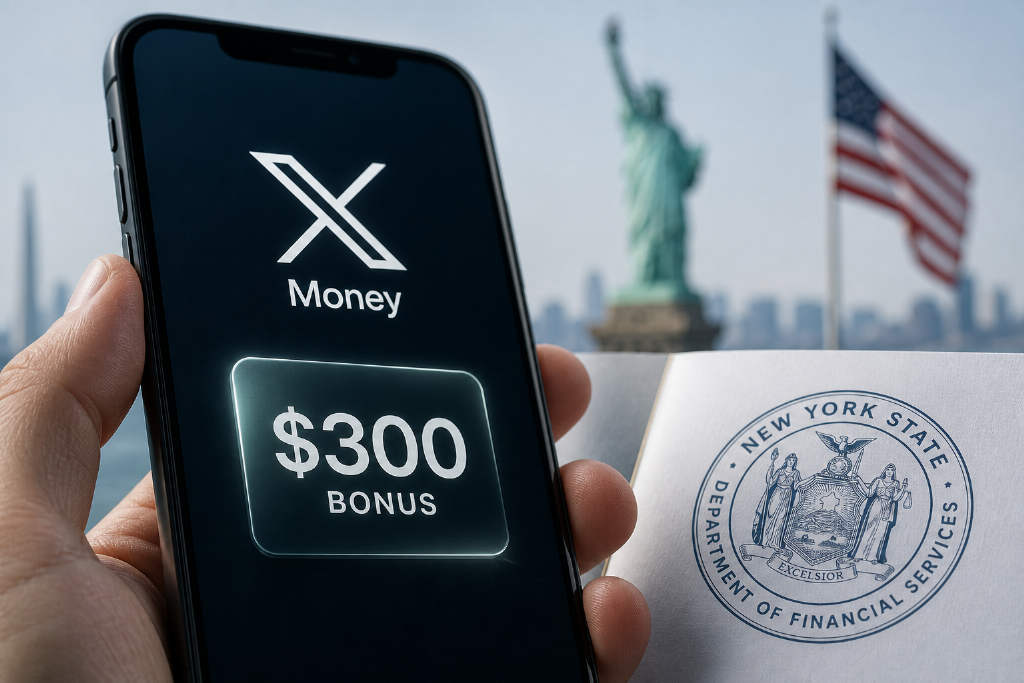
The New York Department of Financial Services (NYDFS) told Elon Musk’s X Money this week that it cannot continue paying bank-account-like interest on funds held for New York residents in non-bank accounts.
X Money answered with a different offer: a $300 "direct deposit bonus" for New York residents, described as "interim compensation." The company repeatedly said the payment "does not constitute APY or interest."
X Money says it does not offer bank accounts in New York
According to Protos, X Money does not offer bank accounts in New York. Instead, it presents the product to New York customers as a way to "earn yield," "get cashback," "send wires," "mail checks," and "pay your bills," while also advertising "free ATM withdrawals" and saying users are "protected with FDIC coverage."
The product holds New Yorkers’ funds in what it calls a "stored value account." X Money says customers can "obtain interest" on their money through September 30 and then "earn a $300 bonus" after October 1. The report says those payments are not any type of bank account interest.
Money transmitter approval does not make X Payments a bank
NYDFS approved X Payments as a money transmitter in New York effective July 23. X Money lists non-bank license number MT-105532 with an issuance date of July 24.
That approval does not turn Musk’s payments business into a bank. NYDFS defines money transmitters as businesses that move money for the public. X Payments’ own license page states, "X Payments LLC is not a bank."
Its stored value account terms go further, stating, "X Payments is not a bank, is not FDIC-insured, and does not take deposits," even though the X Money homepage mentions deposits 16 times.
How the $300 payment is structured
Despite those legal disclaimers, X Money says it will credit the $300 "direct deposit bonus" within 14 days after New York residents make "$3,000 of qualifying deposits." Protos notes the tension in that language because X Payments also says it does not take deposits, arguing that a stored value account is not a bank account.
As presented in the report, the central issue is that X Payments holds a New York money transmitter approval, not a banking charter, leaving X Money unable to keep offering interest-like returns on these balances to New York users.