
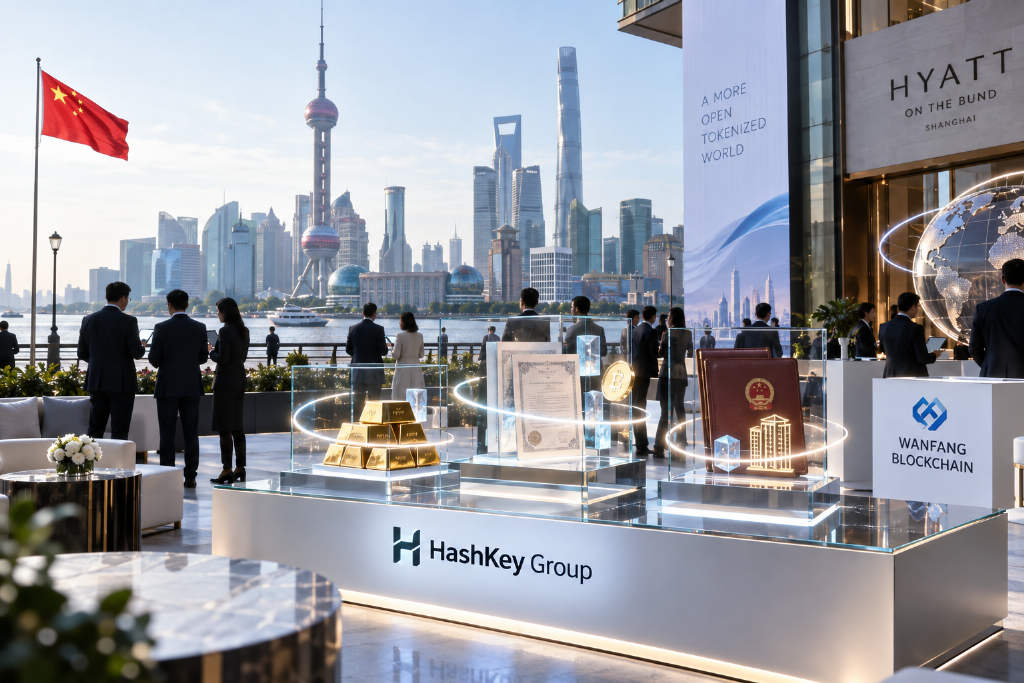
On Sept. 23, 2026, the 12th Blockchain Global Summit hosted by Wanxiang Blockchain Labs was held at the Grand Hyatt Shanghai on the Bund. At the event, Wanxiang Blockchain Chairman and HashKey Group Chairman and CEO Xiao Feng delivered a keynote titled "Asset Tokenization and 24/7 Trading — Blockchain Rebuilds the Global Financial Market." The text below is based on a transcript of his speech.

A U.S. signal sets the frame
Xiao began by saying the summit’s discussions had largely followed two tracks: tokenization plus round-the-clock trading, and the relationship between AI and blockchain. His remarks focused on the first track. The question he wanted to tackle was direct: if an international financial center commits to large-scale tokenization of financial assets and launches 24/7 trading, what does that mean for other global financial centers, and how should they respond?
He pointed to the "2026 12th U.S. Treasury Market Conference," held in New York on Sept. 22 U.S. time, or the night before in Beijing. According to Xiao’s retelling, the event was jointly organized by the U.S. Treasury Department, the Federal Reserve, the Federal Reserve Bank of New York, the Securities and Exchange Commission, and the Commodity Futures Trading Commission. He said the CFTC chair argued there that the next 10 years of change in the U.S. financial system, driven by large-scale tokenization, on-chain finance and 24/7 trading, would exceed the changes seen over the past several decades.
Xiao used that point as his entry into a larger discussion. He revisited the changes the U.S. financial system has already gone through. In the past 20 years, he said, much of the transformation came from internet and information technology. Going further back, from the 1970s to 2000, the U.S. also rebuilt its trading, clearing and settlement infrastructure.
He cited the Depository Trust & Clearing Corporation, or DTCC. Formed in 1999, DTCC was not simply a brand-new company, he said, but the result of nearly 25 years of consolidation that brought together fragmented custody, registration and settlement institutions across the U.S.
Xiao also recalled that in the 1960s, the New York Stock Exchange had to close on Wednesdays because financial infrastructure could not keep up with market activity. The problem, he said, was clearing physical stock certificates in time. Today, by contrast, Nasdaq has announced that it will launch 23x5 trading on Dec. 6 of that year, meaning 23 hours a day, five days a week. To Xiao, that move alone shows how much the underlying system has changed.
He said the forces behind the next wave of change can be grouped into four areas: tokenization, 24/7 trading, on-chain finance, and stablecoins.
How Xiao defines the financial system
Xiao then stepped back and described the financial market system as a structure with five layers. At the top sits the central bank. In his words, the central bank is the master valve for money, the source of all base money, and the lender of last resort when institutions get into trouble or when the broader economy runs into stress.
He used the sharp rise in U.S. interest rates a few years earlier to illustrate the point. As rates rose, U.S. Treasuries issued in a lower-rate environment fell in price, leaving banks with losses on their balance sheets. Xiao said one estimate put the hit to U.S. bank capital at close to $600 billion.
He then brought in Circle. According to Xiao, the stablecoin company had more than $3 billion of reserves at Silicon Valley Bank. After losses on Treasuries left the bank insolvent, a bank run followed, and the reserves backing USDC nearly went to zero. Under the U.S. deposit insurance system, he said, Circle would have recovered only a very small amount, in the range of several hundred thousand dollars.
Xiao’s point was that this was not mainly a story of one badly run bank. It was a system-level problem tied to rising U.S. interest rates. In response, the Treasury Department and the Federal Reserve stepped in and announced that deposits at failed banks with inadequate capital ratios would be fully protected by the federal government during that period. That, he said, is what a lender of last resort looks like.
He also revisited 2008, when Morgan Stanley and Goldman Sachs sought bank holding company status. During the financial crisis, Xiao said, Wall Street liquidity dried up. Firms like Goldman and Morgan Stanley needed to borrow and roll over tens of billions of dollars a day through money markets and repo markets just to keep operating, while borrowing costs had jumped to 24%. In his telling, the two firms applied in the morning, were approved by the afternoon, and received tens of billions of dollars in liquidity from the Fed shortly after.
That is why, Xiao argued, the deepest anchor of a global financial center is not the exchange. It is the central bank’s operating structure. In New York’s case, he said, the key foundation is the New York Fed, where open market operations and dollar liquidity management are centered.
Financial institutions and credit creation
Below the central bank layer are financial institutions. Xiao described them as the creators of money multipliers and asset credit. While central banks issue base money, banks expand it through capital adequacy arrangements. In his simplified example, $1 from the central bank can become $5 or $8 in use inside the financial system.
Financial institutions also create credit through assets, he said, by issuing different financial instruments and designing structures that improve capital efficiency. He used U.S. Treasuries as an example. If an institution buys $100 worth of Treasuries, it can immediately pledge them as collateral and borrow at least $95 against them. For Xiao, that process is a straightforward example of how modern finance creates credit from both money and assets.
Alongside central banks and financial institutions, he placed money markets, capital markets and derivatives markets as the other layers that complete the financial market system. When the CFTC chair talks about large-scale change ahead, Xiao said, this is the full structure under discussion.
What makes a market mature
Xiao broke down efficient market structure into four dimensions.
- First, a fast trading system, where matching can happen quickly and at scale.
- Second, an efficient settlement network, because settlement speed is one of the clearest ways to judge whether a market is effective.
- Third, a sound credit-creation mechanism, whether through leverage on funds or by turning assets into collateral and margin.
- Fourth, a deep pool of liquidity, meaning enough width and enough depth in the market.
On settlement, he said blockchain-based digital asset markets are different by design. Settlement happens at the same time as the trade, so exchanges dealing in digital assets are naturally able to support 24/7 activity.
Legacy markets are still constrained by their payment and settlement rails. Xiao said Nasdaq’s current infrastructure cannot yet support 24/7 trading, which is why it is starting with 23x5. If a market wants to move to 24/7 in a fuller sense, he argued, the settlement currency itself must be tokenized. Banks close in the evening. They are not open on Sundays or public holidays. That makes traditional cash movement incompatible with always-on trading.
He also tied liquidity to execution quality. If an asset is marked at 100 but trading it costs 3%, then its effective value is 97, not 100. If market depth is strong enough, the same asset might trade at 100 or 99.99.
Blockchain as the third major shift in bookkeeping
Xiao argued that the reconstruction now underway in financial markets rests on a new method of record-keeping. In his view, tokenization can only be done on blockchain, and 24/7 markets with real-time settlement require distributed ledgers.
He called blockchain the third major innovation in bookkeeping in human history.
The first, he said, appeared around 3500 BC in Sumer, in what is now Iraq, where an excavated clay tablet was later identified as a basic ledger tracking income and expenses.
The second came around 1300 in the Mediterranean region of Italy with double-entry bookkeeping, which added assets and liabilities to the ledger.
The third arrived in 2009 with the Bitcoin blockchain and the introduction of distributed bookkeeping. Xiao’s conclusion was that if the underlying accounting system changes only once in many centuries, the impact on market structure and market institutions should not be underestimated.
Tokenization on the funding side
Turning to what he called digital twins and tokenization, Xiao said financial markets have already begun to restructure themselves on both the funding side and the asset side, starting with fund tokenization in 2024.
On the funding side, he grouped central bank digital currencies, tokenized bank deposits and private stablecoins together under one label: tokenized money.
He said the process had effectively begun as early as 2014, the year USDT emerged.
Xiao spent time explaining how he sees stablecoins. Functionally, he said, they are the same as private digital cash. If a person withdraws 100 yuan in banknotes from a bank account, that money has left the banking account system. Stablecoins work in the same way: once 1 unit of stablecoin is minted and sits in a mobile wallet, it is like cash in a pocket, outside the account-based banking layer.
He listed three traits. First, stablecoins leave the account system in the same way cash does. Second, holding cash usually pays no interest, and holding stablecoins usually pays no interest either. Third, cash allows peer-to-peer payment with immediate settlement, and stablecoins do the same.
His example was simple: if someone uses cash to buy a bottle of soy sauce in a store, the merchant receives payment immediately. There is no delay to the next day. Xiao said that is also true of stablecoins and, in functional terms, Bitcoin. His shorthand was clear: stablecoins are digital cash.
Tokenization on the asset side
Xiao said tokenization is no longer confined to money. On the asset side, he noted that, according to a Hong Kong lawmaker speaking earlier at the summit, Hong Kong has already completed more than HK$70 billion in tokenized bond issuance.
In his account, tokenized bonds, tokenized funds and tokenized derivatives already exist.
He then moved to a case that he said drew close attention from domestic financial regulators in China: before ChangXin Memory Technologies was listed in the A-share market, products linked to it were already trading on the decentralized exchange Hyperliquid overseas. When the stock did list in the A-share market, Xiao said, its opening price was very close to the price seen on Hyperliquid.
That, for him, exposed a difficult question. If domestic markets do not tokenize, overseas venues may still move first, scale faster and begin shaping the price discovery process for Chinese assets before those assets even start trading onshore.
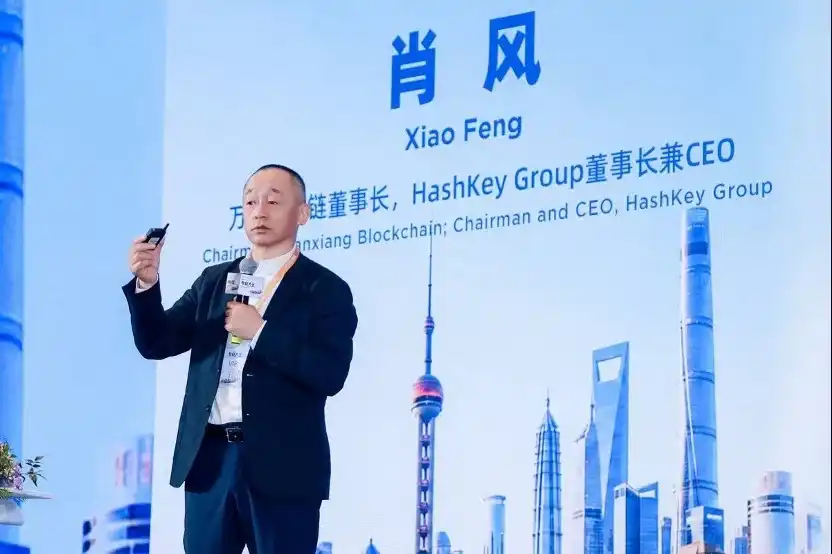
Xiao said that once both the funding side and the asset side are tokenized, the end result is on-chain finance — a financial market system that can close the loop on its own.
What happens when one financial center moves first
A central part of the speech was Xiao’s view of the global spillovers created if one major financial center adopts large-scale tokenization and 24/7 trading ahead of others.
Liquidity could be pulled away
His first point was liquidity. Other financial centers, he said, would face some degree of liquidity loss. Whether the hit is 10% or 20%, liquidity would be drawn toward the market that offers 24/7 access.
He defined liquidity using two primary measures: trading volume and depth, plus the cost of market impact and the size of bid-ask spreads. In the U.S., he said, the New York Stock Exchange and Nasdaq do not yet trade around the clock, but U.S. equities already trade outside regular hours through alternative trading systems and dark pools.
If the major exchanges themselves open 24/7, Xiao said, that fragmented liquidity could flow back into those venues. He believes that even during nighttime hours in the U.S., trading volumes there could exceed those seen at other financial centers around the world.
The longer trading window would also attract investors globally. People who previously had to stay up late to trade U.S. stocks could do so during daytime hours in their own location.
Capital follows liquidity
His second point was funding. Capital would also be siphoned toward the more liquid market. A trader, Xiao said, has no reason to stay in a market where slippage is 2% if another market offers 0.1% slippage.
He connected that advantage to the scale of U.S. capital markets and to the valuations they support. That, he argued, helps explain how the U.S. can produce listed companies with market capitalizations of $5 trillion and private companies such as OpenAI and Anthropic with $1 trillion valuations while still attracting funding.
Xiao used a Chinese expression that roughly means big water raises big fish. In markets with deeper capital pools, companies receive larger valuations even if their profits are the same.
He said one very clear reason the U.S. wants tokenization and 24/7 trading is to prepare financing capacity for AI infrastructure. The U.S., in his telling, has not undertaken a major nationwide infrastructure buildout in many years, but now faces a new investment cycle centered on AI infrastructure, from electricity to data centers. Over the next five to 10 years, he said, those needs could reach $10 trillion.
Building a 24/7 funding and capital market would make it easier to raise that money. Xiao added that only a global, round-the-clock market could support future AI companies worth $10 trillion.
Issuers go where the pool is deepest
His third point was issuance. If liquidity and capital are both drawn into one market, issuers will rationally choose to list and distribute assets there. In Xiao’s view, the first market to combine large-scale tokenization with 24-hour trading could gradually become the center for global issuance, trading and settlement of financial assets.
Pricing power becomes more concentrated
The fourth issue was pricing power. Xiao returned to the Hyperliquid case and said it prompted a first real shock for many observers: the price of a Chinese asset destined for the A-share market appeared to be formed overseas in a decentralized venue with no obvious jurisdictional home, legal framework or clear regulator.
That kind of shift, he said, means financial discourse and market influence become more concentrated as well.
Investors face fewer barriers
The fifth point was access for investors. If financial assets are tokenized and trade 24/7, investors in other countries can buy them more easily than before. Xiao said investing in U.S. stocks traditionally may require a U.S. bank account and a foreign-exchange step into dollars. Under a tokenized market design, he said, investors could use stablecoins directly from anywhere in the world, including during daytime hours in Hong Kong.
He added that the NYSE’s 24/7 trading plan already proposes using stablecoins as a trading medium and settlement tool. If that model takes hold, he said, access to U.S. equities would become much easier and the effective trading day would become much longer for global investors.
Xiao compared the result to an always-open financial supermarket: broad selection, workable pricing, deep inventory and new products appearing there first. Rational investors, in his view, would naturally prefer that market.
Settlement conditions have changed
The sixth point was settlement. Xiao said earlier attempts to build a global 24/7 market system did not work because markets in Asia, Europe and the U.S. traded different products, settled in different currencies and relied on different banking systems.
Now, he said, the combination of stablecoins, tokenized bank deposits and central bank digital currencies changes that. Once financial assets are tokenized, global circulation becomes easier in much the same way Bitcoin trades across hundreds of exchanges around the world while using USDT and USDC as settlement tools.
He went a step further and said always-on tokenized trading is also preparation for machine trading. If AI agents are going to help humans trade, or even make trading decisions on their own, then capital markets should be rebuilt as 24/7 systems. Machines do not understand dollars and yuan in the way humans do, he said. They understand tokenized money. Without tokenized and programmable currency, machines cannot use it.
Disclosure rules and standards may clash
Xiao’s seventh point concerned financial information. He recalled the long-running dispute over whether U.S. regulators should be allowed to inspect audit work papers of Chinese companies listed in the U.S. The compromise, he said, was that U.S. regulators could inspect them, but the documents would be reviewed in Hong Kong rather than taken to the U.S.
He said similar tensions could emerge in tokenized capital markets. If a venue tells issuers it no longer lists traditional shares and only issues tokens, foreign companies wanting access would need to decide whether they recognize tokenized equity, whether they accept new disclosure standards for tokenized securities, and whether they are willing to follow any new accounting requirements that come with that system.
Those conflicts, in Xiao’s telling, would become conflicts between market standards. And the side with the greater need for funding is usually the side that must compromise.
Financial centers may split apart
His eighth point dealt with the hierarchy among financial centers. Under this kind of collision, conflict and reconstruction, Xiao said, global financial centers will split. The most optimistic outcome would be limited impact and parallel systems. He sees that as unlikely. A middle outcome would be a world of one dominant center and several strong ones. A more pessimistic outcome would be an even more concentrated order in which one center stands far above the rest and other centers lose status, function and influence.
His ninth point was about market models. For other international financial centers, refusing tokenization, blockchain and 24/7 trading could mean staying inside the old market system while the most important system moves on. Xiao described that as a real form of decoupling.
He used Hong Kong’s currency arrangement as an example of how financial centers choose the pool they connect to. Offshore renminbi markets, he said, are around RMB 1.5 trillion in size, while the dollar market is $50 trillion. In practical terms, the question for a financial center is which pool it links itself to.
His answer was that markets should not choose decoupling. Instead, they should combine off-chain and on-chain financial systems and take part in building the next market structure.
Why Xiao says the U.S. is the one actually doing it
In the final section of the speech, Xiao moved from theory to current positioning. He said only the U.S. is clearly moving in this direction. Europe is still discussing. Asia, in his words, remains fragmented, with different jurisdictions pursuing their own agendas and without a unified set of rules or standards that could compete with another market system.
Money markets
On the money-market side, Xiao said stablecoin legislation, Stripe and SWIFT have each launched global stablecoin alliances. He also said JPMorgan, Citibank, Wells Fargo and Bank of America have started an alliance focused on tokenized deposits, while 30 U.S. regional and smaller banks are pursuing their own tokenized deposit alliance.
He described U.S. financial institutions as moving at full speed in the money market arena.
Capital markets
On capital markets, Xiao referred to a friend who had recently traveled from Silicon Valley to New York. The feedback, he said, was that Silicon Valley talks about AI everywhere, while in New York the level of discussion around Web3, blockchain, digital currency and digital assets remains almost unchanged from a year earlier.
What has changed is the topic. The conversation has shifted from Bitcoin to tokenization.
Xiao also noted that Ondo and Canton, two guests from the Web3 industry, were speaking at the summit that afternoon about their work in asset tokenization.
He closed his remarks with a short line: "That’s roughly what I wanted to share today. Thank you."