

Xiaohongshu’s dots model lab has open-sourced dots3-note preview, the first public release in its dots3 series. The model is aimed at long-horizon tasks that are closer to real-world use and harder to score with fixed benchmarks.
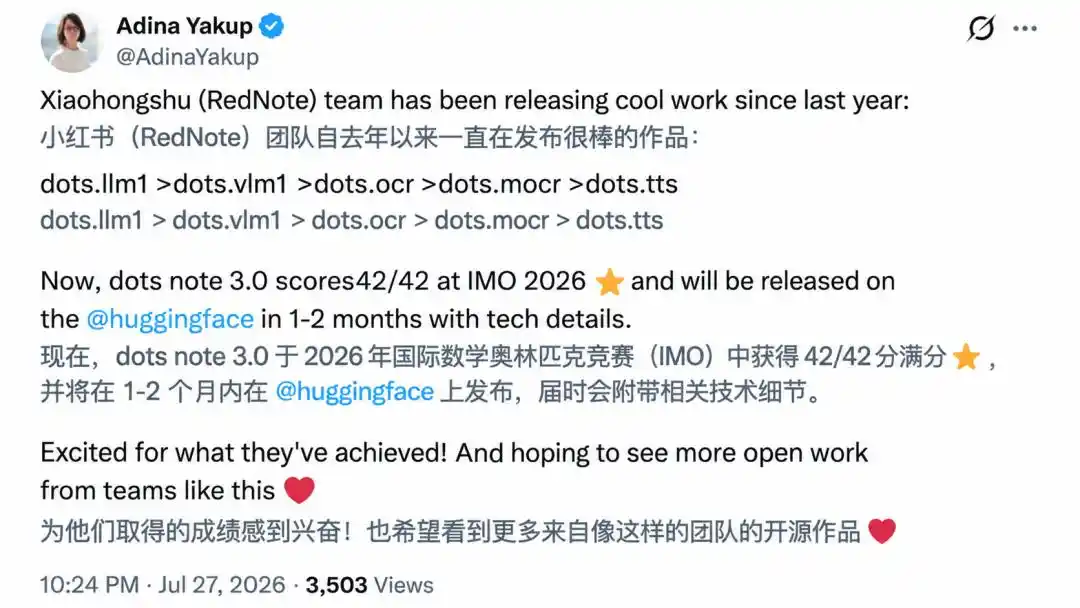
The release follows growing interest around the dots family after Xiaohongshu said last month that its in-house model dots-note-3.0 became the first AI system to earn an officially certified perfect score of 42 at the International Mathematical Olympiad. Since then, one of the main questions from the community had been when a related model would be opened up.
Model specs and access points
According to the company, dots3-note preview has 280B total parameters and 16B active parameters. It supports a 512K context window and multimodal understanding across text, vision and speech. Xiaohongshu said the model was optimized for complex reasoning, agent work and multimodal perception.
- API: https://dots.ai/platform/
- Hugging Face: https://huggingface.co/dots-studio/dots3-note-prev
- GitHub: https://github.com/studio-dots-ai/dots3-note-prev
While the IMO result highlighted the model family’s strength in mathematical reasoning and proof generation, this open-source release shifts attention to a different class of work: travel planning, wedding preparation, store operations and other tasks that may run for hours, days or longer and do not have a single correct answer.
Built around long-horizon agent work
Xiaohongshu framed the release around a broader trend in agent development: models are increasingly being asked to take on longer and more complete workflows on their own. The company cited OpenAI’s disclosure that in May this year, more than 70% of users asked Codex to handle work that would take a human more than an hour, and that by June, the top 1% of active internal OpenAI users were generating more than 60 hours of agent turns per day.
The company argued that the gap between controlled environments and open-ended real-life settings remains large. Agents already perform relatively well in areas such as math, coding and engineering, where objectives are clearer and outcomes can be checked. Real-life settings are less structured and user requests are often vague, which puts much more pressure on planning, judgment and error correction over long stretches of interaction.
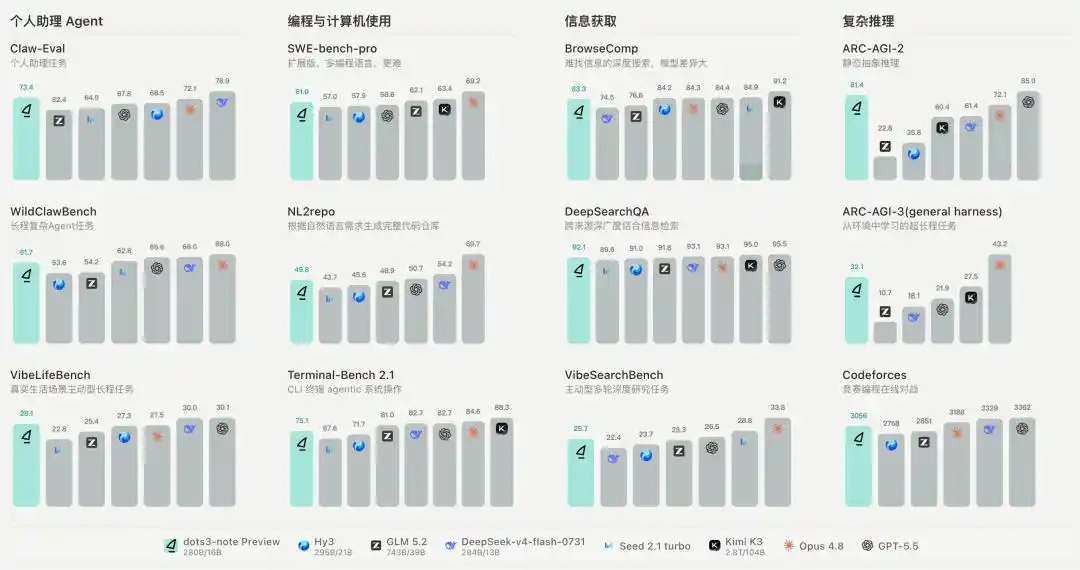
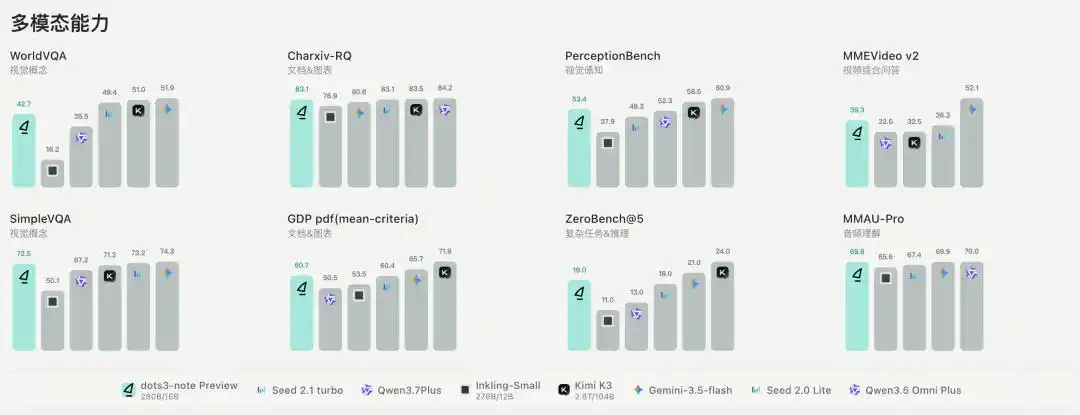
Xiaohongshu said benchmark results show dots3-note preview can match, and in some cases outperform, much larger models on several reasoning and agent tasks. It also said the model’s vision performance stands out within its size range.
Adding the agent piece to the open-source dots lineup
Before this release, Xiaohongshu had already open-sourced the text model dots.llm1, the multilingual document layout parser dots.ocr, and the multimodal vision understanding model dots.vlm1. dots3-note preview adds the agent layer to that lineup.
Test cases: from gaming to software engineering
To show what the model can do beyond leaderboard scores, the company shared a set of test cases built around tasks with scattered information, many steps and changing conditions.
Taking over a run in Slay the Spire II
One test put dots3-note preview in control of a game of Slay the Spire II. The challenge in that setting comes from route planning, card selection, deciding whether to fight elites, spending gold, and choosing between rest and upgrades at camps. A decision that looks good locally can create trouble much later in a boss fight.
Xiaohongshu said the model had not been specially trained on the game in advance, yet it learned card and enemy mechanics from battle feedback while managing health, deck composition, gold and potions. It then kept making trade-offs across shops, camps and elite battles and reached floor 33.
Solving ARC-AGI 3 from scratch
In ARC-AGI 3, a long-horizon reasoning task with unknown rules, the model had to inspect the screen, form hypotheses and test them through actions. Xiaohongshu said dots3-note preview gradually discovered patterns such as vertical synchronization and horizontal mirroring between two blocks, then worked out mechanics involving danger tiles, movable markers, pressure switches and gates.
When a hypothesis failed, the model invoked a Self-Critiquing mechanism to reassess the situation and wrote the revised rules into a file called memory.md, which the company described as a notebook that preserves the model’s evolving understanding of the environment.
The model eventually cleared all six stages in 320 steps.
Using images to answer a home renovation question
Xiaohongshu also shared a practical case based on home renovation. In that test, a user uploaded a floor plan and specification screenshots for two refrigerators, then added one more detail: a 1.5-meter countertop had already been installed on the kitchen wall next to the study, and the user wanted to know whether a refrigerator could still fit on that wall.
The information needed to answer the question was spread across images and text. The model had to combine the floor plan, the existing countertop length and the refrigerator dimensions, then calculate the remaining wall space and produce a compatibility judgment. Xiaohongshu said the model also reminded the user to remeasure the site in person.
Using the same floor plan, the company then asked the model to design several solid-wood-style options for the study. The model retained size and lighting information identified earlier, searched related Xiaohongshu posts, organized four design options and generated a webpage, linking image reading, calculation, retrieval and content generation in one chain.
Building a visionOS app end to end
Another test asked the model to develop a native Apple Vision Pro app while referencing Xiaohongshu’s design style. Instead of writing code right away, the model first interpreted the product requirements and reviewed nine interface images. It then selected a technical route based on SwiftUI and RealityKit, and planned separate modules for windows, immersive space and 3D product displays.
After that, the model prepared local images and 3D assets and moved through implementation step by step. Xiaohongshu said the project produced 12 Swift files and 1,876 lines of code, covering interfaces for feed, profile, direct messages and products, while also integrating USDZ 3D models. The model then generated an Xcode project, called xcodebuild for compilation, checked the result in the visionOS Simulator, and ended with a "BUILD SUCCEEDED" result.
The company said that took the workflow from requirement understanding and technical selection to coding, compilation and verification all the way through. In the final output, the feed could scroll, notes could open detail pages, the profile and messaging sections could appear as standalone windows, and users could view and switch between 3D products inside the shopping interface.
How the model is trained: memory, long trajectories and mid-course self-evaluation
Xiaohongshu said the most distinctive feature shown in those tests is the model’s ability to explore, retain new information and revise its course when conditions change or earlier judgments turn out to be wrong. The company broke that down into two core requirements: keeping information that remains useful later, and detecting mistakes in time to correct them.
One problem the lab set out to solve was whether a model can continue learning from the environment and from users after training has ended. To train that behavior, the company said it built thousands of novel, ultra-long environments that do not rely on prior knowledge. Agents are placed into unfamiliar settings, keep exploring, learn rules and knowledge through interaction, and use those discoveries for later decisions.
Xiaohongshu added that once a task extends far beyond the model’s context window, the model cannot depend only on whatever remains in context. With reinforcement learning, it gradually learns how to preserve information that still matters later. The company said ARC-AGI 3 already validates that capability.
In terms of cost efficiency, Xiaohongshu said dots3-note preview reached roughly 0.35 on ARC-AGI-3 at a cost of less than $500. Its absolute score was below Claude Opus 4.8 (high), but the company said it was markedly more efficient on a cost basis.
TEMPO and macro-step policy optimization
Training long-horizon agents creates another problem: exploration is expensive. A single run can take more than ten hours. If a system relies on value-free reinforcement learning with only end-of-trajectory rewards, the signal does not arrive until the entire run ends. That slows training and also makes it hard to tell which earlier action actually contributed to success or failure.

Methods such as PPO can ease part of that issue, but Xiaohongshu said traditional critics usually estimate state value with one fixed-compute forward pass. In complex agent tasks, by contrast, the actor may reason repeatedly and call tools before choosing the next move. A critic that cannot do the same may misread the real state of progress.
To address that, the lab introduced TEMPO, short for Test-time-scaled Value Estimation with Macro-step Policy Optimization. The method breaks a long trajectory into multiple macro-steps, each containing several rounds of interaction between the model and the environment. At the end of a stage, the model temporarily switches from actor to critic and uses reasoning, tool calls and test-time scaling to estimate the reward still available from the current state. That estimate is then turned into a training signal before the full trajectory is over.
Xiaohongshu said the model is learning two things at once under TEMPO: how to act and how to evaluate how well it is doing at that moment. That self-evaluation allows reinforcement learning to scale to longer tasks and keep improving behavior deep into long trajectories.
According to the company, TEMPO’s advantage becomes clearer later in a task. As interaction rounds increase, the scores of GRPO and the base checkpoint begin to level off, while TEMPO keeps improving. The performance gap also widens noticeably in the second half of the task when measured by progress through the environment.
Self-Critiquing in both training and inference
Xiaohongshu said the Self-Critiquing mechanism turned out to be stronger than initially expected. Even when an agent has not solved a problem yet, the model can still judge which of two similar-looking intermediate states is more likely to lead to a breakthrough.
The same ability is used during inference as well as reinforcement learning. The company said that in the earlier IMO 2026 competition, a branch version from the same model family generated proofs while repeatedly checking them through tool calls, then revised and improved those proofs based on the evaluation results before ultimately securing a perfect score.

Looking ahead, the lab said it plans to explore recursive self-critiquing in open tasks so a model can judge task progress even when clear external rewards are missing, then adjust memory and plan later actions on that basis.
Why Xiaohongshu is focusing on long-horizon agents for real-life tasks
Xiaohongshu tied that research direction to its own product setting as a lifestyle and interest community. Many of the questions users discuss every day do not have a single answer, and in many cases the users themselves have not fully settled what they want at the beginning.
Travel, weddings, home decoration and fashion all carry varying preferences, evolving constraints and dense multimodal inputs. Xiaohongshu said those are exactly the kinds of long, complex demands it has dealt with for a long time, which is why it treats them as a natural focus for both agent research and application.
The company contrasted those scenarios with fields such as math and coding, where the goal is clearer and the output is easier to verify. In everyday life tasks, standard test cases are harder to come by, while goals and constraints may change while the task is still underway. That ambiguity exposes the weak points of long-horizon agents much more directly.
Two new benchmarks: VibeSearchBench and VibeLifeBench
The lab also open-sourced two evaluation suites intended to show those gaps more clearly.
The first is VibeSearchBench, which asks whether an agent can work out what a user actually wants when the request is not fully specified at the start. It spans 20 domains and 200 tasks. The benchmark simulates real users who add requirements and restrictions over multiple rounds of dialogue, then checks whether the model correctly understands the target.

The second is VibeLifeBench, which emphasizes time and environmental change. It asks whether an agent can keep up after external conditions shift. It covers 10 domains and 20 tasks. Each task contains 20 to 30 stages and includes 1,247 atomic checks used to verify state consistency, correct tool execution and the final delivered result.
Xiaohongshu said the results show that even leading models such as Claude Opus 5 and GPT-5.5 did not reach the benchmark’s passing level.
- VibeSearchBench: https://vibebench.github.io/VibeSearchBench.github.io/
- VibeLifeBench: https://vibebench.github.io/VibeLifeBench_homepage/
What comes next for the dots3 series
Xiaohongshu said dots3-note is the lightest model in the dots3 family. The preview release still has room for refinement in product experience and implementation details, and the company said a formal dots3-note release will be open-sourced in the near term.
The broader dots3 family will also include jazz and aria, with the three tiers intended to cover different levels of task complexity, response speed and compute cost.
More technical details on the training methods are available in the company’s Chinese technical blog: https://studio.dots.ai/dots/dots3-zh.html
This article is based on information credited in the source to the WeChat account Machine Heart (ID: almosthuman2014). The byline in the source names Machine Heart’s agent-focused team as the author, with Du Wei and Yang Wen listed as editors.