
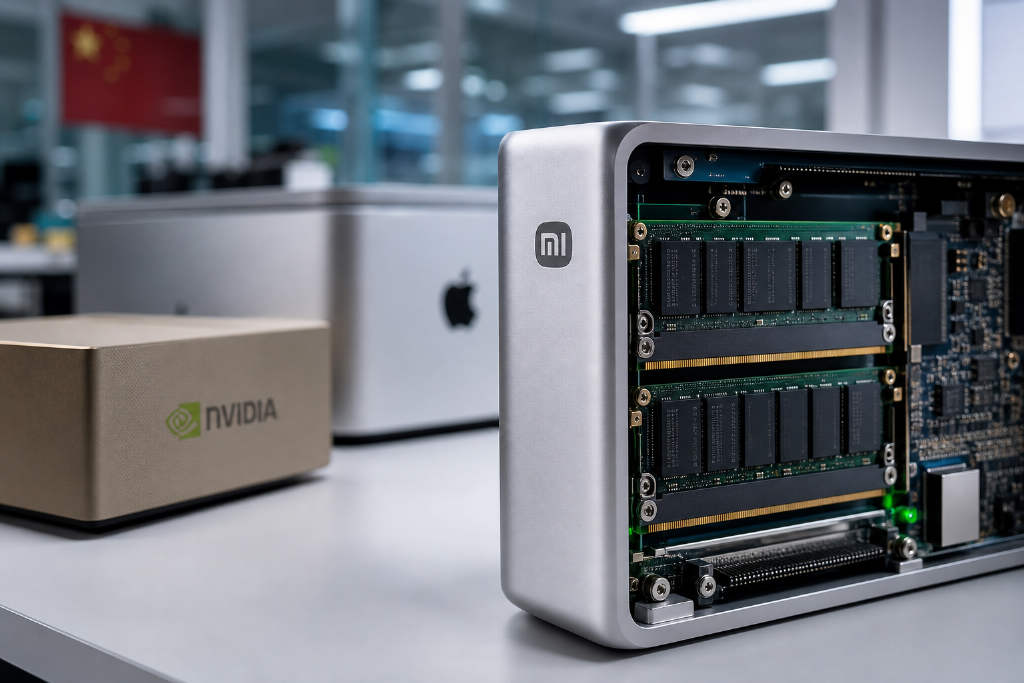
Xiaomi has unveiled an engineering prototype called AI Cube, putting the machine in direct comparison with Nvidia’s DGX Spark and Apple’s Mac Studio. The system uses three Xring chips and carries 160GB of unified memory, but its debut comes as the global memory crunch keeps pushing costs higher across the industry.
That timing matters. While vendors are cutting configurations and raising prices, Xiaomi is presenting a product centered on one of the hardest components to secure right now: memory.
Memory has become the most expensive part
The report says global DRAM contract prices rose about 90% to 95% quarter over quarter in the first quarter of this year. In the second quarter, they are projected to increase another 58% to 63%. SK hynix has also warned that shortages could continue beyond 2030.
In the report’s reading, this is not a problem tied to one supplier. Pressure is building across the whole chain at the same time. As cloud companies keep stockpiling DRAM to build out computing centers, the share left for consumer devices is getting smaller.
Nvidia and Apple have already adjusted. DGX Spark went from $3,999 to $4,699, a $700 increase. Apple removed the 512GB option for the M3 Ultra version of Mac Studio, leaving 256GB as the top configuration mentioned in the report, and the upgrade from 96GB to 256GB climbed from $1,600 to $2,000.
For local large models, memory is the real limit
The report argues that the main barrier for running large models locally is not compute power but memory. A 200B-class model, even when compressed to 4-bit quantization, would still need about 100GB just for weights. At FP16, that figure expands to roughly 400GB, and that still excludes KV cache and other runtime overhead.
Put simply, local AI machines are not only competing on speed. They are competing on how much model they can actually hold in memory.
- Nvidia DGX Spark: 128GB, with bandwidth of about 273GB/s
- Apple M4 Max: up to 546GB/s bandwidth
- Apple M3 Ultra: 819GB/s bandwidth
- Xiaomi AI Cube: 160GB unified memory
What 160GB allows Xiaomi to run
The report lays out the math. A 120B-class model at 4-bit quantization would take about 60GB for weights, leaving roughly 100GB for KV cache and runtime overhead. That is presented as a comfortable range, and the model size Xiaomi demonstrated falls into that bracket.
Moving up to the 200B class pushes weight storage to around 100GB, leaving only 60GB of headroom. The machine can still run it, but long-context workloads begin to get tight. Xiaomi’s stated upper limit stops there.
Running a 200B model in FP16 is out of reach. Weights alone would require about 400GB.
The same calculation also highlights the gap with DGX Spark. With 128GB of memory, once roughly 100GB is taken by the weights of a 200B model, around 28GB remains. The report frames Xiaomi’s extra 32GB as additional operating headroom.
Still a prototype, with no price or production schedule
AI Cube is still an engineering prototype. Xiaomi has not announced a price, and it has not provided a mass-production timeline.
The absence of a price is itself notable in the report. Xiaomi may not yet know whether it can afford to fight on price in a market where memory remains scarce and expensive.
By that logic, AI Cube’s real opponent is not only Nvidia or Apple hardware. It is the memory shortage expected to define 2026. The company that can secure more memory at a lower cost will be the one in a position to talk about a price war.