
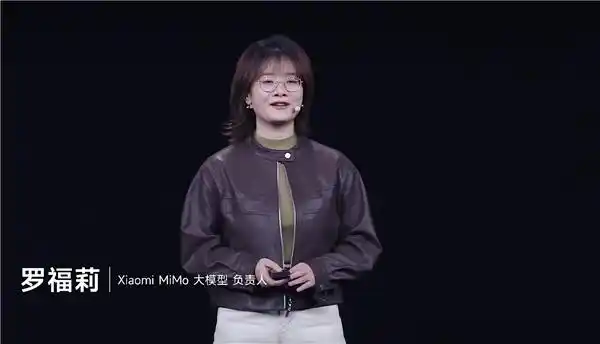
Xiaomi has promoted Luo Fuli, the 31-year-old head of its MiMo large-model team, to level 22, according to a report published by MarsBit. From her publicly announced arrival at Xiaomi in November 2025 to reaching the top of the company’s rank structure, the move took 10 months and set what the report described as the fastest promotion record in Xiaomi’s history.
The promotion was announced alongside the formal release and open-sourcing of the Xiaomi MiMo-V2.6 series, which includes the Pro and Flash native multimodal models. The report said MiMo-V2.6-Pro scored 46 points on the Artificial Analysis Intelligence Index and ranked first among open-weight models. At the same intelligence level, its price was listed at one-twentieth to one-sixtieth that of overseas models.
The MiMo team described the launch as a key step in exploring a path toward RSI, or recursive self-improvement. Luo said, 「The research innovation and engineering challenges behind this work exceeded those of DeepSeek R1, which I partially participated in.」
Xiaomi rank jump in 10 months
According to the report, Xiaomi’s internal rank system runs from level 13 to level 22, excluding founder Lei Jun. Director roles correspond to levels 19 to 20, while vice president roles correspond to levels 21 to 22. The article said employees at level 19 can earn total annual compensation of more than 2 million yuan, implying that level 22 compensation is higher.
By that measure, Luo has entered Xiaomi’s core executive ranks after leading the release of the new model series.
The story of her move to Xiaomi first drew wider attention through a trending topic last year. Early last year, Securities Times reported that Lei Jun wanted to recruit Luo with an annual package in the tens of millions of yuan. In November last year, Luo wrote on WeChat Moments, 「Intelligence will eventually move from language to the physical world,」 and announced that she had joined Xiaomi’s MiMo team.
She soon made her first public appearance at Xiaomi. In December last year, she appeared as the person in charge of the MiMo large model at Xiaomi’s “Human x Car x Home” full-ecosystem partner conference.
In March this year, Xiaomi released three models at once: the flagship foundation model Xiaomi MiMo-V2-Pro for the agent era, the multimodal foundation model Xiaomi MiMo-V2-Omni, and the speech synthesis model Xiaomi MiMo-V2-TTS.
At the time, Luo wrote on social media, 「I call this a silent ambush — not because we had a plan, but because the shift from the Chat paradigm to the Agent paradigm happened so fast that even we could hardly believe it. Somewhere in the middle, there was a process that was exciting, painful, and fascinating.」
In July this year, Xiaomi adjusted the organizational structure of Xiao Ai, splitting technical capabilities into three parts: foundation models, cloud, and on-device. The foundation-model capability was assigned to the MiMo team led by Luo, a sign in the report that her business scope had expanded again. With this latest promotion, she reached Xiaomi’s top rank in just 10 months.
From Peking University to DeepSeek and Xiaomi
The report said Luo was born in 1995 in Yibin, Sichuan, into an ordinary family, and attended Yibin No. 1 High School. Her former homeroom teacher described her as “not among the very top, but hardworking enough.”
Luo later studied computer science at Beijing Normal University. In her own words, she was an absolute “low-starting-point person” in computing. Even so, she began preparing in her sophomore year for graduate admission to Peking University’s computer science program and eventually made it.
Her early research interest focused on word sense disambiguation, a subfield of natural language processing. As large-model technology advanced, she concluded that the essence of traditional disambiguation tasks was being absorbed by the “next-token prediction” paradigm of large models. She then shifted her focus to text generation, a move that later fed into her work on large-model development.
Her breakout year was 2019. Luo published eight papers at ACL, a top international conference in natural language processing, including two as first author. That was when the “genius girl” label began to follow her.
She rejected that label. In an interview with the Peking University alumni association, she said such tags are stereotypes created to attract attention and that 「it glosses over the real effort, resilience, and wholehearted commitment in research, implying that success is innate.」
Looking back on her graduate years at Peking University, Luo said, 「The free research environment at Peking University benefited me enormously.」 She also said the university gave her an early lesson in collaboration. In the lab, she first experienced the force of teamwork: some classmates were good at building GPU clusters, others specialized in algorithms, and each person contributed in a different way.
After earning her master’s degree, Luo started her career at Alibaba. She joined Alibaba DAMO Academy through the “Alibaba Star” program as a researcher in the Machine Intelligence Lab, working on artificial intelligence. There, she led development of the multilingual pretraining model VECO and helped advance the open-sourcing of AliceMind.
Three years later, she joined High-Flyer, the parent company of DeepSeek, to work on deep learning, and later became a deep learning researcher at DeepSeek, participating in the development of models including DeepSeek-V2. As DeepSeek’s large models gained attention, Luo appeared more often in the public eye. She once said, 「My time at DeepSeek was a major turning point.」
The report argued that her path shows no shortcut or stroke of luck. Luo has repeatedly said she is not a genius and that her starting point was ordinary: 「Curiosity about essential problems, decent execution, and a little unwillingness to give up are what brought me here step by step.」
China’s big tech groups compete for young AI researchers
The article places Luo’s promotion in a wider battle for AI talent across China’s technology sector.
In December last year, Tencent appointed former OpenAI researcher Yao Shunyu as chief AI scientist when he was 27 years old. Tencent later merged its Hunyuan multimodal model unit and large language model unit into a foundation model department under Yao’s management.
ByteDance has also stepped up hiring. Earlier this year, DeepSeek core researcher Guo Daya left the company, triggering competition among major internet firms before he ultimately joined ByteDance’s Seed division. At the same time, ByteDance launched its “Top Seed” campus recruitment plan to hire 30 top PhD graduates worldwide, offering what the report called top-tier industry compensation with no upper limit.
Baidu joined the contest as well. In July this year, Sun Tianxiang, born in 1997, formally joined Baidu as head of the foundation model R&D department and also entered Baidu’s model committee. The report described him as a computer science PhD from Fudan University, the leading core developer of the open-source ChatGPT-like model MOSS, and an early proposer internationally of the Model-as-a-Service, or MaaS, concept.
Competition for students has intensified too. Tencent launched its “Qingyun Plan” internship recruitment in March, covering six technical areas including large language models, multimodal systems, and agents, with uncapped pay. Moonshot AI introduced Kimi’s top-talent “Crossing Plan,” offering company equity to interns who have not yet graduated. MiniMax also launched a Top Talent program, and CEO Yan Junjie said publicly that for truly top talent, salary and equity have no cap and seniority does not matter, only the scale of the problems a person can solve.
Compensation has been rising. The report cited data disclosed by Business Insider at the end of 2025 showing that a four- to six-month AI internship or short-term research project paid $7,000 to $18,000 per month, or about 49,000 to 126,000 yuan. It also cited LatePost as saying ByteDance’s Top Seed campus recruits earned about 1.5 million yuan annually in 2024, rising to 3 million to 5 million yuan in 2025, with some core roles reaching 6 million yuan in 2026.
Based on those examples, the article said China’s AI talent competition has moved beyond high pay and benefits into a broader model of strategic authority, resource concentration, and exceptional rank promotions.
Luo’s advice to younger researchers
The report closed by saying the paths taken by Luo, Yao and others do not point to a “genius narrative,” but to a simpler logic: keep building engineering capability in the right direction, turn frontier technology into something deployable, and then scale that value on a large platform.
At the Zhipu conference, Luo offered this advice to younger people: always keep the desire to explore and stay curious. 「Make full use of frontier AI tools, build your own judgment and research aesthetics through constant trial and error. In an era of rapid technological change, unique cognition, judgment, and aesthetics are the most core and irreplaceable competitive strengths for young people.」
The original article was credited to the WeChat account Touzijie (ID: pedaily2012), written by Liu Bo, and published by MarsBit.